



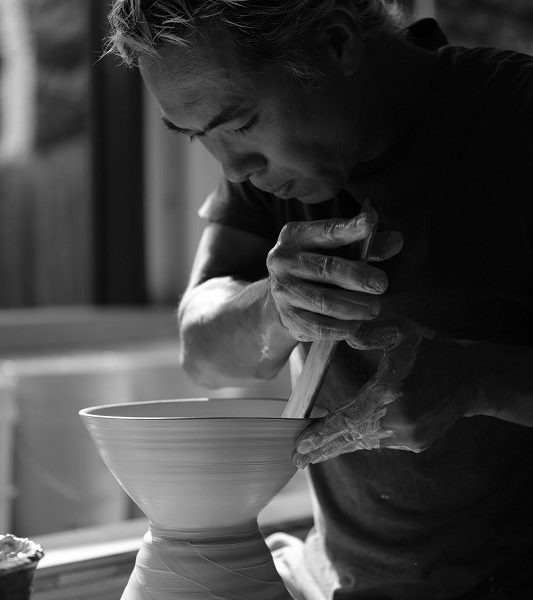
Today we’d like to introduce you to Kazu and Yuka Oba.
Hi Kazu and Yuka, we’re thrilled to have a chance to learn your story today. So, before we get into specifics, maybe you can briefly walk us through how you got to where you are today?
We established O’baware about 25 years after I started sculpting and throwing. I apprenticed under Jerry Wingren, a master sculptor for 4 years, and Takashi Nakazato, a master potter in Japan for a couple of years. My wife, Yuka, joined me here in 2016. She studied pottery for many years in Japan and has developed a jewelry line, épice, which is available as part of our O’baware offerings. Our focus is on learning and following where that leads, even now.
Would you say it’s been a smooth road, and if not, what are some of the biggest challenges you’ve faced along the way?
We realize that art is often about problem-solving so whether it is sculpture, jewelry, or ceramics, it is all the same for us. It is all part of the creative process and about approaching a problem using a wide network of resources (people, ideas, materials, techniques, methods) to experiment toward many potential outcomes. Artists develop many layers of skills and are valuable problem solvers. Right now, we are offering in-kind donations for families who lost their homes in the December 30th Marshall Fire. Louisville and Superior are our neighboring communities. We were able to donate over 160 pieces of essential everyday dishes directly to 8 families we knew and an additional 250 pieces through the relief tent at Blackbelly Restaurant through Conscious Alliance. We are also donating 100% of profits from our online candle sale toward the Conscious Alliance Marshall Fire fund. Link to candle sale: https://www.obaware.com/marshallfirefund
What we have witnessed from the area art community during disaster relief is generosity, resilience, and determination. We have seen this in the 2010 floods, throughout the pandemic, after the 2021 Boulder shooting, and again with the 2021 Marshall Fires.
A lot of our learning has been on the business side too, of building relationships in both retail and wholesale markets. In the Denver area, our work is placed with a few select shops including The Shop at Denver Botanic Gardens, Eyes Open Project within The Source as well as Boulder’s Dancing Grains. Colorado collectors often order from us directly or join our newsletter list to receive notice about our local events and sales. We have also enjoyed a long and positive relationship with the Sushi Den family of restaurants. We are also “plated” at Boulder’s secret sushi and izakaya gem, AOI, as well as Denver’s Ramen Star. These are some of our favorite local restaurants, but we are happy that our work is placed in San Francisco, New York, Tokyo, and a lot of beautiful spots in between. We love to travel and bringing our work to connect with collectors and chefs in other cities is something we greatly enjoy!
Can you tell our readers more about what you do and what you think sets you apart from others?
I work in stone, wood, and clay mainly and other materials. It helps my throwing that I also sculpt, and it helps my sculpting that I throw. There is a shared yet coherent underlying theme among the different materials and I move fluidly among them, and that theme is about what it is and less about myself. To me, working with what’s given is that shared theme for everything I make. One example of this is that my first bronze piece was the casting of a pebble. The pebble is already complete, or perhaps captures a moment in time, and the only interaction I had with it was to have it enlarged in bronze. There is very little of me in the work. I’m just showing what I found to be interesting to the world. My approach to pottery is largely about its function. I want the pottery to be of use to you and that is to simply celebrate what you cook. “All function, less decoration” as function has purpose, while decoration is superficial. Maybe it was many years of working in restaurants, and before that, my upbringing in the country where some switch out their pottery according to the season. I think about the vessels being such a significant part of the dishes.
I am curious about how to carry that intention through in making the vessels that compliment your menu. My hope is that we can offer the sensible beauty of our vessels into your everyday dining. We hope that you can sit down to every meal with a sense that it is a special time and that in being mindful of subtle beauty, you are reminded to relax. When we relax, we can make friends, we can exchange ideas, and we can build community. Function is purposeful. We believe dining could be so meaningful because that’s what literally nourishes us all.
I think of pottery like calligraphy and aim toward a single motion to shape the form. Pottery then becomes a form of practiced spontaneity, where muscle memory pulls a bowl from the clay in one single, honest gesture. Then the form is more about the intention, which is the purpose of the vessel, and less about finesse of the maker. The less fussing over the clay, the more successful I consider the work.
When I work with chefs now in creating O’baware, we work around their menus, around their ideas about food. I enjoy the collaboration involved in commissioned work, of developing prototypes based on conversations, and then making the final selections and production. It’s a dynamic process that is challenging, fun, and very educational for me. Right now, I’m focused more and more on wholesale commissions with collectors and restaurants. I embrace that process into my studio practice.
What do you think about happiness?
Working professionally, earning a living, and raising a family in this business is something for which we feel a lot of gratitude.
Contact Info:
- Email: info@kazuoba.com
- Website: www.obaware.com
- Instagram: oba_ware


Image Credits:
Studio Image
James Florio
Popular
-

The Trailblazers: Rewriting the Narrative
-

Celebrating the Spotlight: Kaytee Shashore Turns Milestones Into Momentum
-

Humanity in the Machine: Alexander Raye Pimentel’s Cyborg Recall Questions the Cost of a Data‑Driven World
-

Raemi Anderson on Courage, Caution, and Answering the Call of the Landscape
-

Hidden Gems: Local Businesses & Creatives You Should Know


