

Today we’d like to introduce you to Laura Campbell Davis.
Laura, we appreciate you taking the time to share your story with us today. Where does your story begin?
Four years at a music conservatory is often enough to rob a person of any joy in music-making, and sadly, that’s where I found myself during my senior year of college. Armed with a degree in voice, I have never felt less sure of myself as a singer than I did when I graduated in 2007. Admittedly, I was fully equipped and felt well prepared to take on a job as a church choir director, which is how I earned a living for the first 5 years or so post-college, but the singer in me felt half dead.
And yet, the love of it was not completely lost. As I stood in front of the choirs I was directing week after week, I found myself longing to be on the other side of it… the singing side. Simultaneously, I took on a few private voice students from the choir and found that even though I didn’t trust my singing voice particularly well, I was good at helping other people find and trust their voices.
I don’t know if it was a twinge of insanity or inspiration that drove me the pursuit of a voice pedagogy degree, but that’s what I decided to make my next step. And so I found myself yet again auditioning for music schools. But I knew this time I needed a different approach. I sought a voice teacher who was also a yoga teacher. He helped me get out of my head and into my body, and ultimately to trust my voice again.
And while I throw a master’s degree in voice pedagogy next to my name to certify that I can teach, I give most of the credit for what I do now to the teacher who helped me in the space between college and graduate school. He taught me how to look at a singer as a whole… that the mental, emotional, and energetic landscape of the singer is every bit as important as the physical. And he gave me a toolset to address it, both in my singing and in the way I taught other singers.
When I finished my master’s degree in 2013, I officially retired as a church musician at the age of 29 and decided to become a full-time private voice teacher. I wanted to continue to build my skill set using yoga in the voice studio and eventually went through 200-hour and 300-hour yoga teacher training. I set up my studio and built up my clientele little, teaching yoga classes on the side to help supplement my income.
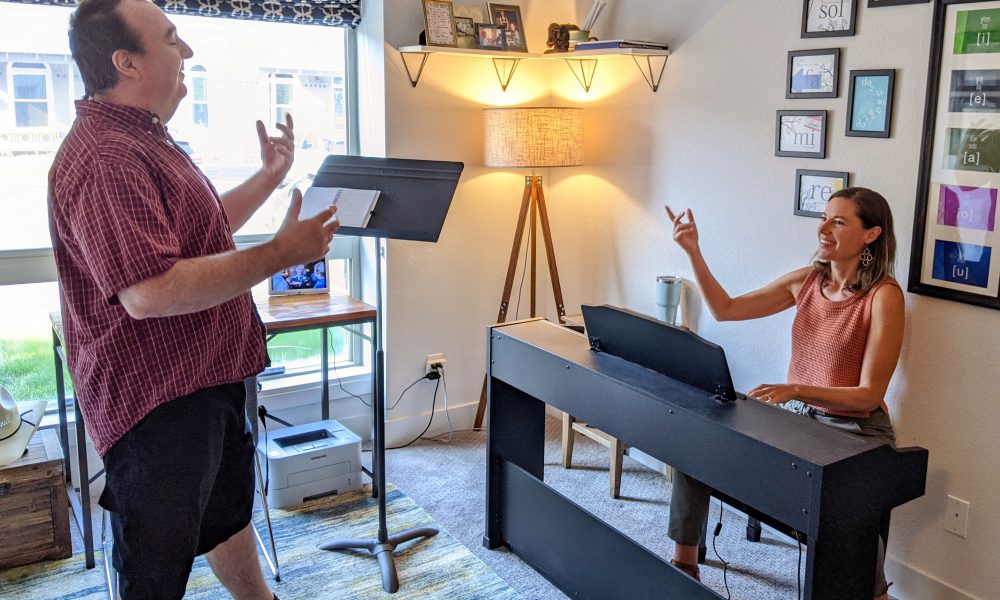
Today I teach anywhere between 30 and 40 lessons a week out of my home studio in Morrison. What I find over and over again is that almost everyone who walks through my door has something in common… a deep desire to know their voice and a decent amount of fear around letting it be heard. And so I look back with gratitude now for my struggles. Because of those struggles, I now have the empathy, intuition, and constructive toolset to help anyone with a desire to sing feel confident and joyful in singing.
Alright, so let’s dig a little deeper into the story – has it been an easy path overall, and if not, what were the challenges you’ve had to overcome?
The pandemic changed something for just about every business, and my business was no exception. For years I had resisted the idea of online lessons for fear that I might miss out on what I intuitively hear or see or feel when working with someone’s life. But in 2020 I would have been completely out of a job, so I begrudgingly gave Zoom lessons a try.
And what I found was, not only could I hear and see and intuit in the same way as I do in person, but students who had struggled with things like pitch matching or holding their own through an entire song became much more independent. The primary difference between an in-person lesson and an online lesson is my ability to play the piano while someone sings. Because of the time lag, I cannot accompany students online. But what I found is, when forced to hold their own, students who had once struggled with pitch retention got much stronger.
Now, whether I’m teaching online or in person, I rarely play along with people. And while the prospect of not being able to teach in person was originally terrifying, I’ve now been able to open my studio to students all over the country. I’ve welcomed back students I worked with when living out east as well as taking on new students in varying time zones. I never could have predicted when the pandemic first hit that it would change my business for the better, but it certainly did.
Alright, so let’s switch gears a bit and talk business. What should we know?
LJDstudios is a voice studio committed to teaching anyone with the desire to sing, whether they have professional aspirations or simply want to understand more about the mechanics of singing. The range of singers I work with is wide, however, I specialize in teaching those who think they truly cannot sing. While many voice teachers brand themselves as voice teachers to the stars, I’m the voice teacher to the voiceless.
So many people truly believe they cannot sing and as a result experience, at best, discomfort around the subject and at worse, deep pain and sadness. Many of the people I work with are wounded or even traumatized from past vocal experiences and see voice lessons as a path toward healing. Watching these singers grow in confidence is a source of great personal and professional joy for me.
Because this has been a theme for me throughout my teaching career, I have become known for my work bringing singers “back into their bodies.” Whether it’s a result of fear and anxiety or maybe just too much mental focus on technique, many singers find themselves stuck in their brains. I use yoga, eastern philosophy, and even modern exercise techniques to help singers truly experience the body as their instrument.
I have found great success with this approach not only with beginning singers but with professionals as well. While beginning singers experience healing and confidence by connecting their voices to their bodies, professionals experience a holistic approach to singing that feels transferable to the stage. Many of my techniques are non-conventional, however, they are deeply rooted in a knowledge of voice science.
Every mental image or yoga pose is aimed at a mechanistic function in the voice, though often what the singer feels is that his or her voice just “magically works.” This root in voice science allows me to teach across all genres. Many voice teachers only teach the style of music that they came from as singers. But even though I was a classical singer, I have committed myself to understand the mechanics of the vocal process and love teaching belt, pop, and musical theater in addition to classical techniques.
For me, teaching singing is not a process of teaching a right or wrong way, but of liberating a singer to express themselves vocally in whatever way his or her heart desires. No two people learn or experience their voice in the same way, therefor I don’t have a one size fits all approach. When I teach a lesson, I teach the person standing in front of me. I observe how he or she came in that day–the physical presence as well as the emotional or energetic presence. And we work from there.
I don’t just have a catalog of exercises or techniques that we work through systematically. Rather, I usually make up exercises on the spot in response to what I’m seeing or hearing. When I teach a lesson, I develop a language and a set of techniques unique to the person standing in front of me, and I think that’s why I see so much success in students of every level of experience. I believe in this approach and I believe in the singer until they can believe in themselves. Because no one should ever be without a voice.
What’s next?
Opening my studio to online lessons has allowed me to work across time zones and teach more people than ever. This has been such a gift, but as a one-woman operation, there are only so many people I can meet within a week. Additionally, many people do not have the resources to sustain private lessons long-term. In response to this dilemma, I have been creating a learn-on-your-own membership option called the LJDstudios Singer’s Toolbox. Members receive unlimited access to a complete library of videos with different exercises and singing tips.
Additionally, members submit and receive video feedback from me. This does not happen in real-time but still allows singers to get the constructive feedback they would get in a lesson. One of the biggest questions people have when they try out exercises they hear and see online is, “am I doing it right?” I hope that the LJDstudios Singer’s Toolbox will level up the learning on your own experience by answering that question.
Contact Info:
- Website: ljdstudios.com
- Instagram: @ljdstudios