
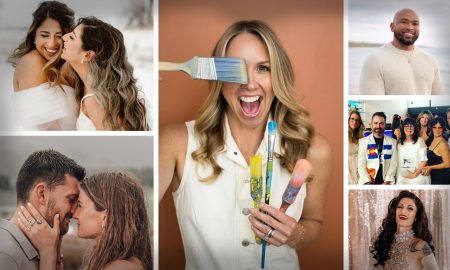


Today we’d like to introduce you to Robin Hextrum.
Hi Robin, so excited to have you on the platform. So before we get into questions about your work life, maybe you can bring our readers up to speed on your story and how you got to where you are today.
I always loved making art as a child. When I was twelve, my family moved to a small coastal town called Stinson Beach in Northern California. My neighbor across the street was a painter, and she gave me drawing lessons in exchange for babysitting her daughter. She opened my eyes to the world of drawing and showed me a potential path forward as an artist.
When I was in high school, I took my first figure drawing classes at a community college and felt the excitement of being in a more serious art environment. I then went on to USC for undergrad where I continued to pursue art. I have always been a very curious person and I wanted to experience everything in college. I joined the marching band, was on the women’s rowing team, and completed a double major in Fine Arts and Neuroscience.
After I finished my undergraduate studies, I wanted to pour all my energy into my art. I went on to complete an MFA in painting at Laguna College of Art and Design because they have a program specifically for representational(realistic) painters. I thrived in this MFA program. I took the time to paint and study with dedicated representational artists. After that, I got an additional degree in Modern and Contemporary Art History at UC Riverside because I had begun teaching art history lecture courses in addition to studio courses.
I then got a tenure-track teaching position at Regis University. When I moved from southern California to Colorado my art career started gaining much more momentum. I am in my seventh year as the drawing instructor at Regis University and I show my work at Abend Gallery in downtown Denver. I’m in my studio almost every day doing what I love.
Alright, so let’s dig a little deeper into the story – has it been an easy path overall, and if not, what were the challenges you’ve had to overcome?
It was not easy to get to where I am today, and I consider myself fortunate to have made it here. I have had many harsh critiques of my work. One professor told me that my painting ability was so rudimentary, that seeing my work made her concerned about the painting department at USC. Though I felt like a failure after hearing this feedback, I realized I wanted to master my craft and had to admit to myself that I was nowhere near where I wanted to be in terms of my skill set.
I spent three years focused on painting in my MFA program and developed my technique. After grad school, I applied to 40 teaching positions and did not get a single interview. I struggled to support myself as an artist for several years, and at one point had five different part-time jobs. I consider myself incredibly lucky to be a tenured art professor now. For a while, I focused on showing at artist-run galleries and co-op spaces because I also struggled to gain commercial gallery representation. The first commercial gallery I did get into let me go shortly after taking me on. I am fortunate to show my work at Abend Gallery now. Chris Mileham and Dave Ethridge are wonderful to work with.
I think the hardest part about being an artist is navigating personal doubts. You spend a long time investing everything you have into your creative career, and you have no idea if it will lead to anything or if you will ever get work that pays for your health insurance/retirement. It is not like becoming a doctor or a lawyer. There is no set path. You are always questioning if you are doing things the right way. Fighting off my doubts and sticking to my vision has paid off now, but it was not always easy to work towards an ephemeral target. The more you let those doubts creep in, the harder it is to make great work and keep following your dreams.
As you know, we’re big fans of you and your work. For our readers who might not be as familiar what can you tell them about what you do?
The title for my current exhibition, Animal Kingdom, is both a reference to the taxonomic term kingdom and an allusion to a fantasy scenario where animals have taken over the world. Each work has a unique approach to presenting this world.
I began to wonder, what would an elegant portrait of a bear or a lemur look like? Or, given the chance, what might a buffalo do in an art museum when confronted with a painting like “American Progress” by John Gast that glorifies its extermination? In a sense, these works are all examples of revisionist history because they take historical human-centric visual narratives and replace them with animal protagonists. I gained inspiration for this work both from my deep love of animals and from my observations of our changing planet. For many years of my life, I have been some form of vegetarian or vegan. These paintings ask viewers to look at animals with a sense of dignity and respect.
Several of the paintings in this series follow traditions of conventional portraiture as a tool to elevate animals. They also demonstrate a sense of anger and frustration in animals. This can be seen in paintings that show animals walking over famous sculptures or destroying iconic artworks. I also enjoyed playing with humorous and absurd narratives in these works. Though this work has a fantastical element to it, real-life examples abound. We all watched with wonder and fascination how quickly nature wanted to take back spaces from us during the COVID-19 lockdown. This past summer orcas attacked yachts in Spain, an elk punched a hole in the tire of an obnoxious tourist in Yellowstone, and an infamous otter stole surfboards to catch waves in Santa Cruz.
I think my work stands out because I make complicated and meaningful contemporary paintings. I strive to make beautiful paintings that appeal to those who are not “in the know” about the art world. And, I also want these paintings to hold something complex and engaging for viewers who have a high degree of visual literacy and academic training. My work is also sincere. Though I do love all forms of traditional and contemporary art, I do not have patience for art that is too disinterested, overly ironic, or insincere. I love art that comes from a deeply personal source and meets the viewer with honesty and urgency. I strive to have this quality in my works and feel quite fortunate that I now get to spend my days making art.
Any advice for finding a mentor or networking in general?
I think it is important to pay attention to all the people around you who are offering their time and mentorship and to take them up on that. Just putting in the simple effort of asking someone you admire to get lunch, grab a coffee, or have a studio visit can lead to a beautiful mentor relationship. Now that I am a professor, I recognize that we are all drawn to the profession so we can mentor others. Much of our time can get sucked away into administrative tasks and long conversations with students about their personal struggles and course registration difficulties. When I get to talk about art with someone who wants to get at the deep questions it is just pure joy, and it also inspires me to cherish my painting practice.
I think taking the initiative can be scary for a lot of people, but they will be surprised by the generosity of artists and other professionals who just want to talk about what they love and help someone navigate a very confusing art world.
Pricing:
Contact Info:
- Website: https://abendgallery.com/artist/robin-hextrum
- Instagram: https://www.instagram.com/robinhextrum/
- Facebook: https://www.facebook.com/profile.php?id=3421276
- Other: www.robinhextrum.com


 Image Credits
Derek N. Parks Wes Magyar | German Velasco
Popular
-

The Trailblazers: Rewriting the Narrative
-

Celebrating the Spotlight: Kaytee Shashore Turns Milestones Into Momentum
-
Humanity in the Machine: Alexander Raye Pimentel’s Cyborg Recall Questions the Cost of a Data‑Driven World
-

Raemi Anderson on Courage, Caution, and Answering the Call of the Landscape
-

Hidden Gems: Local Businesses & Creatives You Should Know


