


Today we’d like to introduce you to Eric Fischman.
Hi Eric, please kick things off for us with an introduction to yourself and your story.
I first became excited about poetry in high school when I learned that every word contains innate, consistent, and measurable beats that can be arranged into deliberate rhythms, like puzzle pieces or links in a chain. It was like I was hearing English again for the first time, discovering this hidden music underneath it.
But it was W. H. Auden who showed me how limitless, how magical poetry can be. In “As I Walked Out One Evening,” there is a line that reads, “I’ll love you till the ocean is folded and hung up to dry.” This image broke my brain. I felt implicitly that what was happening was something unique to poetry and could only happen on the page. To hold the water in my mind as both wet and dry at the same time, solid and liquid, hanging and running. No painting, drawing, or video could ever capture precisely what these words allowed my human imagination to do. In that moment I became a little bigger, a little broader, a little more neuroplastic. Anything could happen in a poem. Anything.
I started undergrad at Northeastern University as a math major (by accident) and chose Modern Poetry for my first-semester elective. The professor was an 80-year-old poet named Joseph DeRoche. As we went down the line of Modernist poets, he pointed to how each of them had helped poetry become freer than it had been before. Whitman invited us to reject rhyme. Dickinson let us see rhyme where others wouldn’t. Wallace Stevens gave us poems that were puzzles. William Carlos Williams gave us back our own voices with directness and simplicity, and so on and so on. One by one, Professor DeRoche showed us how each of these poets had taken every rule we thought we knew about poetry and broken them. Then, on the last day of the semester, he said, “Now you live in a world with no rules. What are you going to do about it?” What else could I do? I decided I would become a poet.
In 2011, I came to Naropa to get my MFA from the Kerouac School. What I like to say about this is that I came to grad school in search of discipline, but what I found was permission. I can’t tell you how many hundreds or thousands of hours my classmates and I spent doing spontaneous freewrites, nonstop timed writings, collaborative poetry games, passarounds, exquisite corpses, and more. During that time, a couple of our classmates, Joe Braun, Craig Collier, and Noah Christie, had gotten a place together which became known as the Pirate Ship due to its vaulted slanting indoor ceiling. There was always a typewriter, a giant pad, paper taped to the walls, collage materials, any way you can imagine poets playing, we played. This is how I learned to trust myself. This is when I stopped wondering when I would be allowed to call myself a poet.
After Naropa, I sort of got lost working in the cannabis industry, first as a trimmer, then as a budtender, then as a manager, and then as a store manager. From what had been an active creative life, regularly attending and reading at open mics and featuring at other events, I fell completely off the face of the poetry Earth. I did this for close to a decade, until finally, a few years ago, they did me the huge favor of firing me (they paid too well for me to ever quit, miserable as I was), and I was able to rejoin the very active local Boulder/Denver poetry scene and balance that with a medley of part-time work, including working at Naropa’s Summer Writing Program these last two years, first as an Assistant Event Coordinator and then as the Assistant to the Director, Jeffrey Pethybridge.
Currently, I am a Board Member of the Beyond Academia Free School, founded by Marcus Palmer, which provides free monthly workshops at the Boulder Public Library every 2nd Sunday, as well as a 1-2 week free summer poetry camp up at Marcus’s property up in Nederland. I am on a committee at the Firehouse Art Center in Longmont which makes decisions around the Firehouse’s poetry/writing programs, including another monthly free workshop every 3rd Friday (which I’ll be teaching in January) and an open mic on the last Friday. and in the coming year, we are planning to host some field trips!
I also curate a calendar of local literary events at boulderpoetryscene.com, a blog page founded by poet, publisher, and fellow JKS alum Jonathan Montgomery, dedicated to documenting this exciting and vital local scene, which has since evolved into a full-blown literary small press. The calendar includes readings, workshops, open mics, collaborative events, book releases, and more, ranging from as far down as Centennial and Highlands Ranch to as far north as Fort Collins and as far west as Nederland and Jamestown. If anyone reading this knows of an event they don’t see on the calendar and would like to, they can email boulderpoetryscene@gmail.com. I was also honored to be invited to teach a workshop at the Crestone Poemfest this past October, which was an amazing event that brought together poets from all over Colorado, including parts as far-flung as Pueblo and Trinidad.
I’ve published one book of poems so far, “Mordy Gets Enlightened,” which Craig Collier aka Alan Mudd published under his imprint, The Little Door, and which he has since reissued in a 2nd print through Turnsol Editions. Beyond that, I have more poems than I know what to do with, and I am hoping to organize them soon into as many manuscripts as it takes to get them out into the world. In the meantime, I’ve focused as much as possible on submitting/publishing in local journals. For instance, I just had 3 poems come out in the Twenty Bellows anthology, “We Are the West: Tributaries.” I also recently became one of 2 winners of Denver Quarterly’s letterpress broadside contest, alongside Emily Perez. There are 60 letterpressed copies of my poem which I got to help print at Rhiannon Alpers’s Gazelle & Goat studio. I also got to read at the release event, and I get a $100 stipend! Imagine that, getting paid for poetry!
I’m sure it wasn’t obstacle-free, but would you say the journey has been fairly smooth so far?
Working a full-time, high-demand job in the cannabis industry as first an Assistant Store Manager and then a Store Manager for about 5 years almost broke me. I was responsible for 30 employees and between $7-9,000,000 in revenue each year. I was on call 24 hours a day in case there was an emergency at the store, such as an overnight break-in, and was required to work opening shifts at the beginning of my week starting at 6 AM and closing shifts at the end of my week until 1 AM or later. I was not allowed to leave at night until every dollar was accounted for.
On my two days off, I was too tired to attend poetry events or even hang out with anybody. I needed that time to rest, do chores, and reset my sleep schedule from going to bed at 3 AM to waking up at 5 AM 2 days later. Thankfully, I have a dear poet friend from my later undergrad years at Hunter College named Jennifer Faylor who created a private group blog for the 30/30 where about 10-15 of us come together every year during April to write 30 poems in 30 days, supporting each other’s efforts and commenting helpfully on each other’s work. It’s called “A Daily Dose of Spring Poems.” We’ve been doing this since at least 2012, and produced, between all of us, if I am doing my math right, something like 3,000 or more poems!
Without this, and without the BAFS summer program (which I made a point of requesting days off to still teach at), I might have stopped writing entirely. I loved my coworkers and employees, most of whom I considered real friends, but this ultimately turned out to be a very dark time for me, I fell into a deep depression, feeling under-utilized, overworked, and creatively bereft. I spent most of my workdays toward the end just feeling dead inside. Until, bless their corporate egoist hearts, they fired me, freeing me to reevaluate my priorities and return to what mattered most to me: poetry.
Can you tell our readers more about what you do and what you think sets you apart from others?
What interests me most as a poet is continuing to explore, to find out what’s possible on the page. Every time I write, I am hoping to do something I have never done in a poem or say something I’ve never said, although I get much more excited by the how than the what. I try to write the poems I think I’d want to read.
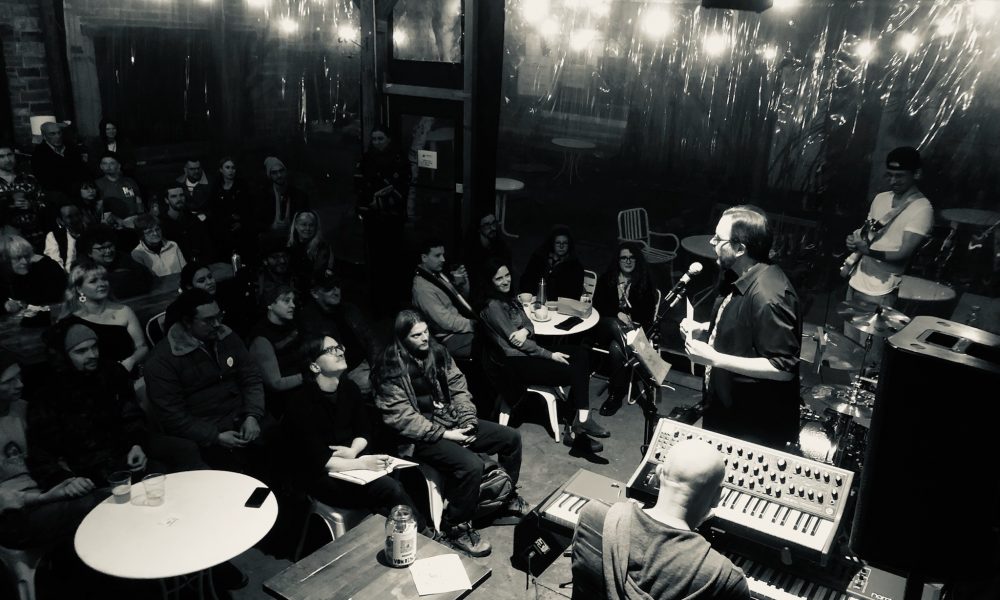
I’d like to imagine that what I’m known for is variety, but my friend and fellow JKS alum Matt Clifford, bassist for Black Market Translation, accountant, BAFS Board member, and one of the founders of the monthly Punketry event at Mutiny Info Cafe every 2nd Wednesday (a punk spinoff of Jazzetry, another event which happens monthly on the 1st Saturday at Trident Bookswhere poets perform live in front of an improvisational Jazz band), once told me that he could tell my poems from someone else’s instantly. For all my attempts to defy style, I guess I wound up having one after all!
There are ways I like poems to feel, flavors I want to experience. Mystery, ambiguity, playfulness, humor. What Derrida termed “serious play.” I’m interested in magic and the impossible, in alternate realities and surrealist landscapes. But it’s also very important to me to connect with the reader/listener. I want to play all my weirdo Naropa poetry language games, but I want the reader to come along for the ride. I want them to play the game I’m playing, and hear the music I’m hearing. The poem should teach you how to read the poem. What’s the point of communication if you alienate the person you are communicating with? I once asked Alice Notley in a talk she gave about poetry as a form of healing, how do you heal people with poetry if they aren’t reading it? “You talk to them,” she said.
What I am most proud of though is the community around me that I get to be a part of and help to grow through the calendar and through public engagement, open mics, spontaneous street readings, etc. For example, BAFS recently curated a gallery exhibition in the Boulder Public Library featuring handmade books, letterpress objects, collages, collaborative poems, finished pieces, and various ephemera from the local scene. The exhibit also included interactive poetry blocks which we hoped that passersby would make poems out of, along with pens, pencils, loose paper, clips, and an invitation for people to write new poems and clip them to the hanging wires. The idea was that this was meant to represent the local poetry scene, and if you were local and a poet, we wanted you to know you are a part of that. The surprise poems that appeared during each of those four weeks were my favorite part.
Another example is “A Poet Wrote It,” which is a booth the Firehouse Art Center hosts at the Longmont Artwalk each year. A bunch of us hang out with typewriters and postcards and pens and paper and produce spontaneous poems for strangers on the spot in exchange for a small, entirely voluntary donation to the Firehouse. And one last example is the Full Moon Poetry Reading, which happens every full moon at midnight in Morrison Alley just off of 13th and Pearl in Boulder, where the Moon has held court monthly for the last 12 years without skipping a beat. Remember when I said anything can happen in poetry? Well, come to the next Moon and see for yourself!
Can you talk to us a bit about happiness and what makes you happy?
My friends make me happy. Hearing new work makes me happy. Watching poets grow in their art in real-time. Also watching them create entirely new humans on earth and raise them into actual people. Things like that are how I know magic is real. I love when someone does something in a poem I would have never thought of, or does something on stage that I couldn’t predict.
Aimee Herman did an amazing performance at their feature at The Stand’s 2nd Friday monthly open mic where they took a stack of their poems and ripped up their pages, then composed before our very eyes a spontaneous verbal cutup, picking up the slips in no particular order and weaving the shredded bits of random language together into what felt like a polished, finished poem. Aimee Herman is a wizard.
Jazzetry. Punketry. Hip-Hopetry. The Firehouse. Mi Chantli. The Moon. BAFS makes me so happy. There is so much space for poetry here, and so many incredible outlets, opportunities, and people. I couldn’t begin to name them all. Like, did you know that between September and October, there were 8 local poetry/literary festivals? Middle Creek Poetry Festival at Wolverine Farm Publick House, Crestone Poemfest at Colorado College, Twenty Bellows and Beyond the Veil Press’s Denver Writing Retreat, Lighthouse Writers Poetryfest, Indie Author & Press Bookfair at Counterpath, Jaipur Literature Festival at the BPL, Fort Collins Small Press Fest also at Wolverine Farm, and Columbine Poets Fest at the Lafayette Library. This is a very exciting time to be a Colorado poet!
In a happiness side note, I got all the way back into comic books during the pandemic after a 25-year hiatus, and it’s been really fun catching up on the stories of all these characters I cared so much about in my youth. These days, they frequently sneak into my poems. Incidentally, things are pretty rough for the X-Men right now. Send vibes to Krakoa.
Contact Info:
- Website: ericraananfischman.com
- Instagram: https://www.instagram.com/ericraananfischman/
- Facebook: https://www.facebook.com/eric.fischman.9


 Image Credits
Morghan Leigh, Maggie Saunders, Shannon Sky, and Eric Fischman
Popular
-

The Trailblazers: Rewriting the Narrative
-
Celebrating the Spotlight: Kaytee Shashore Turns Milestones Into Momentum
-
Humanity in the Machine: Alexander Raye Pimentel’s Cyborg Recall Questions the Cost of a Data‑Driven World
-
Raemi Anderson on Courage, Caution, and Answering the Call of the Landscape
-

Hidden Gems: Local Businesses & Creatives You Should Know


