



Today we’d like to introduce you to Daniel Smith
Hi Daniel, we’d love for you to start by introducing yourself.
In March of 2020, I was conducting Les Misérables with the Loveland High School Pit Orchestra. Our performance opened and closed on March 13th after just one show. At the time, we all thought we’d be gone for two weeks, but as we now know, two weeks stretched into months, and the pandemic completely changed our world.
That year, I had a group of seniors who had been with me since they were in sixth grade—an incredibly talented and dedicated group of musicians. As everything shut down, I kept asking myself: What can I do to give them, and next year’s seniors, an opportunity to continue making music? In-person orchestra was out of the question, and online orchestra wasn’t a viable alternative.
That school year came to an end, and over the summer, I spent time brainstorming with family about what could be done. I had always imagined that one day—far in the future—I would start a youth orchestra. But the more I thought about it, the more I realized: Why wait?
I spoke with a parent, Sonja Pancoast, who suggested the idea of a youth orchestra and generously offered space at Zion Lutheran Church for rehearsals. This was a major turning point because we needed a space large enough to accommodate musicians with the required six-foot social distancing. From there, I reached out to local music educators and individuals with experience launching youth orchestras.
The next step was to get permission from Larimer County to hold rehearsals. After two months of petitioning, we received approval in August 2020 to meet with a maximum of 20 people, including students and directors. That first season, we launched with three orchestras:
* Apprentice Ensemble, a non-audition group
* Concert Ensemble, an advanced middle school and early high school group
* Chamber Orchestra, an advanced high school group, similar to Colorado All-State Orchestra
Auditions were due in October 2020, and our first-ever rehearsal took place in November. Over the next four months, our musicians worked diligently toward their first performance in March 2021. Unfortunately, due to a COVID-19 surge, our variance for a live audience was denied. Instead, we recorded each ensemble’s performance.
The recording of the Chamber Orchestra turned out so well that one of our directors at the time, Alison Mayes, encouraged us to submit it to the American String Teachers Association (ASTA) Nationals. It was a long shot—acceptance into ASTA Nationals is incredibly competitive—but we decided to take the chance.
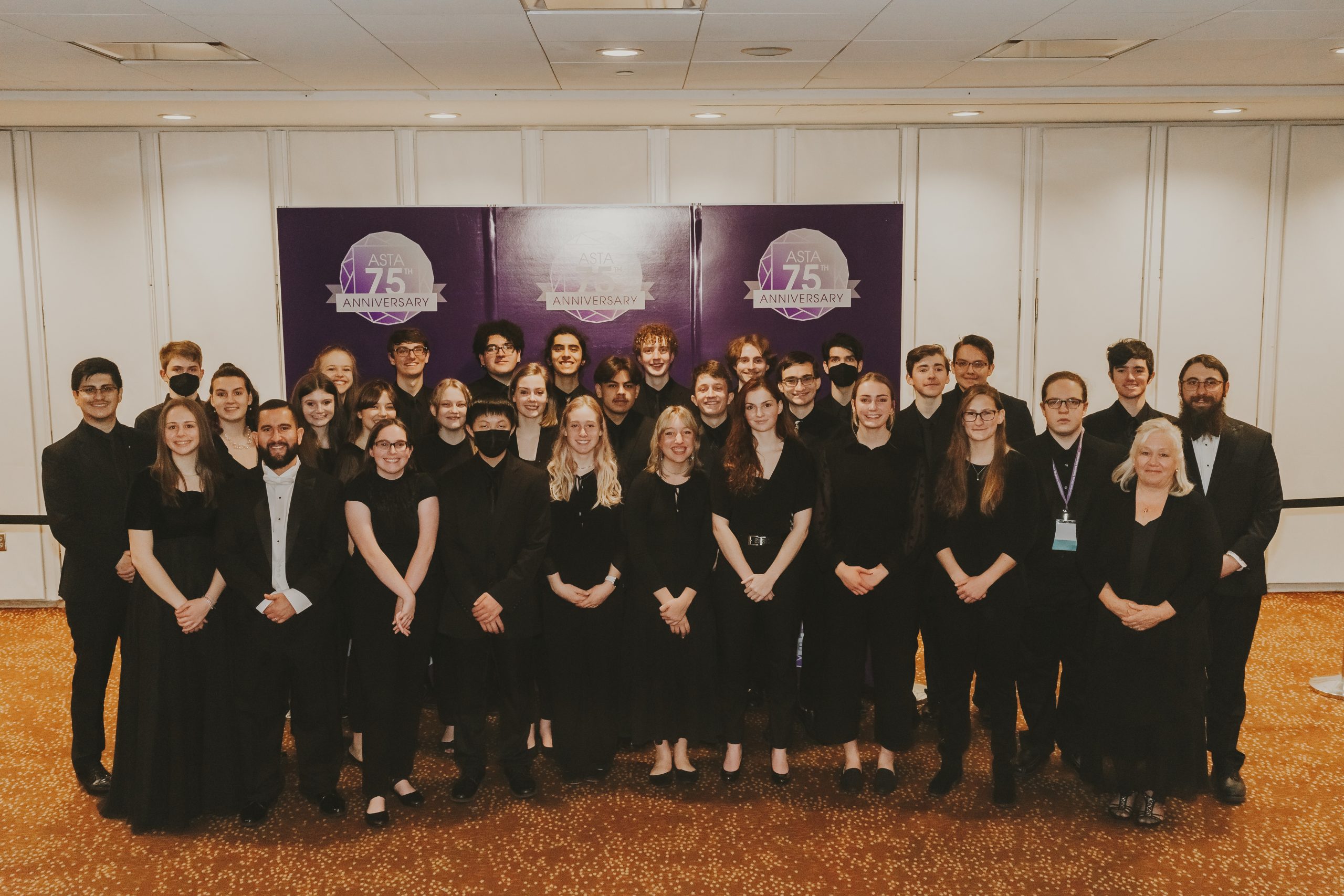
In June 2021, we received the news: we had been accepted to ASTA Nationals in Atlanta, Georgia, for March 2022. This launched a year-long planning process, culminating in our first-ever live performance taking place on the ASTA stage. We brought a total of 50 people, including 32 students, and our Chamber Orchestra placed third in the nation.
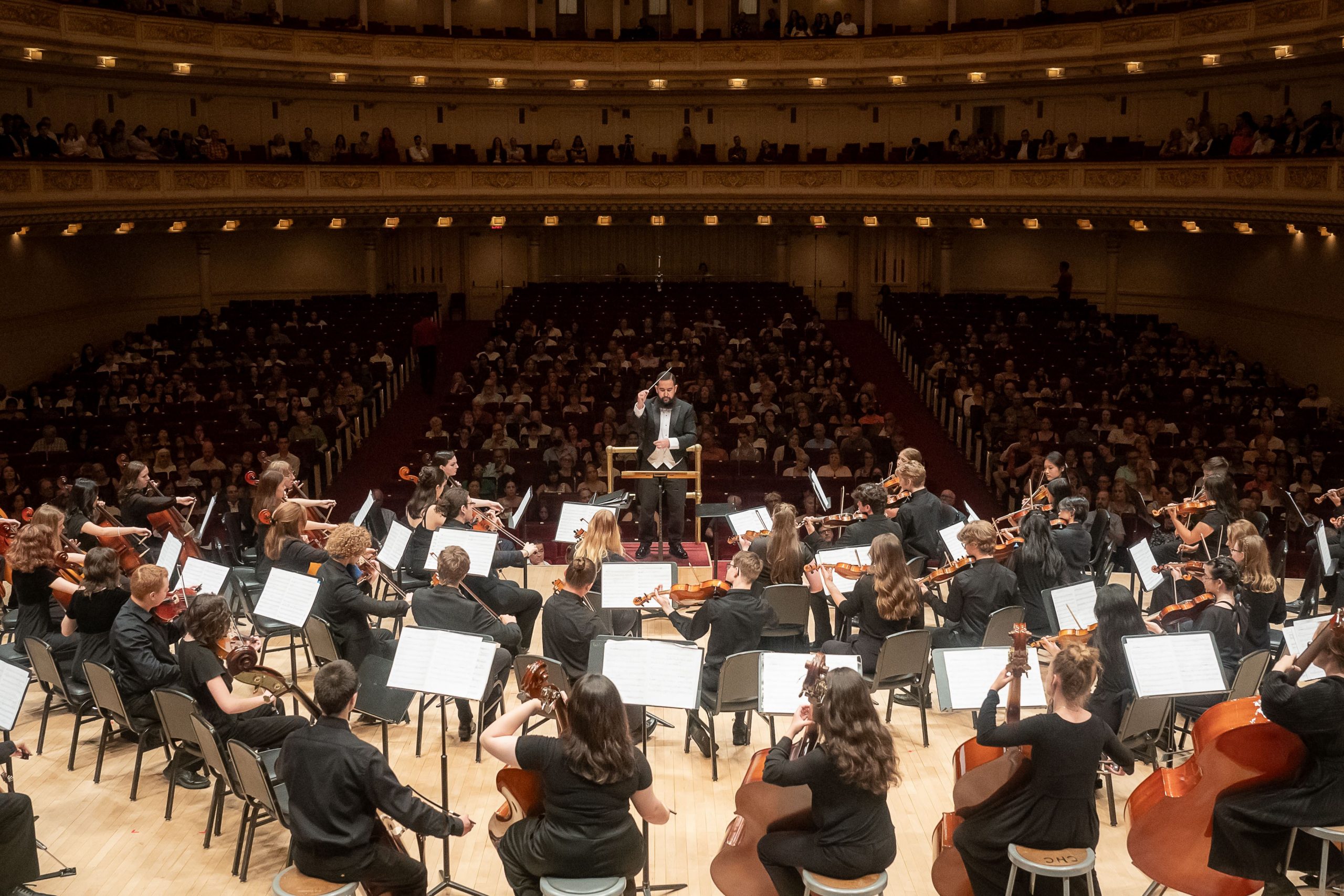
Following that performance, just a few months later, we received an invitation to perform at Carnegie Hall in June 2024. I collaborated with my friend, composer Chris Pilsner, to commission a new piece for the occasion. In January 2023, we revealed to the students that we would be performing at Carnegie Hall, and excitement soared.
By this time, our program had expanded significantly. The Chamber Orchestra grew to 51 musicians, and in June 2024, we took a total of 80 people to Carnegie Hall, where we premiered Interstellar Dreams, composed by Chris Pilsner. That same day, we received an invitation to perform at Walt Disney Concert Hall in Los Angeles in 2026.
From our humble beginnings in 2020—three small ensembles of 20 musicians each—we have now grown to serve around 120 students annually. In recent years, we’ve expanded to include a chamber music program under the guidance of Barbara Thiem, retired professor of cello and chamber music from CSU. This program features four quartets each season.
Another major milestone was finally launching a full symphony orchestra. During the pandemic, wind and brass instruments weren’t allowed due to aerosol concerns, so for years, we were exclusively a string orchestra. However, we have now overcome that hurdle and will be performing a side-by-side concert with the Colorado State University Orchestra, conducted by Dr. Rachel Waddell, in April 2025.
Looking back, it’s incredible to see how this journey unfolded. What started as a simple idea to give students an opportunity to make music during the pandemic has transformed into something far greater than I ever imagined. I’m beyond proud of our students, our directors, and the community that has made The Northern Colorado Youth Orchestra a reality.
Our vision is simple: to inspire harmony for tomorrow. And as we continue to grow, I can’t wait to see where the music takes us next.
Can you talk to us a bit about the challenges and lessons you’ve learned along the way. Looking back would you say it’s been easy or smooth in retrospect?
Just about everything we’ve encountered in forming The Northern Colorado Youth Orchestra has come with challenges.
First and foremost, we were founded during the pandemic, which was a struggle for all musicians. At the time, we were the only orchestra within a 90-mile radius that was rehearsing in person. Even professional orchestras weren’t allowed to meet. Securing a variance through Larimer County was a major hurdle—we spent months navigating regulations, submitting petitions, and working through the logistics of safely bringing musicians together.
That first year, and for several years after, we had to follow strict COVID protocols. We took the temperature of every person who walked into the building, maintained social distancing, and followed detailed safety procedures. A lot of those protocols were adapted from my time in the Army. When I founded the Youth Orchestra in 2020, I was still serving in the Army, and I remained in for another two years before retiring in January 2022. Balancing my military commitments with launching and growing the orchestra was another challenge in itself.
We also faced some turnover in staff. Our first-year directors were Shawn Murphy on violin, Alison Mayes on viola, Joshua Greiner on cello, and myself on double bass. Over time, as people moved on to other opportunities, we saw some changes: Leanne Griffey replaced Shawn Murphy, Drew Mendizabal replaced Alison Mayes, and Kristin Rangel later replaced Leanne Griffey. That core team remained for a long time—Kristin Rangel on violin, Drew Mendizabal on viola, Joshua Greiner on cello, and myself on bass. After our Carnegie Hall performance, Kristin Rangel retired, and we welcomed a new director, Cathy Verbyla.
Another significant challenge was navigating some early leadership conflicts. A few individuals involved in our first year had previously worked with another youth orchestra in Northern Colorado and attempted to steer our organization in a different direction—one that didn’t align with the vision I had for NoCoYO. That was difficult because we had initially trusted these individuals, but ultimately, we needed to establish our own identity and ensure that the orchestra stayed true to its mission.
Despite these hurdles, we’ve experienced steady growth and incredible successes. We made it to ASTA Nationals in our first year of live performances, performed at Carnegie Hall, and are now preparing for Walt Disney Concert Hall. More importantly, our students and families have embraced this journey, creating a positive and thriving musical community. While the road hasn’t always been smooth, every challenge has strengthened our commitment to providing young musicians with incredible opportunities.
Alright, so let’s switch gears a bit and talk business. What should we know about your work?
I’ve had a pretty unique journey as a musician. I actually started out playing in a metal band as a kid—I picked up the bass when I was 12, but I didn’t learn how to read music until I was 16. About two years later, I auditioned for college and got accepted as a music major. After that, my path wasn’t entirely clear—I was performing in jazz, classical, and wedding bands, but I wasn’t sure what direction I wanted to take.
Right after starting college, I joined the 101st Army Band, which allowed me to continue performing while figuring out my next steps. Around that time, I started teaching at The Broadmoor Academy of Music in Colorado Springs, and that experience really shifted my focus. I realized how much I loved working with students, so after earning my Bachelor’s degree in Music Performance, I pursued a Master’s degree in Music Education and a teaching certification at Colorado State University.
During my student teaching semester, I was placed with Bob Kreutz, the orchestra director at Walt Clark Middle School and Thompson Valley High School. The moment I stepped into his classroom, I knew this was what I wanted to do for the rest of my life—teaching orchestra from sixth through twelfth grade.
In 2013, I began my teaching career at Lucile Erwin Middle School, where I’ve now been for twelve years. I started by teaching sixth through eighth grade orchestra, along with a variety of other subjects over the years—advanced chamber strings, multimedia, even sixth grade band and seventh grade choir. But orchestra was always my main focus.
In 2018, I took on the role of director for the Loveland High School Orchestra program, which allowed me to teach students from sixth grade all the way through their senior year. That continuity is something I truly cherish. I get to know their families, their siblings—some families I’ve taught up to six siblings! Watching students grow as musicians and individuals over seven years is incredibly rewarding.
One of my proudest moments was being awarded the American String Teachers Association (ASTA) String Teacher of the Year in 2021 for founding The Northern Colorado Youth Orchestra during the pandemic. It was an incredible honor to be recognized for something that was born out of such a difficult time.
My middle and high school orchestras have consistently earned superior ratings at competitions and festivals. The Loveland High School Chamber Orchestra has been a state qualifier and has performed at ASTA State every single year since I began teaching there.
Beyond the classroom, I’ve worked to expand opportunities for my students. I founded Simply Strings, a nonprofit booster organization that provides financial support and enrichment opportunities for the orchestra program. We also established the Orchestra Leadership Council, which functions like a student council for orchestra. These two groups work together to bring in professional clinicians, organize workshops, and enhance the student experience.
One of the most exciting expansions has been the addition of a chamber music program at both the middle and high school levels, led by Professor Barbara Thiem. This has allowed students to refine their skills in smaller ensembles and deepen their musical understanding.
What sets me apart is my commitment to building long-term, meaningful connections with my students and creating opportunities that extend beyond the classroom. Whether through the youth orchestra, the chamber music program, or side-by-side performances with professional musicians, I want every student to have access to experiences that will shape them not just as musicians, but as lifelong learners and passionate individuals.
Looking back, I’m incredibly proud of what we’ve built. The programs at Loveland High School and Lucile Erwin Middle School have flourished, and The Northern Colorado Youth Orchestra has grown beyond anything I could have imagined. It’s been an amazing journey, and I can’t wait to see where life takes me from here.
What matters most to you? Why?
What matters most to me is my family. While my career is incredibly important and fulfilling, my family is at the center of everything I do.
I’ve always been very close with my immediate family, my in-laws, and I’ve been married for 12 years—my wife and I have been together for almost 14 years now. But the most profound shift in my life happened in July 2023 when I became a parent. My daughter, Sydney, has become the absolute center of my world. I’ve always wanted to be a dad, and getting to be her parent is truly the most important thing in my life.
Because of that, I’ve spent the last couple of years working to create a better work-life balance. For nearly 20 years, I’ve run a private studio, primarily teaching double bass students, many of whom have gone on to make the Colorado All-State Orchestra and some that have become professional musicians themselves. But this year, I made the decision to significantly scale back my studio. I reduced my student load from fifteen to just five, only teaching before school, Monday through Friday. The remaining students—seven in total—I paired with other double bass teachers, while three graduated.
This shift has allowed me to be more present with my family and spend more time with Sydney, which is something I wouldn’t trade for anything. While I’m deeply passionate about music education, at the end of the day, my greatest joy comes from being a husband and a father.
Contact Info:
- Website: https://www.nocoyo.org/
- Instagram: https://www.instagram.com/nocoyouthorch/
- Facebook: https://www.facebook.com/nocoyo




Popular
-

The Trailblazers: Rewriting the Narrative
-

Celebrating the Spotlight: Kaytee Shashore Turns Milestones Into Momentum
-

Humanity in the Machine: Alexander Raye Pimentel’s Cyborg Recall Questions the Cost of a Data‑Driven World
-

Raemi Anderson on Courage, Caution, and Answering the Call of the Landscape
-

Hidden Gems: Local Businesses & Creatives You Should Know


