

Duncan Gilchrist and Valentina Setteducate shared their story and experiences with us recently and you can find our conversation below.
Duncan Gilchrist and Valentina Setteducate, so good to connect and we’re excited to share your story and insights with our audience. There’s a ton to learn from your story, but let’s start with a warm up before we get into the heart of the interview. What is something outside of work that is bringing you joy lately?
Duncan: I recently went on an epic sailing trip with my older brother and best friend from college through the San Juan Islands northwest of Seattle. We sailed from Friday Harbor to Sucia Island, where we anchored in Shallow Bay… Ironic, because this trip was anything but shallow. My older brother just got divorced and my best friend is in the midst of a big career transition. We brought a copy of ‘the Wild Edge of Sorrow’ along with us on the sailboat and read passages aloud to each other about the transformative power of grief. Three brooding dudes on a sailboat, against the backdrop of moody pacific northwest skies and vivid oceanic sunsets. We also made plenty of time to mess around and crack jokes.
Valentina: I spent the summer in Brooklyn, NY and it was so fun to spend time in a different city. I lived next to this park all summer that had a track, soccer field, paddle courts and every day after work I walked over and sat on a bench and would watch people run, play soccer, workout and walk. Something about the amount of people and the energy and vitality of New York made me feel so alive all summer, and this simple act of going to the park, being present, and watching everyone interact brought me joy and made me feel connected to humanity.
Can you briefly introduce yourself and share what makes you or your brand unique?
Duncan: For my day job, I’m a policy advisor for a conservation non-profit. Outside of my day job among other passionate projects, I run a men’s emotional support circle for men in the Denver Metro Area called Mile High Men’s Circle. I’m also an artist. I love painting, writing poetry, and writing songs on my acoustic guitar.
Valentina: I am a therapist by trade and have my own private practice where I see couples and adult individuals struggling with relationship issues. I met Duncan a year ago through our mutual friend and we connected over our love for supporting people, going deep and helping others connect and foster community.
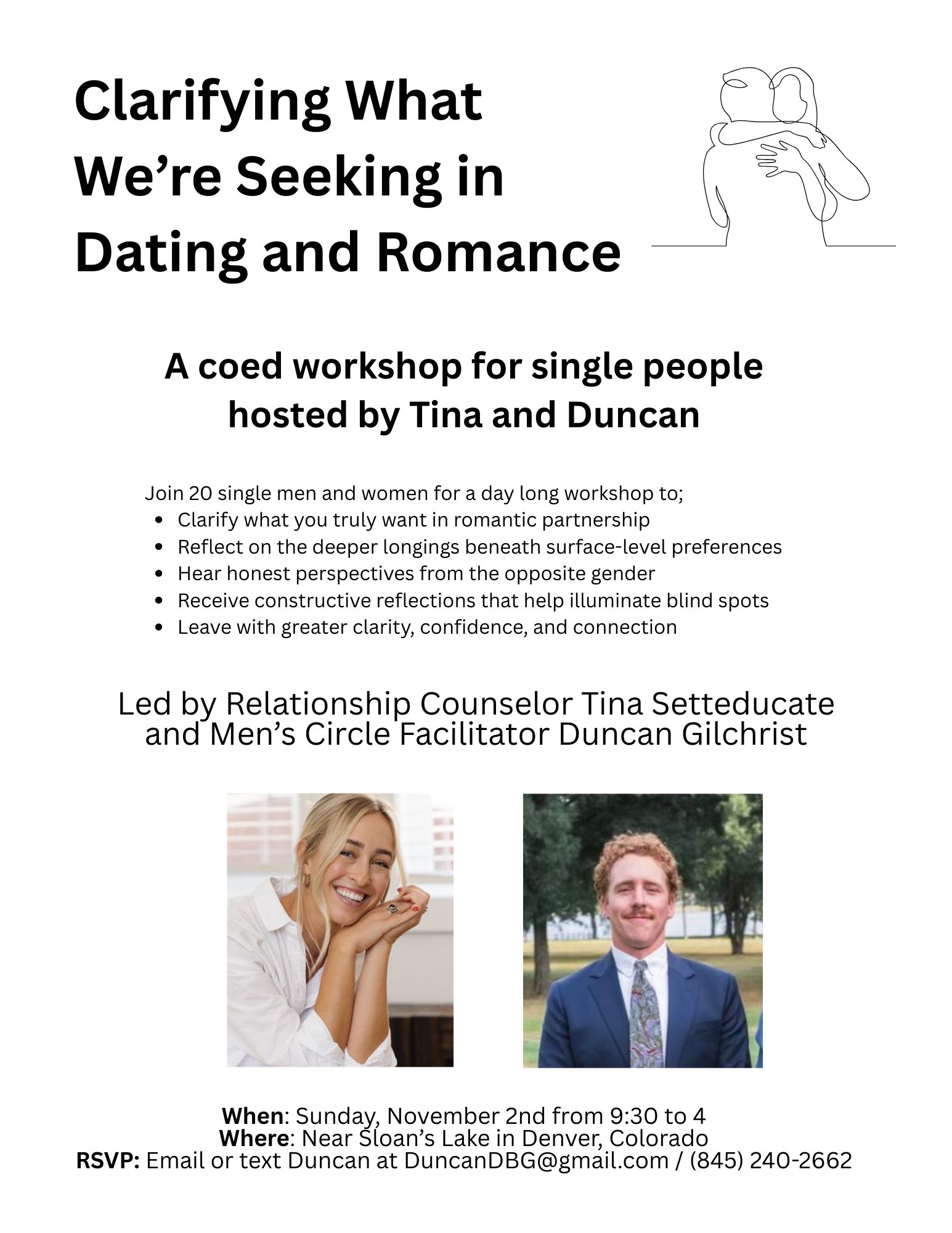
We’re leading a co-ed workshop in Denver on November 2nd for 10 men and 10 women to come together in a supportive environment to talk openly about modern dating and romance, what we’re after, and what’s getting in the way. Many single people are frustrated with modern dating culture; shifting gender roles; the seeming disposability of dating-app connections; an abundance of options for some and lack of options for others etc. Amidst widespread frustration, we’re wanting to bring men and women together to help them get crystal clear on what they want, as a way to cut through some of the noise and focus on what we are most longing for in romantic connection.
Appreciate your sharing that. Let’s talk about your life, growing up and some of topics and learnings around that. What breaks the bonds between people—and what restores them?
Duncan and I believe there’s a deeper cultural undercurrent driving the disconnection we’re seeing today. Despite unprecedented access to technology, information, and mobility, our society feels increasingly siloed off into competing camps. It feels like a sense of shared reality is being replaced by competing perspectives of reality further entrenched by our individually-tailored social media feeds. Growing social divides in America have fueled a crisis of loneliness and relational breakdown, which is feeding into a modern dating crisis.This cultural analysis is partly what inspired the concept for our workshop: to create spaces where people can come together, in person, and experience the kind of humanizing connection that’s nearly impossible to replicate online. We’ve both seen firsthand how transformative group work can be, and we’re passionate about using that model to restore relational bonds, especially in the realm of dating and romance. We think that de-siloing people is essential to healing the cultural wounds of our time.
What did suffering teach you that success never could?
Valentina: So much of my work with clients I see is helping them to understand that in order to grow true trust, connection, and intimacy, we actually need rupture in relationships. The rupture, repair, rupture, repair process is a foundational piece of how we become close to one another and create deeper bonds and trust. We have (and continue) to be sold this narrative that relationship success is all about less conflict or avoiding it all together and this is simply not accurate. The ability to tolerate tension relationally is, in my opinion, one of the most important skills we can learn and foster, and learning how to navigate tension teaches us more than avoiding conflict ever could.
Duncan: Due to the circumstances of my upbringing, I entered into young adulthood with an extremely low self-esteem, which caused a lot of loneliness and pain. I’ve had to work really hard to build a healthy, positive perception of who I am from scratch. I think that being forced to dig deep for an answer to the question of ‘where does my worth come from?’ has resulted in a really sturdy, deep, authentic self-relationship and a lot of empathy for other people that struggle to feel worthy and valuable.
Alright, so if you are open to it, let’s explore some philosophical questions that touch on your values and worldview. Where are smart people getting it totally wrong today?
In Western culture, we’re often taught to equate technological innovation and economic growth with progress. This mindset fuels a kind of techno-optimism, or the belief that technology alone can solve all of our societal problems. Yet despite remarkable technological advances, Americans are experiencing widespread psychological distress and a fraying social fabric.
As our lives become increasingly mediated by technology, our dependence on one another has diminished. The result is that our social and relational muscles have weakened. We’ve reached a critical turning point where more devices, more computing power, and more convenience aren’t translating into greater personal or collective well-being. In fact, they may be undermining it. Technology has delivered speed, ease, and frictionless experiences, as Kyla Scanlon writes about. But ultimately, a frictionless life is a meaningless one. Humans crave connection, tension and all.
If we want to move beyond mere survival and toward a thriving society, we have to recognize that economic growth alone won’t save us, and that to evolve as a society, we need to figure out how to evolve our social, and relational systems. The success of the American experiment will depend on us doing so. How can we create systems that foster deeper, more harmonious connection to one another at a familial, neighborhood, community, city, country level without sacrificing the freedoms of individuality that are also a beautiful feature of our society?
Okay, we’ve made it essentially to the end. One last question before you go. What do you think people will most misunderstand about your legacy?
**can we please answer this below question instead*
What’s a cultural value you protect at all costs?
Duncan: I grew up in a household where my parents were always viciously debating each other, which was sort of annoying and sad, but also instilled in me an appreciation for the way that difficult, honest conversations can sometimes bring us closer to a more complex and truer picture of reality, one that is impossible to understand if we don’t venture out beyond the scary boundaries of our own subjective perception of things. I think it’s deeply important for us as a society to create and protect spaces where people from different walks of life who disagree with each other can come together in person to have difficult conversations, compromise on solutions to shared problems and recognize each other’s shared humanity. If we fail to do this, democracy fails.
I think Duncan and I would agree that collectivism is a cultural value we deem as highly important to the success of human beings. And here, we are defining success as people feeling healthy, joyful, connected, supported, shared responsibility.
This idea that personal well being is deeply tied to the well being of others and the community as a whole is central to what Duncan and I believe and why we want to bring people together. We can clearly see that the success of an individual does not equate to success as a whole. We are all better if those in our circle, community, and society at large are included, taken care of, healthy, and have strong social bonds.
Contact Info:
- Website: https://thecouplescollectiveco.com
- Other: *we have a flyer for this workshop that we would love to post- can you email me so I can send this to you and we can include it in this section?*
alternatively, we could provide a google drive link where the flyer is posted online

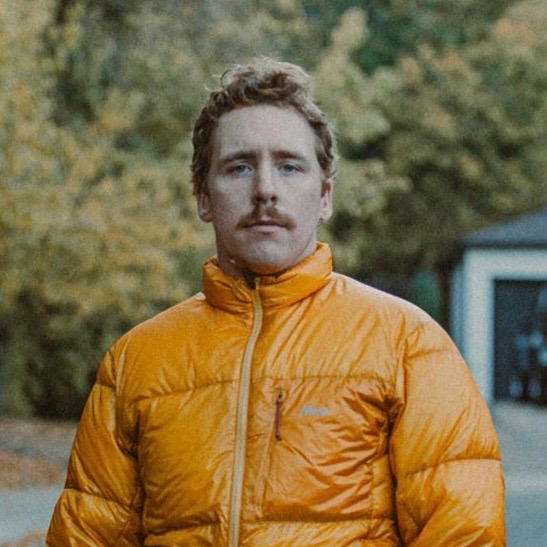
Image Credits
Kylie Fitts (took the image of Valentina)