


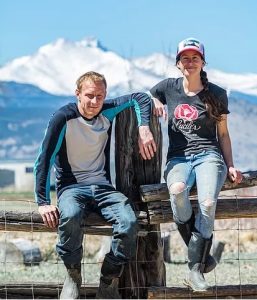
Today we’d like to introduce you to Chloe Johnson and Craig Scariot.
Hi Chloe and Craig, can you start by introducing yourself? We’d love to learn more about how you got to where you are today?
Back in 2013, we weren’t farmers. We didn’t know whether you really needed a rooster to get eggs or not. We certainly didn’t know how to shear sheep. We lived in a loft, which we hated. At some point during our one-millionth trek up four flights of stairs to take our dog out to play, we realized that where we were wasn’t really where we wanted to be. We longed for the open spaces we had enjoyed as children in rural America, and for more space to play fetch with our Australian Shepherd, Charlie.
Where we ended up next was more space than Charlie really needed, so we bought a couple backyard chickens. And then we bought a goat because he seemed nice, and then we got another because goats need friends, and then we figured that since we already had goats, it couldn’t hurt to have sheep, too. Pretty soon we had 30 chickens, 24 sheep, 4 dogs, a couple barn cats, and a 128 sq. ft. organic garden. And then we decided what we really needed was a farm.
SkyPilot Farm was previously the Haas Family Farm. The Hass family owned this farm for over 100 years.
Since we opened for business in 2016, we have grown from those 24 sheep and 30 hens to raising 800 sheep, 10 cows, 200 pigs, and 500 laying hens across about 800 acres in Boulder County.
Would you say it’s been a smooth road, and if not, what are some of the biggest challenges you’ve faced along the way?
The most difficult problem facing all new farmers is the startup cost. Starting from scratch with no breeding stock and no equipment along with the price for land is incredibly expensive. Capitol for beginning farmers is critical to making sure the people who are willing and able to do the work can start up farm businesses. It is also high risk considering the fact that we have no control over nature or weather, both of which are certain to impact and, in some years, determine your success.
The most pressing issue facing Colorado’s livestock producers specifically is the lack of USDA processing facilities. Colorado ranchers could raise many more animals, but there aren’t enough facilities to process them. It’s a major infrastructure problem that is capping the growth and financial viability of our livestock operations across the state.
Thanks for sharing that. So, maybe next you can tell us a bit more about your business?
Today we rotationally graze sheep, cows, pigs, and laying hens across about 800 acres in Boulder County. During a typical day, we check on all our herds, evaluate pasture conditions, restock livestock waterers, collect and wash eggs. Like many other livestock operations, we don’t slow down in Winter, instead we will be heading into lambing season in just a few weeks. While it would be nice to have an off season, this model does allow us to have products available on our webstore year-round.
Locally sourcing is also very important to us as a business. We source much of our feed grains from other Boulder County farmers at a fair price, not the commodity price. We purchase breeding stock from other farmers, again, at much higher price than they would get in the commodity market. All our staff is paid much higher than minimum wage. Paying fair wages and prices is very important to us and our business model. We are really trying to build a more stable local farm economy with other local producers.
Is there a quality that you most attribute to your success?
What makes our operation unique is that we work with local private landowners, to mutual benefit, in order to access almost all of the land we graze. It’s a win-win that gives us access to pasture and allows landowners to save on property taxes by keeping their land zoned for agriculture. Arrangements like this keep hundreds acres in agricultural production every year. Grazing animals improve the health, diversity, and beauty of land by adding fertility to the soil, helping control invasive weeds, and reducing the need for mowing. When mowing or tractor work is needed, we can bring that to the table to help landowners manage and improve their land. In the end, this means easier land management for landowners, more pasture for our animals, and more resilient and diverse grass ecosystems for Boulder County.
Contact Info:
- Email: info@skypilotfarm.com
- Website: www.skypilotfarm.com
- Instagram: /skypilot_farm
- Facebook: /skypilotfarm

 Image Credits
Daniel Gambino
Craig Scariot