

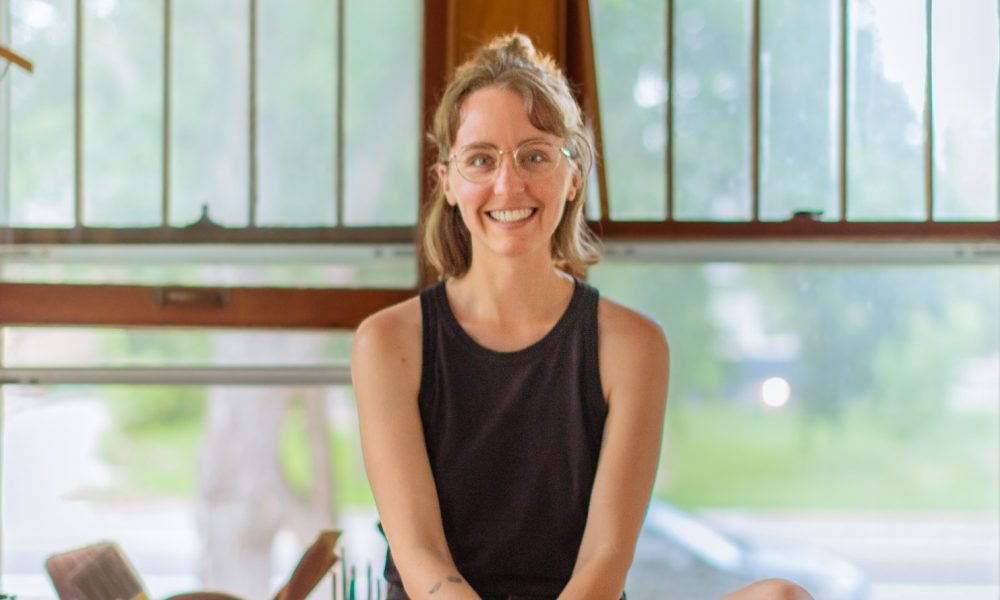
Today we’d like to introduce you to Lydia Cruz.
Hi Lydia, thanks for joining us today. We’d love for you to start by introducing yourself.
I didn’t start drawing or didn’t start liking things I drew until I was twenty and in my second year of college. I started writing, however, at age eight, deciding at ten that that was what I wanted to do with my life. I wrote nonstop until I was twenty-three, a time period that included earning a degree in creative writing and literature. I was very fortunate to have a mother who was a talented writer and who took me seriously before I began to take myself seriously.
Growing up, she read anything and everything I gave to her, giving me feedback, and assigning me editing tasks. This poem is great, she would say as we sat in the back of the community gymnasium during my younger brother’s karate lessons, now remove thirty-five words and add a metaphor. She taught me more than any schoolteacher would until I reached college. I took art classes through high school—ceramics, graphic design, printmaking—always lamenting my lack of drawing skills. I loved the processes involved in printmaking but felt it wasn’t as fun if you couldn’t draw your own stuff.
At eighteen, I would move across the country to study writing in New York. It was an unlikely opportunity, to say the least, but I had been awarded a surprise scholarship and so I packed up my life in Laramie and headed east. I wanted to write fiction but was placed in a creative nonfiction class for my first year. I was frustrated—Everyone knows the worst part of applying to colleges is writing the personal statement, I lamented, and this class is called The Personal Essay—but there were no spots in any fiction workshops, so I was stuck. A few months later I would have a visceral reaction to a David Foster Wallace essay where it would suddenly occur to me that this was what I wanted to do with my life. Less than a year later I would spontaneously sit down to draw my house while home for Thanksgiving Break, which would kickstart a deepened jump for me into visual art. I suddenly found that I did like what I was drawing, whether it was buildings or people or pieces of toast. I have since spent many hundreds of hours drawing, but that leap that happened twelve years ago did and does feel like a kind of magic. My Style, as it has been called, emerged immediately and while it has evolved, it is easy to recognize my earlier work. When asked about it, I say I’m just trying to draw what I see with as much fidelity as possible. Sometimes I draw quickly, sometimes slowly, sometimes without looking, sometimes with a single line, but as far as Style—they just sort of inexplicably turn out that way. I think also, especially in those early days, I was very unfamiliar with Art.
I didn’t go to museums or look at art in books or have any contemporary artists that I followed or even really knew about. I knew authors, not illustrators. So in that way, perhaps I had less opportunity to absorb another style because I didn’t know any styles. Ignorance, I suppose. Now, here we are, eleven years later. All of my professional creative life has been in visual art. After graduating, I found it was much easier to sell a drawing than an essay and so I naturally gravitated toward that. I’ve been fortunate enough over the past decade to have had a number of solo shows, a wide range of commission work, a current Patreon, as well as an ongoing residency at a coffee shop in Fort Collins (something I think more places should do). I wrote and illustrated a memoir that came out in 2020. And after a bit of a hiatus from writing, I started again about a year and a half ago and am working on a new full-length collection of essays that will also include a series of works in charcoal.
Would you say it’s been a smooth road, and if not what are some of the biggest challenges you’ve faced along the way?
It has not been a smooth road, though the picture I’ve painted, especially of the origins of my illustrating, seems a bit gold platter. I’ve come up against two major obstacles when it comes to my creative process. The first happened immediately after graduating from Sarah Lawrence. I moved home, temporarily, after graduation and, for a number of reasons, found myself in a serious mental health struggle.
I had been tiptoeing around depression and anxiety since high school and now I felt like I’d been hit by a steamroller.
It took some time, but eventually, I was able to get the help I needed—for me, this included therapy and medication—to at least tread water during what would be a number of very difficult years. I would begin to keep a visual journal as part of my therapy—I had never been a journaler, though growing up as a Writer, had a literal mountain of journals that had been given to me as birthday presents—and these pages, a kind of real-time chronicle of the following year and a half that would end up being amongst my most difficult, would eventually become my first book, titled Hello and Farewell and Hello and Farewell. I had not originally intended the pages to do anything other than languish the way I was languishing as I drew them, but in 2019 I was contacted by a gallery in Fort Collins, asking if I would want to take their April show after the original artist had dropped out. Of course! I said, thinking surely I could create an entirely new body of work in nine weeks. I did have an almost inhuman drive during that time, but still only had enough for half a show. I decided to pull thirty pages from the journal, which I had drawn in 2015/16, to include in the show. I was incredibly humbled by the response to the pages and began to consider what it would look like to release the full work. All of this said, don’t read what I’m not saying. Creating, in any form, while dealing with mental illness is hard. Sometimes it is impossible. That journal was a life raft for me, but I have experienced periods where I feel incapable of writing or drawing, where I am instead walled in by that thick cotton of depression or wound so tight around the fingers of my anxiety I feel like I’m cutting off my own circulation. It feels trite to say it ebbs and flows, though it does. The challenge within the challenge is learning how to discern when you will best serve yourself by pushing through and when you need to lean back and just float in the waves for a while.
Then, in 2018 I was diagnosed with a genetic connective tissue disorder called Hypermobile Ehlers-Danlos Syndrome. At its most basic, this means my body doesn’t produce enough collagen and so my connective tissue (aka most of the tissue that makes up your body—skin, organs, tendons, ligaments, etc) is too stretchy. There are many implications, but, for me, it especially means my body is not great at holding my bones in place and I experience multiple subluxations, or partial dislocations, on a daily. I grew up super active—I played soccer for twelve years, including two years in college, and felt that I could rely on my body to help me deal with my mind (lots of running to deal with anxiety and nothing like a hard, hot afternoon of yardwork to get me out of my head). Now I had to leave my job as a barista, a field I’d worked in for the past seven years because I could no longer safely lift a gallon of milk. I have injured myself reaching back to flush a toilet (mystery forearm strain), slouching in a chair (my lower rib pushed up until it was touching the rib above it), and wearing a sweatshirt that was slightly too small (neck sprain, if you can believe it).
The last three years have seen my condition significantly deteriorate to the point of invisible disability and when it comes to drawing, it has meant I am unable to hold a pen/pencil/stick of charcoal for very long without adverse effects on my hands, must mitigate how much work I do while standing, if I am working on something hanging on the wall, I must be careful not to hurt my neck while looking at it, etc. And I am tired. I have always been tired, but my stamina is even more diminished. What this means is having to learn how to live in a way where I stop working before something hurts. If it hurts, it’s too late. This is exactly the opposite of how I have lived my entire life and the adjustment has been slow. Here, the challenge is largely in learning how to hold loosely to expectations and to practice shedding the guilt associated with Not Doing Enough. This is true of any artist, however able-bodied. I have never found success in creating with a guilty mind. Before, I was capable of pushing myself anyway, thinking maybe just over this next hill was the next step in my career or the next drawing someone might buy or whatever. And I’m not saying pursuing those things, passionately pursuing them, and stretching yourself to reach your professional or creative goals is a bad thing or somehow not noble (clutching the pearls of artistic purity in a financial vacuum is a position of privilege, not righteousness), but I do think the core of why and how we make is sacred in a way that anything that tells us who we are is at all defined by what we produce can never be sacred.
My ability to grind has been taken away from me. I must pay close attention to my mind, lest I get caught in a web of sadness and white-knuckle lies, and I must pay close attention to my body, or it may betray me. What I write and what I draw bear witness to these experiences, whether in subject or in the ashes I spread across the page with hyperextended fingers, and all I’m really trying to do is tell the truth. Right now, if I could choose to be healthy, I think I would choose that. Do I think I would still be a good artist if I was healthy? Yes. Do I think I probably would have produced more work than I have? Yes. Would that work be meaningful? Yes. Would it be meaningful in the way that the work I’m producing now is meaningful? No. Does that matter? I don’t know. Probably not. Cheryl Strayed called the lives we may have led, but didn’t the ‘ghost ships that didn’t carry us’. What does that mean when it comes to tides and ebbs and flows? I don’t know, but it feels like proof that it’s all connected, all doing its best to point us toward something deeper. Now, take out thirty-five words and add a metaphor.
Thanks for sharing that. So, maybe next you can tell us a bit more about your work?
Professionally, I mostly draw, specializing in black and white portraiture, whether of people, pets, house plants, you name it. I suppose I’m probably most known for my blind contours—illustrations where you look at the subject and not at the paper (though I do typically work in a sort of Mostly Blind Contour space). I have dabbled in painting (my first painting was a large mural—boy was that a steep learning curve) and in the past two years have worked primarily in charcoal. I am very proud of my book, Hello and Farewell and Hello and Farewell, (you can find it in the shop on my website). And I am proud of the work I currently have up at the coffee shop where I have my residency, Bindle Coffee in Fort Collins. The mural is at their roastery location, and the hanging work—which is currently a selection of pieces that are part of my new essay collection—is at their flagship. I’m not sure what sets me apart from others. I suppose there isn’t a surplus of artists working primarily in black and white. Perhaps the blind contours. And that I’m not on any social media anymore.
Maybe that I both write and draw, though in the last couple years I have found it difficult to do both at once, instead needing to focus on one and then the other, even if all the work is for the same project. It sounds lame, but I’m proud to be able to bear witness to myself and those around me, which sounds unavoidable, but as any artist knows—everything is avoidable if there’s a dish to be washed or a meal to be made or a breath to be breathed over there on the other side of the room. So. There’s that.
Is there anyone you’d like to thank or give credit to?
So many people deserve so much credit, but I’ll try to keep it short. Thank you to my mom again, for the innumerable hours she spent reading my stories and poems, for treating them as works with gravity and potential, and for believing that I was utterly capable.
Thank you to my dad, who is a musician and imparted his love of music to my brother and me. I know all the time I spent listening and reading when I was growing up was so formative in my interest and ability to approach making outside the box of genre. Thank you to my former professors Jake, Kris, and Jo Ann, who all played pivotal roles in my development as an artist and writer. And thanks to Andrew and Jenn at Bindle for giving me a continual space to show work for the last handful of years.
Contact Info:
- Website: www.lydiacruz.com
- Other: https://www.patreon.com/lydiacruz


 Image Credits
Seth McClain