


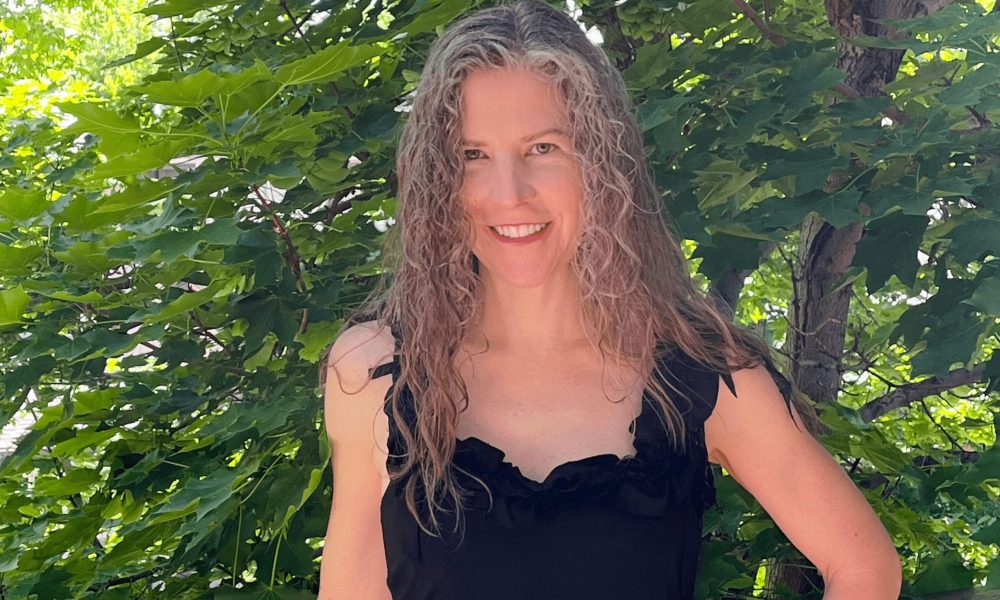
Today we’d like to introduce you to Stacy Fahrion.
Stacy, we appreciate you taking the time to share your story with us today. Where does your story begin?
I’m a composer, pianist, Lumatonian (I will explain this later), and educator based in Colorado. I grew up in Iowa, and moved to Denver in 2004. I earned my master’s in piano performance and pedagogy from the University of Iowa in 2002, but didn’t start composing my own music until nearly a decade later.
In 2011 I was inspired to start writing piano solos in a style I called “Whimsically Macabre.” I gradually switched over from mostly performing works by other composers to mostly performing my own pieces, and had fun performing them in venues around Denver and in house concerts. So far, eight books of my piano music have been published by Piano Pronto Publishing, including my most recent instructional book, Polyrhythms for Pianists.
About five years ago I ventured off on a different, rhythmically-driven composing path inspired by Carnatic rhythms of South India, and shortly after that I discovered how much I loved exploring alternate tunings. In 2020 and 2021, I had the opportunity to study Carnatic rhythm online in International Rhythm Courses with BC Manjunath, a world-renowned konnakol expert and Mridangam player known for innovative and mind-bogglingly complex rhythms.
I also met my mentor, Michael Harrison, in the Creative Music Online program in 2020. He has studied music of North India for nearly 50 years, and is known for creating his own tuning systems in just intonation. I’ve taken many raga classes and private lessons with Michael over the past four years, and his unique music is one of my biggest inspirations. Michael suggested that I try composing in just intonation in 2020, and at first I politely declined, thinking it was beautiful and fascinating, but very impractical, and he kindly responded that he understood and didn’t push it.
Now almost everything I compose is in just intonation. I started out programming different tunings on a traditional keyboard layout using software called Pianoteq, and then acquired a Lumatone, an isomorphic keyboard with 280 hexagonal keys that I can program with more than 12 notes in an octave. I’m excited to be releasing an album with 15 tracks for solo piano and Lumatone in just intonation, Alien Dreamscapes, later this year.
We all face challenges, but looking back would you describe it as a relatively smooth road?
Both times I went to music school it sucked most of the joy out of making music and made me want to quit being a musician. I’m still unlearning the unhelpful things I absorbed decades ago. Since I didn’t have the confidence to start composing until later in life, I’m doing my best to encourage all piano students to explore improvising and composing, and to nurture their confidence by showing them all the helpful tools and ideas I’ve discovered as a composer, pianist, and human.
For me, teaching is just as much of a creative act as composing, and this is a journey of continuous unlearning and learning.
I recently created a series of piano tutorials on YouTube in order to help demystify improvising and composing. There are now more than 30 tutorials on my Whimsically Macabre YouTube channel that help pianists explore the building blocks of music, learn how to play polyrhythms, and improvise in different ways.
It’s often challenging to continue creating while witnessing so much turmoil and cruelty in our world, and at the same time, I’m grateful that I have this outlet for transmuting grief and other strong emotions.
Thanks for sharing that. So, maybe next you can tell us a bit more about your work?
Aside from the upcoming Alien Dreamscapes album and the piano tutorials, I’m most proud of a string quartet I wrote last year in collaboration with the Bergamot Quartet, called For All We’ve Destroyed. This was my fourth string quartet, and with this quartet I finally started feeling pretty comfortable writing for strings. All four of my string quartets are influenced by my study of Carnatic rhythm, and this is something I plan to continue to explore in all of my composing.
For All We’ve Destroyed opens with the performers singing while playing, and contains an insect chorus which includes the songs of a few different katydids that I transcribed from a website called SongsOfInsects.com. I’m very often inspired by learning about nature, whether it’s the mating rituals of jumping spiders, or the rhythms of insect songs.
I have this idealistic hope that more we learn about the non-human creatures that we share our planet with and how they communicate, and the more we can appreciate their distinct beauty, the sooner we will stop destroying them (and ourselves) with pesticides and our current destructive ways of producing food, and do everything we can to help instead.
It’s tricky balancing all of the creative projects I want to work on. I’m also creating a book of spells that contains structured improvisations designed to help ease pianists into improvising, that I hope to complete this year. Some of these spells are already published as singles by Piano Pronto. https://pianopronto.com/composers-community/stacy-fahrion/
In terms of your work and the industry, what are some of the changes you are expecting to see over the next five to ten years?
I would love to see the classical and microtonal music scenes feature more women and nonbinary composers and composers of color on every single playlist and program.
Classical music culture has been silently permissive of harassment of women for far too long, and I hope that in the near future no woman ever has to experience this disempowerment.
Along with Michael Harrison, Jacob Adler, Zhea Erose, and other xenharmonic composers, I hope to help shift the musical world so that more people have a greater understanding of tuning systems like just intonation.
I’m doing what I can in my own piano studio and with sharing tutorials so that improvising, composing, arranging, and generally exploring and experimenting at the piano are seen as just as important, if not more important than playing music by other composers.
In my own composing I plan to continue exploring ecological themes in order to bring more attention to the incredible beauty and diversity in nature.
Thank you so much for this interview, I appreciate having the chance to share.
Contact Info:
- Website: https://www.whimsicallymacabre.com/
- Instagram: https://www.instagram.com/whimsicallymacabremusic/
- Facebook: https://www.facebook.com/WhimsicallyMacabreMusic/
- Youtube: https://www.youtube.com/@WhimsicallyMacabreMusic
- Yelp: https://buymeacoffee.com/stacyf
- Other: https://whimsicallymacabre.bandcamp.com/


Image Credits
Stoph Long