


Today we’d like to introduce you to Beth Twigs.
Hi Beth, we’re thrilled to have a chance to learn your story today. So, before we get into specifics, maybe you can briefly walk us through how you got to where you are today?
I grew up in a surf town on the coast of Norther California and could always, as long as I can remember, feel the pulsing of dance within my body. Even at a very young age, the hunger to express myself through movement was always present. I saw an outlet for this part of myself when I was exposed to ballet for the first time. I was six and, knowing very clearly that dance training was the path that I most desired, I very explicitly told my parents that I wanted to take “serious” ballet.
Fortunately, there was an excellent school in my home town, Santa Cruz Ballet Theater, and my family had the means and capacity to enroll me in classes. I was a very self-motivated and driven child and dance student. Adults in my life were often telling me that I could take things easy, and less seriously; but heeding these calls for balance would have felt incredibly inauthentic to me. Reflecting back now, I think that my strongest, internal driving force was my desire to dance as much as possible as a means of self-expression. Dance gave me a voice that I didn’t have at the time — it still provides this for me to this day.
As a career, I have been led to many different experiences and roles within the world of dance. I danced professionally for many year, mostly in a company setting in Austin, TX, but also as a freelance artist in San Francisco and London. While in London I began my exploration into choreographing which I continued after a move to Seattle, WA. While in Seattle, I founded a dance company and received my MFA in dance from the University of Washington. Last year, I accepted a position to teach in the Theatre & Dance Department at the University of Wyoming, which is what brought me to Fort Collins, CO.
While I am deeply grateful for the opportunities that I have had, throughout my career, I have continually noticed and felt the field of dance’s limitations — of the roles, the power structures, and the narrow definitions of what it means to be a dancer. Today, much of my research is focused on finding languages and frameworks for things I had long felt and still feel to this day — especially around consent, the many binaries, and embodiment in ballet. I ask difficult questions in relation to these subjects in the studio, on stage, and in the structures that shape our dancing lives. I also choreograph from that place: somewhere between critique and love, between rigor and rebellion.
I’m sure it wasn’t obstacle-free, but would you say the journey has been fairly smooth so far?
Oh, the road has been incredibly textured. But, like crunchy peanut butter, it may be a bit trickier to eat, but is worth it for the experience 🙂
The ballet world is a struggle. Growing up, and throughout my career, I heard a great deal of commentary regarding my “fit” in the field. Many of them being more tropeic: you’re too fat/muscular/thin/tall/boney/masculine/ugly/turned in/etc; and others maybe more unique: your dancing is too sterile/funky/full/timid/mature/immature/technical/un-technical/etc. Ballet is a field whose culture really foster very personal commentary. And some of that still goes on to this day, despite the fact that I am well retired from the stage. While there were a lot of turbulent times, a few really stand out.
One of the standouts was when I was sixteen, and I was told that I would never dance again. It was very dramatic at the time; I had sustained very serious injuries to both hips, however, I was able to work with an incredible woman named Kim Gardner. She is a pilates instructor who was incredibly thoughtful, detailed and rigorous in supporting my recovery. Her wildly creative approach to her field allowed for me to learn how to dance by utilizing muscles other than the ones I had injured. I owe her my career. I also think that this experience also opened up a world of creative approach and problem solving that I had never really been exposed to and that i have applied to many different things throughout the years.
Another standout was my motivation for retiring from dance performance. I had been with a company for many years when I started to experience some really abusive behaviors from one of my dance partners. Partnering in ballet, as well as many other forms of dance, is complicated: both emotionally and physically. And while I had experienced quite a bit of pain and sustained some injuries from partnering, this was the first time I had really experienced pain and injuries that were intentionally caused. The toll that this took on my mental and physical health left me feeling like the only real option that I had at this point was to leave. The safety and support that I needed at the time was absent. It was really heartbreaking.
As you know, we’re big fans of you and your work. For our readers who might not be as familiar what can you tell them about what you do?
My artistic journey is one of expansion—expanding out of perfectionism and into pleasure. I have found this experience of unfurling, this stretching of my imaginative self, to be an incredibly abundant, captivating, and delightfully confounding way to experience life. Through this, my personal investigative curiosities have become rooted in the belief that dance is a formidable tool for exploring the complexities of affection, identity, and power.
While excavating my choreographic realms, I am fascinated by the tension that lies between humor and absurdity, two forces that both disrupt and illuminate our everyday realities. The body, in all its vulnerability and preposterousness, becomes a vessel for questioning the roles that we are asked to perform—whether as culturally gender-beings, as deep lovers, as artists, or as individuals. I am drawn to the ways that wit can expose the contradictions of societal expectations, particularly when it comes to gender performativity, as well as the pervasive structures of dominance that act to shape how we navigate our individual worlds.
My choreography is a space where pleasure and pain, passion and discomfort, coexist. I am intrigued by the way our physical and emotional selves can hold both extremes at once—where joy and agony blur, where a fit of laughter might accompany excruciating tears. I believe that these contradictions are not meant to be reconciled, but to be felt, questioned, and experienced in all their intensity. Through this exploration, I seek to give voice to the intricacies of lived experience—particularly the often unseen or unsaid aspects of human existence.
I work to create dances that feel visceral, raw, and unpredictable, that invite the audience to confront their own assumptions about power, vulnerability, and resilience. In each piece, I aim to offer a space for collective catharsis. The body, for me, is not just an instrument of action, but a battleground, a site of resistance and possibility—where the perplexities of being human can be both celebrated and critiqued.
In all my endeavors, I strive to remain open to the mystery of the body’s potential—to let the dance evolve, to allow moments of joy and folly to interrupt our expectations, and to create a space where both lightness and gravity can coexist. Through this practice, my hope is to offer my exclusive perspectives on the ways we live, perform, and move in the world in hopes of connecting to yours.
How do you define success?
Success takes many different forms in my life these days. I play with so many roles: mother, teacher, wife/sister/daughter, friend, choreographer, dancer, human trying to human, etc.
I think I would define success as resiliency. Not just me being resilient, but allowing for the definition itself to be resilient.
What I need, what my loved ones or career needs, what the world needs; all of these needs fluctuate. I love expanding my adaptability in order to continue to explore all of the nuances within all of these life topics. Often, when we think of success, we think of binaries: I have the job or I don’t, my kids are thriving or they are not, I am making enough money or I need more. I think that it is much more interesting to think about all of the nuances and subtleties within our life topics. Maybe success for me is allowing for fluidity and curiosity throughout the many topics of life.
Contact Info:
- Website: https://www.bethtwigs.com/
- Instagram: @bethtwigs

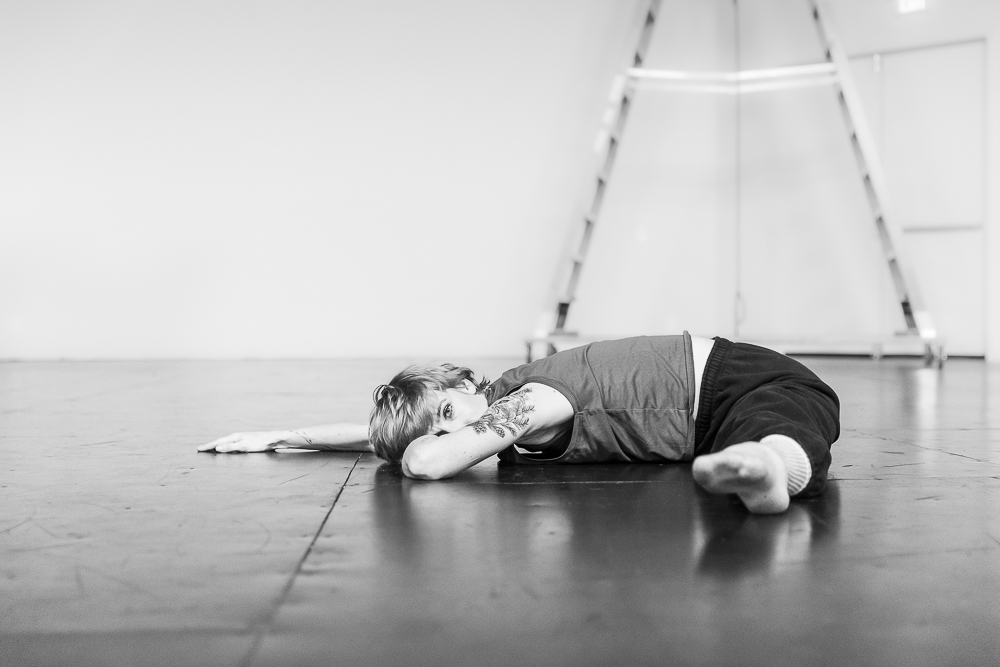


Image Credits
1. Photo 1-3: Shannon Carpenter
2. Photo 5: Sydney Arts