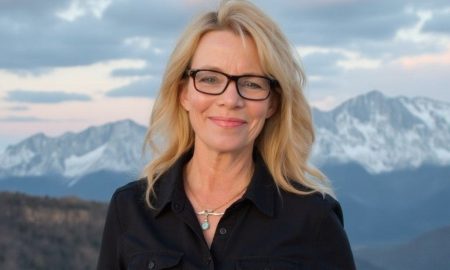


Hi Pam, so excited to have you with us today. What can you tell us about your story?
The desire and journey to work as an artist have been a long one. I have a background in teaching Art History at the college level and working as a curator for the Art Department at Wellesley College. Still, when I found myself relocated to a new city and new life, I chose to return to study painting and get an MFA at Savannah College of Art and Design. I also begin to seriously study and work in Botanic and Scientific Illustration, looking at a program based at Kew Gardens. More moves and relocations across the country, with time in Washington, DC gave me more opportunities to pursue my passion for creating art. I established a studio presence in DC as well as starting to work with The Smithsonian Museums, specifically the Natural History Museum’s Anthropology Dept. doing illustration work. Having been born in Colorado and studying Anthropology at the University of Colorado, this gave me an opportunity to really start to draw on my roots. Out of this also came a serious study of creating my own pigments/paints and inks out of locally sourced plants, soils and minerals. This is a primary focus that continues in my artwork today. More moves and I found myself back to my roots in Denver, Colorado, where I am today. I have established a studio here and continue to do contract work for the Smithsonian Museum of Natural History. I do have a small studio in Boston that I also work out of off and on. The work I find myself creating today uses pigments that I create from plants, soil, and minerals from the Rocky Mountain region and some from New England.
We all face challenges, but looking back, would you describe it as a relatively smooth road?
My journey was not smooth, and I often found I was questioning my ability to “remake” my art career and life as I moved from various cities and states and regions of the US. Just as I found I was learning about the local art pulse and feeling a sense that I was getting established as far as knowing others in the arts community and knowing me and my work, I would be uprooted once again. While this was very difficult, it also opened up opportunities that I could never have imagined. In an attempt to ground me and my work in where I was “planted,” I started the process and use of local soils, plants, and pigments to do my work.
Thanks for sharing that. So, maybe next you can tell us a bit more about you’re your work?
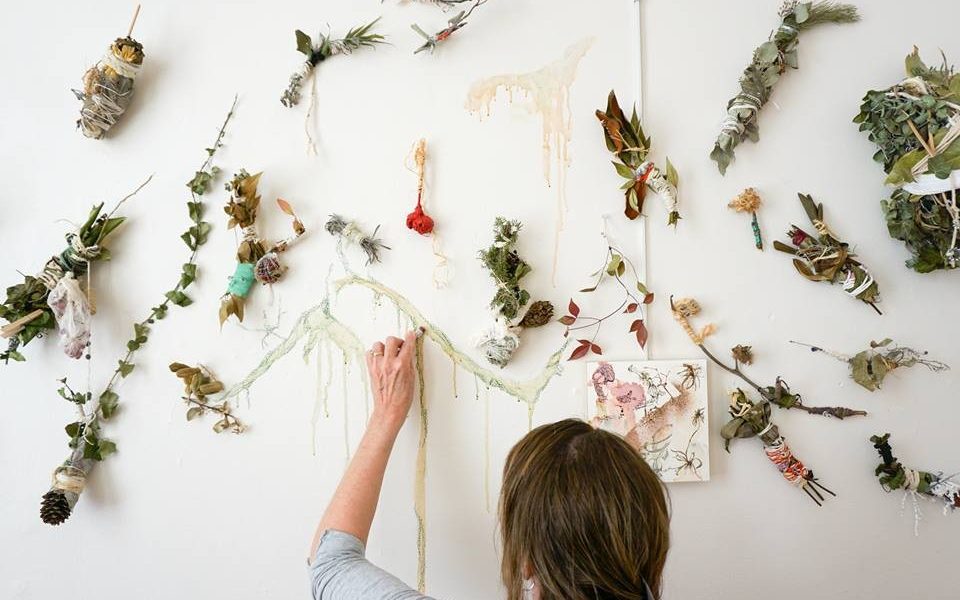
I currently spend my time working on various contract pieces for the Smithsonian National Museum of Natural History/ Anthropology dept and my personal Art Practice. My own practice consists of works with a broad array of organic materials to create fluid, abstract works on paper as well as large-scale nature-based sculptures and installations. I create her works on paper utilizing plant and soil pigments, often making the paper as well. My sculptural installations are assembled from an array of vegetation in various stages of bloom and decay. I attempt to address the complex relationship between individuals and nature, sustainability and growth, past and present in all her works. The sculptural installations, whether suspended or earth-bound, use locally found flowers, leaves, and herbs, along with fiber and disjunctive pieces of hardware and are bound into massive, compelling forms that are infused with an ominous beauty. Grounding the work into the current season and creating these pieces to be site-specific and incorporating organic materials reflect the shifting cycles of nature while utilizing plants relevant to a specific place. Currently, I am making much more two-dimensional work. I have been doing quite a few site-specific commissions as well as large series work for exhibitions. The work on paper often reveals dense passages of paint while complemented by strong use of negative space. I try to evoke a profusion of natural imagery, often counter-balanced by decay, elements that choke or bind, and sometimes s suggestion of tiny creatures hopelessly trapped in the mass of organic matter. Yet in my continuing examination of the complex relationship between people, plants, and place, I work to never lose sight of the beauty inherent in the cyclical character of nature. I also create my own pigments and inks for the work out of plants, soil, and minerals. This gives the pieces grounding in the location where they are created and adds an element of unique character to my work. I am always intrigued by presenting beauty with elements that challenge the viewer to question what lurks beneath. I find that my illustration work often informs my personal practice, which is always fun. I have been very happy that I am able to do something that I love, share it with people, and often have collectors returning to add to their collections.
Are there any apps, books, podcasts, blogs, or other resources you think our readers should check out?
I love reading art history books, bios on artists past and current, as well as “recipe” books for pigments. There are some great paint recipe books from Renaissance Italy. I have taught/studied Art History and to this day, love immersing myself back into it.
Contact Info:
- Email: pam@pamrogersart.com
- Website: http://www.pamrogersart.com
- Instagram: @rogpk


Popular
-

The Trailblazers: Rewriting the Narrative
-

Celebrating the Spotlight: Kaytee Shashore Turns Milestones Into Momentum
-

Humanity in the Machine: Alexander Raye Pimentel’s Cyborg Recall Questions the Cost of a Data‑Driven World
-

Raemi Anderson on Courage, Caution, and Answering the Call of the Landscape
-

Hidden Gems: Local Businesses & Creatives You Should Know