
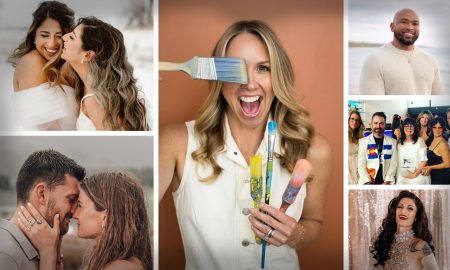


Today we’d like to introduce you to Dora Abbo.
Hi Dora, thanks for joining us today. We’d love for you to start by introducing yourself.
I’ve been painting for as long as I can remember. Even as a child, I was fascinated by color, by the way a simple line could suggest movement or emotion. I was born in The USA and spent part of my youth Costa Rica and later in Maracaibo, Venezuela — places filled with light, color, cultures and texture — and that visual rhythm never left me. Later, when I moved to Florida and studied at Florida Atlantic University, I began to understand painting as more than expression — it became a language of my own, and has been evolving until today. A constant growth.
In my early years I worked with watercolor and vibrant tones. I was exploring the body, the feminine form, and how emotion takes shape. But over time, I felt drawn toward simplicity — to stripping everything down to what really matters. That’s how my “White Series” was born. I started removing color, leaving behind these fields of white space, where a single line or shadow could carry an entire feeling.
White, for me, is not emptiness — it’s presence. It’s silence. It’s a space where everything begins again. Some lines fade, others stay. That layering, that history of touch, is what makes a piece alive.
My work always circles back to the feminine — not as an image, but as an energy, a state of becoming. Painting for me is a way to listen, to connect with that quiet part of ourselves that doesn’t need words.
Every canvas feels like a conversation — between light and shadow, presence and disappearance. After all these years, I’m still searching, still discovering new ways to say what can’t be said.
We all face challenges, but looking back would you describe it as a relatively smooth road?
No, it hasn’t always been a smooth road — but I don’t think art ever is.
For me, art has always been a place of wonder — a space to imagine, to create, and to find peace. It transports me into an infinite world of possibilities, where limits disappear and only curiosity remains.
During COVID, a completely new stage was born in my painting due to the isolation. Because I couldn’t be in nature — which is essential to me — I began painting watercolors that were deeply connected to it. In those works, the human figure becomes nature, dissolving into the landscape. It was my way of breathing during isolation, of feeling alive through that connection.
There have been long moments of silence and uncertainty. When I had breast cancer for the second time, I couldn’t paint — I didn’t have the strength or space for it. That’s when my collages were born. I began cutting and pasting paper, using my hands in a slower, more intimate way. It allowed me to keep creating when painting wasn’t possible. These collage celebrates the creative process behind my paintings. Even when elements disappear from the final work, I strive to keep them alive-transforming those moments so they can exist again in a new present.
That period taught me that art can always find a way — even through pain, even through limitation. The collages became a form of healing, a quiet way to stay connected to life, to the past, present and future.
Every challenge — illness, isolation, silence — has opened a new door in my work. It has taught me that creation is not just about expression, but about resilience, and the endless ways life finds to speak through us.
Thanks for sharing that. So, maybe next you can tell us a bit more about your work?
What sets my work apart is the way I approach silence, simplicity, and the human form. I’ve learned to trust restraint — to say more with less. My paintings often begin with emptiness, with a white space that becomes a place of discovery. From there, a single line, a gesture, or a trace of color becomes a conversation between presence and past.
I’ve moved through many different stages — working with drawing, charcoal, collage, acrylic, and oil. Each phase has its own voice, and I always feel the need to bring one to a close before entering a new stage of growth and exploration. Each technique has taught me something that carries into the next.
My black-and-white periods are moments of rest from color — a way to return to it renewed, with deeper clarity. And I always come back to drawing, because it is the essence of everything.
How do you think about happiness?
What makes me happiest is to be surrounded by my family, by nature and to create — both give me balance and peace.
To be in my studio, in that quiet space where time slows down, listening to my favorite classical music while I work — that’s where I feel most myself.
Creation, for me, is a form of meditation. When I paint or draw, everything else disappears. It’s just me, the canvas, and that silent dialogue that only art can hold.
Contact Info:
- Website: https://doraabbo.com/
- Instagram: https://www.instagram.com/doraabboart/?hl=en


Popular
-

The Trailblazers: Rewriting the Narrative
-

Celebrating the Spotlight: Kaytee Shashore Turns Milestones Into Momentum
-

Humanity in the Machine: Alexander Raye Pimentel’s Cyborg Recall Questions the Cost of a Data‑Driven World
-

Raemi Anderson on Courage, Caution, and Answering the Call of the Landscape
-

Hidden Gems: Local Businesses & Creatives You Should Know


