
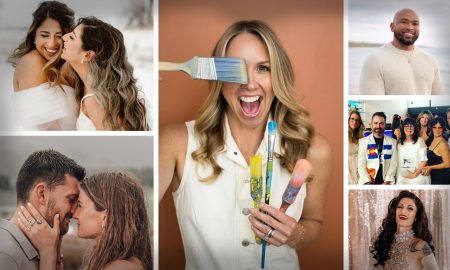


Today we’d like to introduce you to Errow Collins
Hi Errow, please kick things off for us with an introduction to yourself and your story.
I spent most of my twenties working as an illustrator. It was an immense pleasure to work on narrative-driven scenes and compositions to bring to life the vision of authors and private clients. Solving the puzzle of how to portray story elements or characteristics of their subjects into a lively and compelling composition was a thrill that kept me focused for several years, but eventually I burned out. Hard. The back and forth communication, the never ending search for more clients and more work, all of the administrative tasks seemed to eclipse the process of making art that I had once found so rewarding, to say nothing of the growing wrist pain that would later result in a diagnosis of arthritis.
I got a job stocking for R.E.I. Co-op and that held me afloat for a few years. What a relief to simply show up, do my job, and go home! Taking a break from capitalizing on my artistic skill was necessary and it took years to rebuild a positive relationship with creating. I remained interested in the topic, of course, and this led me to discover art conservators on YouTube. Several months went by before I realized how often I was thinking, “I wish I could do THAT with my life.”
I re-enrolled in college in spring of 2022 to pursue a degree in Art History with a minor in Chemistry in order to apply for an eventual masters in art conservation. I’m right in the middle of that now, balancing two disciplines that often prompt surprise in those who ask me what I’m going to school for. I’m slowly exhausting the list of art history and otherwise relevant electives available to me, including a course in Museum Studies to which I owe the job I have now in gallery work. In one spring semester rife with snow closures and consequently cancelled studio visits, I learned more and gained more practical experience than I had in my previous four and a half years of art college combined. My professor encouraged me to apply to the campus gallery over which he oversees and by fall semester I was hired. Since then, I’ve worked on installing a variety of exhibitions, meeting with artists and handling condition reports. As of this spring I’ve stepped into a new role involving more administrative work and research for future shows, as well as cataloguing collections for artists and lenders. It’s incredibly rewarding to apply my skills, both innate and practiced, to the world of art stewardship, engagement, and interpretation, and while my pathway is taking longer than I initially imagined back when I was just watching YouTube videos, I’m quite happy to be on this journey and soaking up everything that I can along the way.
Can you talk to us a bit about the challenges and lessons you’ve learned along the way. Looking back would you say it’s been easy or smooth in retrospect?
There’s a degree of isolation inherent in taking uncommon paths, I think. While I am far from the first, or only, student pursuing a combination of liberal arts and sciences, I am the only one in my milieu. Navigating between colleges that don’t communicate, advisors who can only cover one area or the other, and the brainhell of task-switching has been the biggest challenge, especially when there’s no one I consider a peer in this regard. Even for someone who loves to be alone, I miss the camaraderie I experienced in my first go at college, rooming with my friends and staying up late at night studying together and finishing our sketchbook assignments.
When I graduated high school, I went into art because it was my passion and skill set, but it also saved me the trouble of investing my time in math or science, my worst subjects, or spending time writing a boring thesis. It’s quite the trip, a decade later, to be doggedly studying all three of those subjects while letting art take the back seat. More than that, I don’t think writing a thesis is boring at all anymore, I now have some dozen papers under my belt and I’ve never been under the word count. It turns out, actually, that I can’t shut up about art history. Unfortunately, I can’t say that math got any easier for me, and that’s all right; but I can say that learning the language of chemistry is changing my life for the better (and my brain patterns), and that every hard-fought calculation done correctly puts me one step closer to my goals. So, it’s hard, and running the marathon of college in my thirties is genuinely exhausting, but it’s proving to be worth it.
Thanks – so what else should our readers know about your work and what you’re currently focused on?
As a gallery coordinator, I’m proud of my commitment to honoring the artworks under my purview and my tendency towards keeping organized, as well as being able to lend my research skills to future exhibitions. I feel well-suited to the task of organizing information and handling artwork with focus and care and to doing things properly and thoroughly. Whether a Shepherd Fairey or Angel Ricardo Ricardo Rias piece comes in or a student drops off their work for an open-call show, I’m invested in dedicating myself to stewardship of the art and ensuring that not only is it well displayed but it goes home in the condition in which we received it. I genuinely believe that art is cultural heritage and should be protected and honored.
What do you like best about our city? What do you like least?
I was not always of the opinion that Denver had much great art, but now I see it everywhere. There are numerous murals in the growing area of downtown, as well as various street artists sprinkled across the urban landscape. While I’m not a fan of every tagger, there are artists among them who beautify my neighborhood and make me smile when I pass. It’s much more expansive than I remember growing up and I think it speaks to the ways in which Denver embraces visual expression. That being said, I like least the shuffling of the homeless population from spot to spot from police sweeps, and while efforts are being made to address homelessness, it’s simply not enough positive action and performed without enough humanity.


Image Credits
Photos taken by myself, Emma Timball and Rian Kerrane.
Popular
-

The Trailblazers: Rewriting the Narrative
-

Celebrating the Spotlight: Kaytee Shashore Turns Milestones Into Momentum
-
Humanity in the Machine: Alexander Raye Pimentel’s Cyborg Recall Questions the Cost of a Data‑Driven World
-

Raemi Anderson on Courage, Caution, and Answering the Call of the Landscape
-

Hidden Gems: Local Businesses & Creatives You Should Know


