
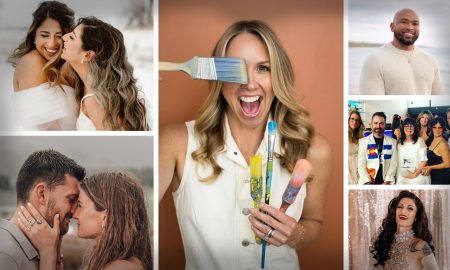


Today we’d like to introduce you to Julia German.
Alright, so thank you so much for sharing your story and insight with our readers. To kick things off, can you tell us a bit about how you got started?
I could describe getting where I am today, working to develop a body of artwork and a reputation as an artist, as the balancing of a lot of life’s tensions. Creativity is always an adventure. It can be hard work to remain curious to the creative instinct and to make time and commit resources to follow the threads of an artistic idea. Creativity, and pursuing it, has become a luxury in this way. I discovered my passion towards the fine arts as a painter in college. Since that time, I’ve walked down a career path that started in the trades and moved to a white-collar career in the practice of law. In each role, the job was a means to an end: money. I wanted to create for myself financial stability and savings, so I could make time to slow down and pursue my creative interests.
Of course, other priorities play into balancing time as well: relationships, other hobbies and commitments, so many of which have been incredibly informative and rewarding. Discovering a path that would allow me time and resources to really nourish my creative passions has, through it all, been a lifelong challenge. I did keep threads of creativity sewn in, like little patches, along the way, but I was far from exploring the work I envisioned for myself.
At age 43, almost as a gift to myself on my birthday, I put in my notice.
Since that time, I have learned more and practiced more at my creative interests in painting, and sculpture with bone and wood, and have begun what I hope will be a long journey learning and growth in working with metal. I feel like I’m starting over in many ways. But I’m grateful to have found a way to make my primary focus my creative work.
Alright, so let’s dig a little deeper into the story – has it been an easy path overall and if not, what were the challenges you’ve had to overcome?
Is there any such thing as a smooth road?
In my prior work, there has always been some element of a known path. I suspected the art world was the same, I just didn’t know what those paths looked like. I’ve been fortunate to have made contacts with experienced successful artists, art dealers, gallery owners, and local artists making work in our community. They have shown me is that there are some paths to pursue a career in the arts, MFA programs for example can help connect and credential you for inclusion in certain galleries and markets, and making a lot of one kind of work you can get known for certainly helps. However, for someone like me, changing careers and building a resume and a varied body of work from scratch, there is no predictable path to tread.
With the time I used to spend practicing law, I had naively expected I would be primarily making art. Instead, a great deal of that time has gone to making an entity, trying to make space to do the work, buying and maintaining tools, building a website, learning to make (sort of okay) content that shows my process, working on educational materials to find ways to engage my community with my work, applying to shows, conducting interviews, and of course, doing all the odds and ends of chasing down every lead and meeting every person from whom I can learn and who may be interested in my journey.
Looking back over the last few years, as I began to prepare for this shift of focus, I am proud of what I have learned, and what I have made. I am grateful for the community and support that has developed around my work. None the less, I still feel I should have spent more time in the studio.
I think keeping it all in perspective is essential. I want to be able to point to the completed art to justify and explain my… well, myself, and what I’ve been doing with my time. Instead, though, I have to return to the knowledge that this is a time for growth, and how I run down this rough road defines the art I will continue to make and the life I live in the process.
Appreciate you sharing that. What else should we know about what you do?
I started out as a painter, primarily working in oil paints, but I am primarily working now as a sculptor. I work in natural materials, preserving and highlighting the rough and elemental nature of these materials while bringing a subject to life. Specifically, I carve in wood, bone and steel. I have started learning to cast metals, and forge, which will open up a new world of possibilities for my work.
I’m most proud of my commitment to the journey. I love the work I’ve made. Recently my piece Issa’s Epiphany was accepted in an Art Show in New York. I was proud to stand with so many talented artists and see this piece, early as she may be in the evolution of my work, being embraced and admired by the members of this experience and established community. However, I have a lot to learn and think of myself as standing at the beginning of my artistic career.
I am excited for a long life of making this work. I hope that does not, in fact, set me apart. I have my own unique voice and creative vision but discovering other voices finding their own ways to do creative work, is the most encouraging and affirming part of my experience.
How do you define success?
Success as a person, for me, is mostly about how you make those in your life feel. I’m an introvert, so it can be difficult to maintain close relationships with all of the people I love. But living a life, showing up with integrity for the people in it is one measure I think a lot about.
As an artist, success strikes me as a more complicated question. I think my simplest answer would be that success is knowing that there is a community seeking to experience and engage with my work. The reason this is hard to answer is because of money and what it does to creativity. For example: if I was as prolific and important an artist as, say Van Gough, and my work sat in my basement, I don’t think I’d define myself as successful. Perhaps, if like so many artists, it was found and loved long after my lifetime, that would still be success. But I’m not sure. Alternately, if I make a lot of one replicable style of pieces and sell them for enough money to bring in a good profit, that would be a kind of success. But if I bend to the market at the expense of my creative interests and vision, I would consider myself a successful businessperson, but not necessarily a successful artist.
I wish I could tell you that this leaves me measuring success for myself as staying true only to my creative passions, money be damned. But I want to build a market around my work and have if valued and appreciated by those that want to invest in it. Entry into this market is a real challenge. With art, there is a vast landscape from “fine art” selling for millions of dollars to “crafts” selling for almost nothing. Pricing isn’t just about quality and craftsmanship: there is the customer, how and where they experience the artwork, what class of artwork it is grouped with, what city you are in, the reputation of a gallery and the artist, not to mention the time and materials cost of making the work.
If my measure of success is going to embrace quality and economy, I have to consider the barrier to acquiring art for most people. I want the work to be loved and I want to feel it is valued as reflected in what I am paid so that I can keep doing the work.
If I can figure this out, I’ll be working towards showing up as an artist in that market with the integrity I use as a measure of success as person. Wish me luck.
Pricing:
- As I mentioned, I’m evaluating how to price my work in a new way. Presently, I have a price range derived from the time and materials costs of each work.
Contact Info:
- Website: https://www.burlycarving.com
- Instagram: http://www.instagram.com/burlycarving
- Facebook: http://www.facebook.com/burlycarving
- Youtube: https://www.youtube.com/@BurlyCarving


Popular
-

The Trailblazers: Rewriting the Narrative
-

Celebrating the Spotlight: Kaytee Shashore Turns Milestones Into Momentum
-

Humanity in the Machine: Alexander Raye Pimentel’s Cyborg Recall Questions the Cost of a Data‑Driven World
-

Raemi Anderson on Courage, Caution, and Answering the Call of the Landscape
-

Hidden Gems: Local Businesses & Creatives You Should Know


