


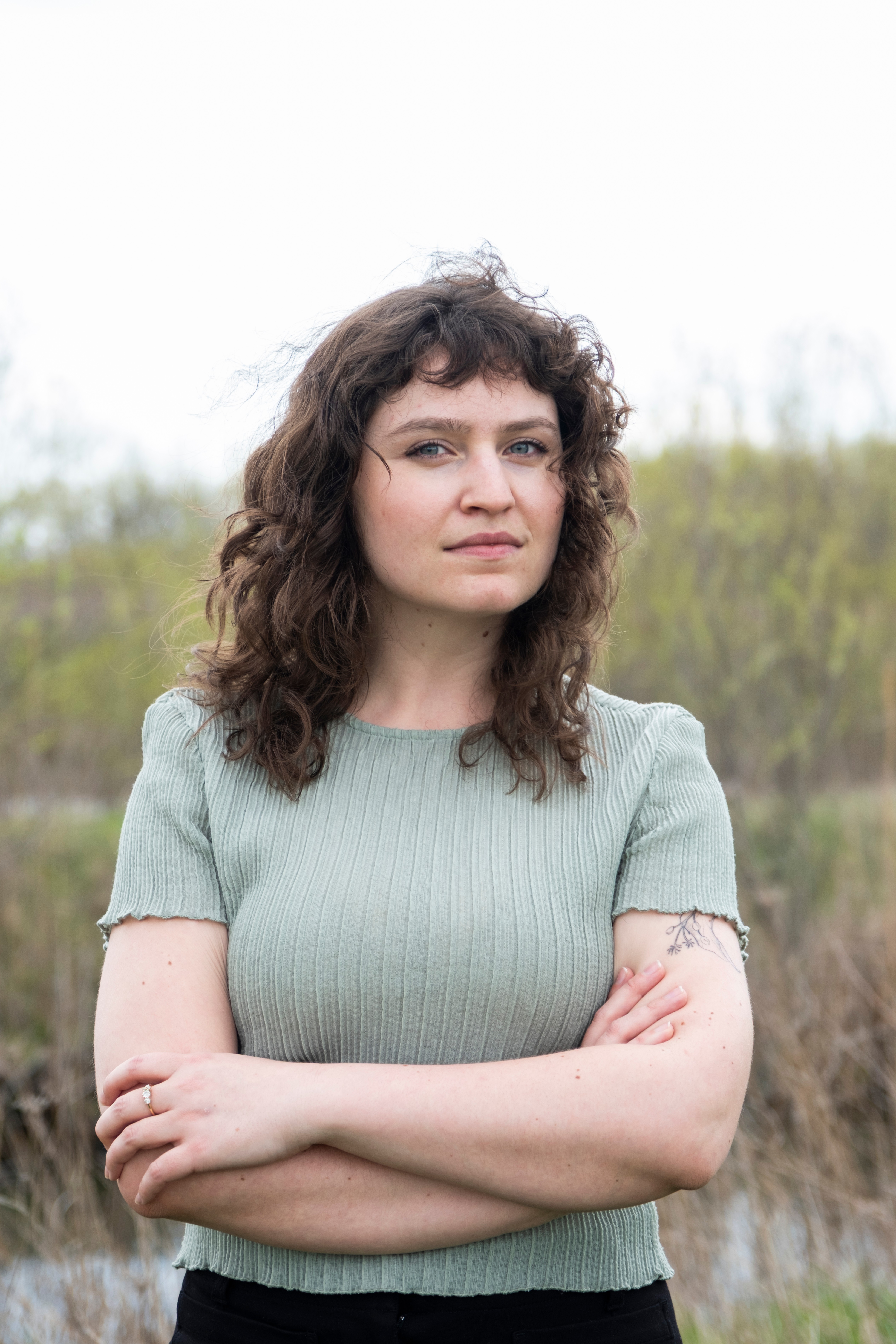
Today we’d like to introduce you to Jullian Young.
Hi Jullian, we’re thrilled to have a chance to learn your story today. So, before we get into specifics, maybe you can briefly walk us through how you got to where you are today?
Right out of college, I was working in marketing, but I continued to pursue ceramics on the side. It was something I had been interested in during college, though I never quite pulled the trigger on pursuing a BFA. I was nervous—hesitant about calling myself an artist. It didn’t feel like a safe choice.
After graduation, I started renting space in a ceramics studio and working there two or three times a week. That rhythm gave me momentum, and before long I was selling work at craft fairs and in small boutiques. Eventually, I decided to pursue my MFA at the University of Denver in Emergent Digital Practices.
My shift from ceramics to new media and digital art was, in many ways, another pragmatic decision. I can be impulsive with big life choices—not in a reckless way, but I’ve learned that if I don’t follow my gut, I’ll never take meaningful steps forward. So, it was a big leap of faith to go back to school and pursue art, and a small, grounding pivot to focus on something more future-leaning.
It turns out, it was a great fit. I’ve always struggled to narrow in on a singular deep interest. I was that person who took way more classes than necessary, simply out of curiosity and a hunger to learn. New media has given me a space to follow threads, chase ideas, and incorporate a wide range of theoretical and narrative influences. It’s a perfect canvas for frenetic exploration.
It still feels a little surreal to describe myself as a full-time artist. Teaching has been a huge part of what sustains that. Working with students keeps me looking at digital tools with fresh eyes—it challenges me to stay curious, to experiment, to play. I get to learn alongside them, and that ongoing sense of discovery is what keeps my practice evolving.
I’m sure it wasn’t obstacle-free, but would you say the journey has been fairly smooth so far?
It was and it wasn’t smooth. My path toward becoming a working artist and art professor has been a winding one, but none of the choices that got me here feel like mistakes or regrets. Not having a straightforward route allowed me to grow, to deepen my interests, and to better understand myself.
Still, there were definitely moments of urgency—feeling like I had to figure it all out: what I wanted to do, where I wanted to work, what my one big passion was. That kind of pressure can be really uncomfortable. But I also followed opportunities that led to major life changes—things I never could’ve planned for, and that I wouldn’t trade. If I had mapped out my career too rigidly, some of those formative experiences may never have happened.
And I’m still not done learning or exploring. I’m open to the idea that I might still “find my passion”—or a new passion, or one that complements what I’m doing now. The path absolutely has more twists and turns ahead. I hope it’s a long one.
Appreciate you sharing that. What else should we know about what you do?
I’m an assistant professor in Time Arts at Northern Illinois University, where I teach courses in digital media, interactive art, and experimental video. Right now, I’m back in Denver for a month-long residency at Deep Space Drive-In, where I’m showing my latest body of work, Manifest Density.
My medium is pretty nebulous. I’m interested in anything that intersects with the digital realm—fabrication of digitally created objects, experimental video, data visualization, projection mapping, sound. I’m especially drawn to mediating real-world environments through digital tools. That impulse connects to my broader interest in how people navigate and relate to the environments that shape them.
The show Manifest Density brings together multiple works, including a video composition titled “Your New Frontier” and a new series of physical plotter drawings called “Our Human Remains”. Both works draw from the same dataset of U.S. plastic waste exports, but they diverge in form and tone. Your New Frontier uses sound and moving image to evoke the scale of global waste systems, while Our Human Remains translates that data into plotted drawings made with a permanent marker on scrap acrylic. The drawings borrow visual language from maps and diagrams, but the use of repurposed materials and a drawing machine gives them a tactile, delicate presence with a distinct honed in precision only a machine could accomplish.
This series grew out of prepping a new project for one of my classes at NIU. I wanted to sharpen my data visualization skills, but it quickly spiraled into something much larger. Over winter break, I found myself completely consumed by it. I couldn’t finish my coffee in the morning without wanting to jump to my computer. I was having those weird in-between dreams where you’re not really asleep and not really awake, but your mind is still generating ideas. I experimented a lot, and there’s a graveyard of near misses on my hard drive—works that almost landed, but not quite. What finally emerged felt both rigorous and intuitive. It was a huge labor, and also a really joyful and playful experience. That kind of fire and hunger is rare, and I’m so excited to finally show the work all together in one place.
Contact Info:
- Website: https://jullianyoung.com
- Instagram: @jullianyoung


Image Credits
Hung artwork and portraits were taken by Emma Vitallo
Popular
-

The Trailblazers: Rewriting the Narrative
-
Celebrating the Spotlight: Kaytee Shashore Turns Milestones Into Momentum
-
Humanity in the Machine: Alexander Raye Pimentel’s Cyborg Recall Questions the Cost of a Data‑Driven World
-

Raemi Anderson on Courage, Caution, and Answering the Call of the Landscape
-

Hidden Gems: Local Businesses & Creatives You Should Know


