



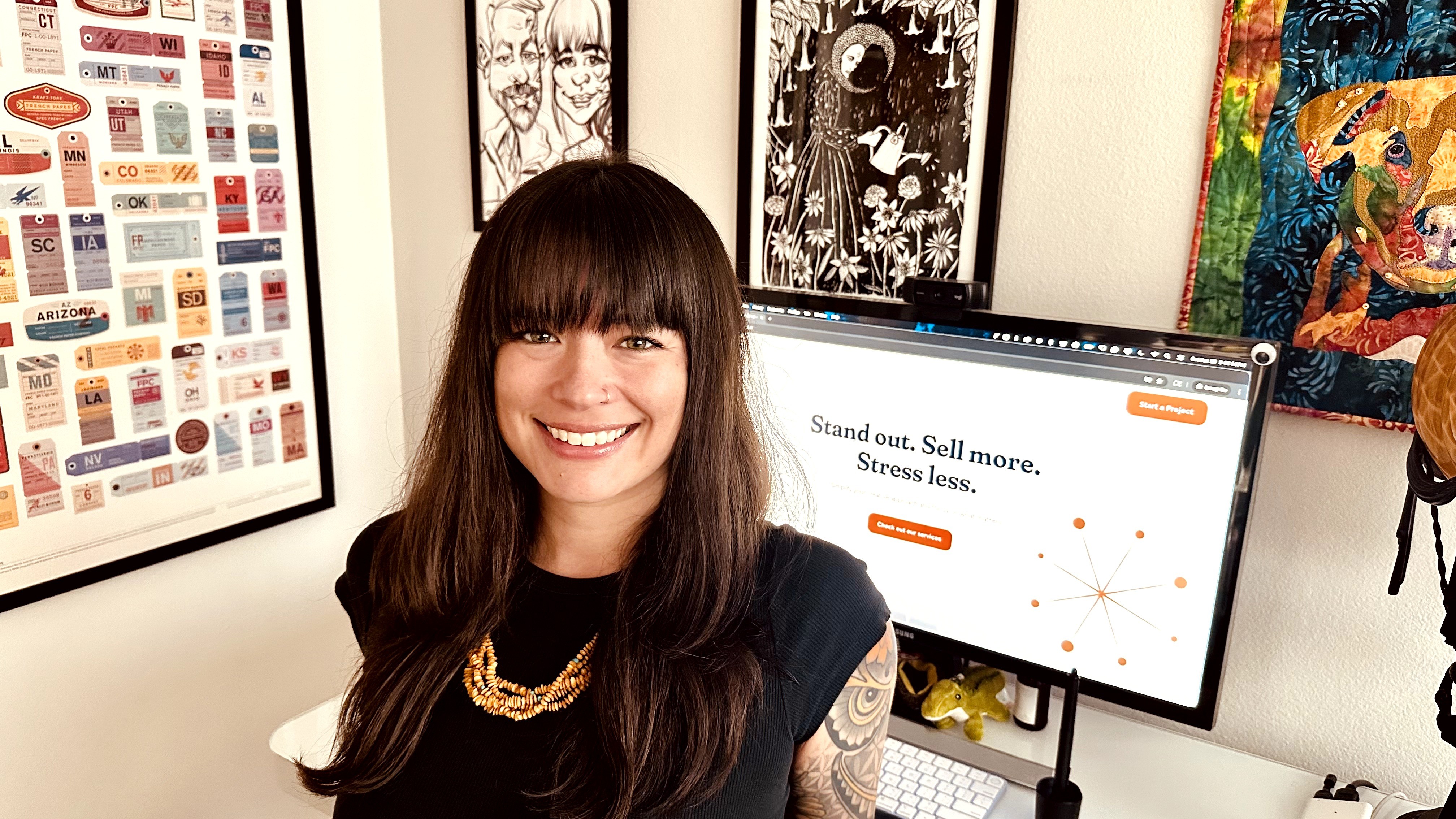
Today we’d like to introduce you to Leanna Derham.
Hi Leanna, thanks for sharing your story with us. To start, maybe you can tell our readers some of your backstory.
Art and design have been central to my life for as long as I can remember. As a kid, I was constantly exploring different creative mediums—drawing, painting, photography, film, and anything else I could get my hands on. That curiosity carried into middle school, where I signed up for yearbook as an elective and discovered how much I loved visual storytelling, collaboration, and designing with purpose.
In high school, I taught myself the Adobe Suite and began translating what I was already creating by hand into digital graphics. At the time, it was driven mostly by experimentation and curiosity, but over time, it became clear that design was something I might want to pursue more seriously. After graduating, a friend told me about the graphic design program at San Diego City College, and I enrolled initially to expand my skills. I ended up excelling in the program and completing nearly all of the graphic design coursework before transferring to San Diego State University to earn my Bachelor of Arts with an emphasis in Graphic Design.
While in college, my education went well beyond traditional design classes. I intentionally took a wide range of art courses to deepen my craft and understanding of materials and process. This included two “Art of the Book” classes, where I studied letterpress printing and woodblock techniques, as well as film and digital photography courses. These experiences grounded my design work in a strong understanding of composition, typography, production, and craft. These are principles that still influence how I approach digital design today.
After graduating from SDSU, I returned to San Diego City College to complete their portfolio classes, which were known for being rigorous and transformative. In 2013, I participated in the AIGA student portfolio exhibition and won the Best of Cross-Cultural Design award. Despite coming from a print background, that experience helped me build industry connections and led to my first role at a large digital agency, where I expanded my skill set into interaction design.
Following that role, the majority of my career was spent freelancing across a wide range of industries. I worked with startups, agencies, and established organizations, which allowed me to adapt quickly, collaborate with diverse teams, and design for a range of audiences and constraints. My freelance years also opened doors for visibility in the design community, including features and interviews in BrandID Magazine, where I shared insights about my work, approach, and design philosophy.
Running parallel to my design career has been my long-standing practice as a yoga teacher, which has deeply shaped how I think about learning, leadership, and creativity. I completed multiple yoga teacher trainings over several years, beginning with 200-hour certifications in 2011 and 2013, followed by advanced yin training, and culminating in an intensive 300-hour training in India. From 2013 through 2024, I taught consistently in studio settings. Teaching yoga reinforced skills that directly inform my design work: clear communication, empathy, structure balanced with flexibility, and the ability to meet people where they are.
Teaching eventually became a natural extension of my professional path. I now teach graphic design and interaction design at a community college, where I combine industry experience with mentorship and accessibility. I’m especially passionate about helping students develop confidence, critical thinking skills, and portfolios that reflect both technical rigor and personal voice.
Two years ago, I relocated to Denver with my husband and dog, and it has felt like both a personal and a professional evolution. The move has allowed me to maintain continuity in my work while expanding my perspective and community. I was an Art/Design Director at Cozy Design for nearly a decade, which was acquired by Border UX in 2024. These days, I am still a fully remote designer with Border UX and continue to teach remotely for San Diego City College. Working remotely has enabled me to stay deeply connected to my teams and students while embracing flexibility, focus, and a sustainable approach to creative work.
Today, my work lives at the intersection of design and education. Whether I’m designing digital/print products or guiding students through their creative development, my path—while not linear—has been cohesive. Every experience has informed how I design, teach, and lead, and I bring that integrated perspective into everything I do. I am energized by the opportunity to continue growing, contributing, and building meaningful work within a new creative community.
Would you say it’s been a smooth road, and if not what are some of the biggest challenges you’ve faced along the way?
It definitely hasn’t been a straight, smooth road. I think many creative careers are inherently nonlinear, and mine is no exception. One of my early challenges was figuring out where I fit within such a broad industry. Design can take you in so many directions—branding, digital products, UX, research, illustration—and early on, I felt pressure to choose a lane before I even fully understood what all the lanes were. It took time, experimentation, and some trial-and-error roles to realize that my strength wasn’t in narrowing myself to a single specialty, but in developing a multidisciplinary practice that reflects who I am.
Freelancing for so many years also came with both freedom and instability. There were times when the workload was overwhelming, and other times when it was anxious and uncertain. Learning how to build client relationships, set boundaries, and trust the ebb and flow was a long learning curve. Those years taught me how to advocate for myself and build confidence not just in the work I produced but in the value I brought.
Another major challenge has been balancing my creative life with my teaching life, and, for many years, with my yoga teaching life as well. Each of those roles requires presence, energy, and emotional investment. There were stretches when I was doing all three at once: working full-time for clients, teaching multiple yoga classes a week, and managing the responsibilities of a classroom. I loved all of them, but I had to learn over time how to structure my schedule and my boundaries so I didn’t burn out.
There have also been moments when imposter syndrome felt very real, especially when transitioning into interaction design, stepping into mentorship roles, or taking on new leadership responsibilities. I’ve had to continually remind myself that growth usually feels uncomfortable and that discomfort doesn’t mean I don’t belong.
The move to Denver was another transition point. Relocating meant stepping away from the familiarity of long-term networks and rebuilding both personal and professional community in a new city. While that hasn’t always been easy, it has pushed me to grow, connect more intentionally, and trust that the skills and relationships I’ve built over time are portable, regardless of geography.
Through all of this, I’ve learned that the winding parts of my path have ultimately been the most shaping. Every challenge, even the ones that felt messy or uncertain at the time, has made me more grounded and more aligned with the kind of work and life I want to build.
Thanks – so what else should our readers know about your work and what you’re currently focused on?
I would say the combination of my design background, my experience as an educator, and my foundation as a yoga teacher. That mix has shaped how I communicate, collaborate, and lead. I bring empathy, clarity, and structure to my work, while also staying open, curious, and flexible. I care about work that feels intentional, well-made, and supportive of both the user experience and the business behind it.
Are there any important lessons you’ve learned that you can share with us?
Early in my career, I assumed that confidence would come from reaching a certain level of skill or experience. I thought if I just worked hard enough, learned enough, or achieved enough, eventually that lingering feeling of “not quite belonging” would disappear.
But what I’ve found instead is that imposter syndrome often shows up in the moments of greatest growth: new roles, new responsibilities, new stages of visibility. For a long time, I interpreted that discomfort as a sign that I wasn’t ready. Now I understand it as evidence that I’m expanding.
There were times, especially moving into interaction design, teaching at the college level, or stepping into more strategic design work, when I felt like I had to prove myself at every turn. What changed things for me was shifting my focus from being the expert in the room to being deeply engaged in the room. Asking better questions, listening closely, owning what I knew, and acknowledging what I didn’t.
Contact Info:
- LinkedIn: https://www.linkedin.com/in/leannajones/
- Other: https://www.cozydesign.com/


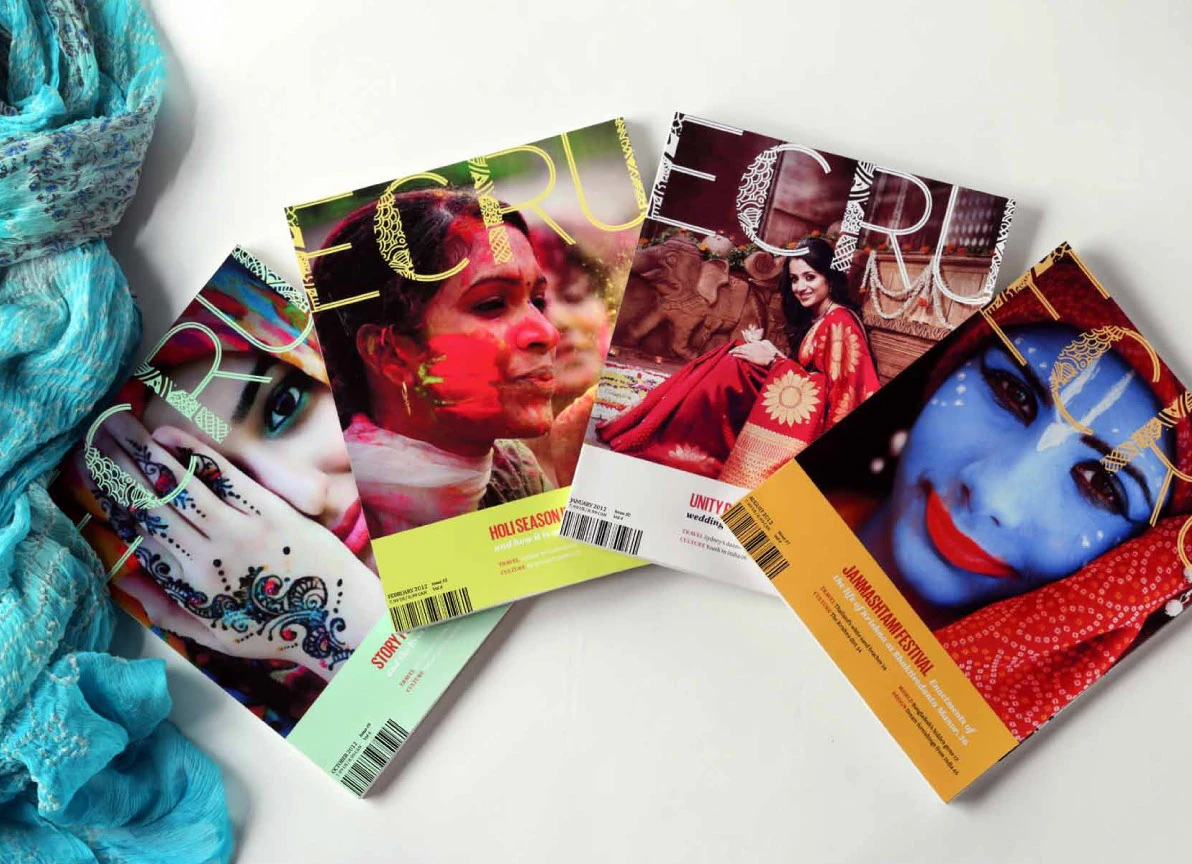


Image Credits
Leanna Derham
Brain Corp
EyePop.ai
Border UX – www.borderux.com
Cozy Design – www.cozydesign.com
Popular
-

The Trailblazers: Rewriting the Narrative
-

Celebrating the Spotlight: Kaytee Shashore Turns Milestones Into Momentum
-

Humanity in the Machine: Alexander Raye Pimentel’s Cyborg Recall Questions the Cost of a Data‑Driven World
-

Raemi Anderson on Courage, Caution, and Answering the Call of the Landscape
-

Hidden Gems: Local Businesses & Creatives You Should Know


