



Today we’d like to introduce you to Lena Johnson.
Hi Lena, thanks for joining us today. We’d love for you to start by introducing yourself.
I started out writing just for myself. I read a lot when I was a kid, of course, and watched a lot of science fiction and fantasy. I was the kid who stayed inside during the entire summer just so I could read. I was never satisfied at the end of the book or the film, and the only way I could express my obsessions was to write stories for myself, exploring whatever I felt was missing or just to continue the story. I eventually found out this was not only something that other people did but it had a name: fan fiction.
A lot of writers look down on fan fiction because you can’t really make money off of it unless you’re picked up by the IP (which is EXTREMELY rare), but it’s a great place to learn skills and just play. I made up new characters and often new settings, so the only thing I took from these IPs was the world-building aspects.
A friend introduced me to NaNoWriMo (National Novel Writing Month) where people around the world try to write a 50,000 word novel in a month. It sounded fun, and I spent the month writing one of my fan fictions. At the end of the month, I had a whole story and realized that so little of it was from the original IP that it wouldn’t take much to make it completely original. It hadn’t occurred to me until then that I could let other people read my stuff. What a concept!
Meanwhile, my friend and I started submitting short stories to anthologies. This is another great way to get experience. We got rejected, of course, but we both really liked our stories and ended up self-publishing an anthology. We had so much fun that we decided to do another one, this time picking our own theme of Domesticated Velociraptors. We expanded our writer group and accepted stories from authors around the world. We followed that up with Last Shot Fired and Welcome to the Alpacalypse (pun intended).
By that time, I wanted to write my own works, so I started working on a novel that took place after the events of my Domesticated Velociraptor story and published a novella about shapeshifters in space. I’ve learned that I love science fiction above all other genres, and I love putting in little twists. Writing has become such a part of my life that it’s extremely rare for a day to go by when I’m not working on something. It’s something that I love, and I can’t imagine not writing.
Can you talk to us a bit about the challenges and lessons you’ve learned along the way. Looking back would you say it’s been easy or smooth in retrospect?
Writing is full of rejections: not just submission rejections, but rejections from readers and sometimes myself. Trying to get a story to work, realizing something’s wrong but not sure how to fix it is frustrating and demoralizing. Having a solid draft of a novel then realizing that it’s fundamentally broken and needs to be torn down to the foundations and built back up is soul-crushing. Getting feedback from a reader that they don’t like something about my story is heart-breaking. Having a table at a convention and making no sales is terrifying. Being an author is having to persevere no matter what. I’ve had to spend a lot of time asking myself if I really want to keep doing this. I have things to prove to myself, and I can’t rely on external validation. I write stories that I want to read, and I know there are people out there that also want to read them.
Writing doesn’t provide immediate satisfaction. It can take months to years to see a project through to publication. I’m constantly fighting with myself that I’m not writing the world’s worst novel, that people will read it and love it. And giving myself permission to take time off when my creative well is dry and I just can’t work anymore. Writing is a marathon, not a sprint. There will be awesome days and there will be awful days.
As you know, we’re big fans of you and your work. For our readers who might not be as familiar what can you tell them about what you do?
I write science fiction (although I do have some fantasy novels planned) because that’s where my mind goes when I daydream. I seem to have a lot of stories with animal companions. Considering I live with four cats, that’s probably not a surprise. I love adding unexpected tropes to genre expectations. Why not have a raptor R9 unit instead of a K9 unit and the raptor is actually the good guy instead of the evil monster everyone is trying to run away from? Why not put shapeshifters in space where they have to inject themselves with animal serums in order to shift? I like turning expectations on their heads and exploring what ifs.
I’m most proud of my science fiction novella, Chimera, which I published last year. A shapeshifter commander must figure out what’s attacking the spaceship’s passengers in an atmosphere that’s very much like the film Alien. I absolutely love the concept, and the commander is one of the most fun characters I’ve written. As a writer, I get to pretend to be people who are not like me at all. She’s boisterous, loud, antagonistic, but very loyal to her squad and willing to die to protect them. Her second-in-command is a level-headed cyborg that keeps her in check. She also gets to do cool things like turn into different creatures as she battles the enemy. She was in my head, and now she’s on paper for everyone to read and enjoy. It’s fantastic that I get to do this.
Are there any books, apps, podcasts or blogs that help you do your best?
Anyone interested in becoming a writer will quickly discover that there are a gazillion resources out there. Everyone claims to have the best plotting structure, the best way to write character arcs, the best world-building techniques. Some of them are good resources, some of them not so good. The problem is that it depends on what works for you. Not all advice will apply, and you’ll have to figure out which works best for you.
The important thing is to balance learning with implementation. There’s a reason that authors tend to follow similar plotting structures–these have been proven to be successful over and over. They work for a reason–readers have expectations, and the better you can meet those expectations, the more likely readers will enjoy your book and recommend it to others. If you think you’re a rule-breaker, know what the rules are before you break them.
At the same time, it’s important to actually write the book. I bet you know someone who claims that they have an amazing story idea and they just haven’t gotten around to writing it for some reason. Anyone can write a book, but so few actually follow through and do it. While I am a huge advocate for doing the work to understanding how stories work and what the popular ones are doing right, I know it can be overwhelming. Sometimes you need to just write. Take what you’ve learned and put it into practice. And don’t just assume that you don’t need to put in the time to learn. Native talent is a thing, yes, but you can’t rely on it. Stories are meant to be shared, so check in with readers and make sure you’re providing what they want.
The most important thing is to get reader feedback. We’re often blind to our own strengths and weaknesses.
With that said, take any recommendations with a grain of salt.
These are the resources that I find most helpful:
Anything by Joanna Penn (books and a podcast)
KM Weiland (books and podcast)
The Writing Excuses podcast,
The Rebel Author Podcast (Sacha Black is no longer producing new episodes, but they’re still up and a fantastic resource)
Sarra Cannon/Heart Breathings on YouTube. She has everything from plotting to mindset to marketing
There are a bunch more, but figure out what you need now and go from there.
And don’t get discouraged. It’s hard work, but it can be so rewarding when you hold a copy of your book in your hands.
Pricing:
- Chimera ebook: $1.99
- Chimera paperback: $7.99
- Domesticated Velociraptors, Last Shot Fired, Welcome to the Alpacalypse ebooks: $4.99 each
- Domesticated Velociraptors, Last Shot Fired, Welcome to the Alpacalypse paperbacks: $14.99 each
- Check out my website for signed copies
Contact Info:
- Website: https://lenamjohnson.com
- Instagram: https://www.instagram.com/authorlenamjohnson/
- Facebook: https://www.facebook.com/authorlenamjohnson/
- Other: https://www.threads.com/@authorlenamjohnson
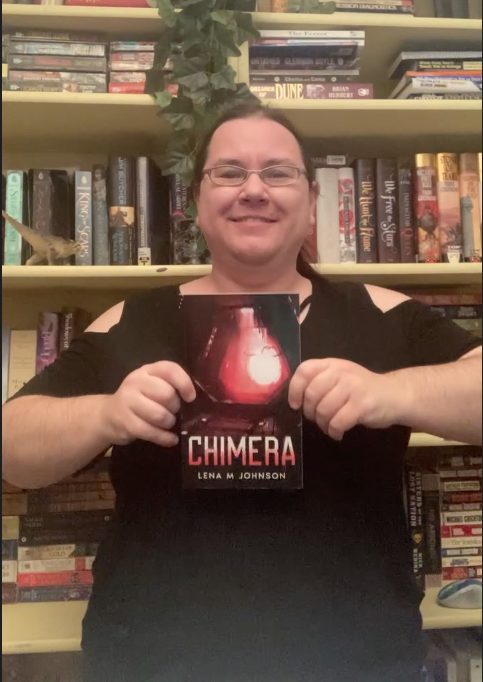


Image Credits
Lena M. Johnson
Popular
-

The Trailblazers: Rewriting the Narrative
-

Celebrating the Spotlight: Kaytee Shashore Turns Milestones Into Momentum
-

Humanity in the Machine: Alexander Raye Pimentel’s Cyborg Recall Questions the Cost of a Data‑Driven World
-

Raemi Anderson on Courage, Caution, and Answering the Call of the Landscape
-

Hidden Gems: Local Businesses & Creatives You Should Know


