
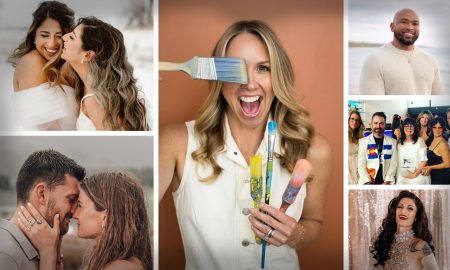


Today we’d like to introduce you to Isabella Briganti.
Hi Isabella, it’s an honor to have you on the platform. Thanks for taking the time to share your story with us – to start maybe you can share some of your backstory with our readers?
My interest in art began at a pretty young age. My maternal grandfather was a cartoonist and sign painter, and my uncle would often gift my sister and I picture books (and later, novels). For a decent chunk of time, I was convinced that I was going to be an author, since I felt I had more potential in my creative writing than my visual arts abilities. This started to change around high school, when I took some art classes and started pursuing the idea of becoming a studio artist. After graduation, I attended University of Colorado at Denver where I got my Bachelor’s in Fine Arts with an emphasis in drawing, painting, and illustration, as well as a Minor in Biology. I was awarded the Outstanding Graduate for my class, and since then, I have been a resident artist at Prism studios in Denver. I received a grant from the Museum of Contemporary Art Denver last summer to produce a series of works about interpersonal communication and the relationship that humans have with each other and with nature. This series is still in production, but will be on view in a gallery setting sometime this fall in the Denver-Boulder area.
Alright, so let’s dig a little deeper into the story – has it been an easy path overall and if not, what were the challenges you’ve had to overcome?
Oh, definitely not. This might seem silly to say as someone who is still in the very early stages of their arts career (I just graduated from school a little over a year ago), and I’m sure that the struggles won’t end here. The biggest and most obvious challenge has been sustaining myself at the same time as sustaining my arts practice. I do not do this full time; it’s simply not financially viable for me, but I am lucky enough to have a solid support system and a day job to pay the bills. Many times throughout schooling, I have had mentor figures ask me if there is anything else in the arts that I could possibly make a living doing, since “making it” as a studio artist can be dodgy at best. I don’t see this as an insult, since the reality of the situation is being an artist for a living is very difficult. I have re-framed this to be less of “is there anything else you can do instead” and more of “how can I expand my skillset to support myself?” This has provided a more tightly woven relationship between my art and my life, since now all of the things that I do in day jobs/gigs/hustles are informing the paintings that I create and the community that I’m part of.
Appreciate you sharing that. What else should we know about what you do?
I am first and foremost a painter, but I am also a printmaker, illustrator, graphic designer, art handler, bookbinder, and all around crafty person. Broadly speaking, I create work that focuses on concepts of interpersonal relationships and communication (or, more accurately, miscommunication). What most of my ideas boil down to is that being a person hurts. Feeling and acknowledging that struggle is important, but it is also important to figure out why that pain is there. The main goal of my work is to connect; connect to the audience, to other artists, to connect to myself more fully and more deeply. There is nuance present in these battles, and I seek to codify it so that this suffering does not have to remain, but can transform into a space of growth, healing, and learning. This work mostly takes the form of figure paintings in a style that is inspired by baroque and classical pieces. I like to incorporate natural phenomena, mostly forms of fungus and vascular flowering plants that I can find myself in the Denver area (I have an interest in science illustration, and this is partly how I integrate that other facet of work into the studio work geared towards gallery settings). Recently I have been experimenting more with composition and form in a way that abstracts the subject, making the audience question what parts of the painting are identifiable, where one element ends and another begins, or simply wondering “what IS that?” I would say I am the most proud of how uniquely each person seems to interpret my work. This reinforces my main ideas; communication is difficult! The things that we try to say are not always received that way, and these variations in interpretations is a reminder of this.
Can you tell us more about what you were like growing up?
I was a very anxious kid. I have distinct memories of feeling sick in the mornings because I was nervous to go to school. I sometimes struggled to hold on to close friendships because of this I think, but I was lucky to have a built in best friend (I have a twin sister). We both were avid readers growing up, our favorites being fantasy and sci-fi novels. I was (and still am) a pretty good example of a nerd. I got very good grades, loved things like Star Trek and Doctor Who, and would obsessively consume media of all types. My dad tells me that I was a “laugh-y toddler” and a bossy sister, which I definitely believe (but he also insists that I was a good athlete, which I have my doubts about). I was and still am very interested in being very good at whatever it is that I am doing. I think that this is one of my biggest strengths when it comes to creating art, but I do have to be careful to not be a perfectionist.
Contact Info:
- Website: https://isabellabriganti.com
- Instagram: https://www.instagram.com/unrefinedmarsupial/


Image Credits
Nikki Rae, Josephine Clark, Alexa Mae Mosley, Tammy Dinh, Bright Lu
Popular
-

The Trailblazers: Rewriting the Narrative
-

Celebrating the Spotlight: Kaytee Shashore Turns Milestones Into Momentum
-
Humanity in the Machine: Alexander Raye Pimentel’s Cyborg Recall Questions the Cost of a Data‑Driven World
-

Raemi Anderson on Courage, Caution, and Answering the Call of the Landscape
-

Hidden Gems: Local Businesses & Creatives You Should Know


