
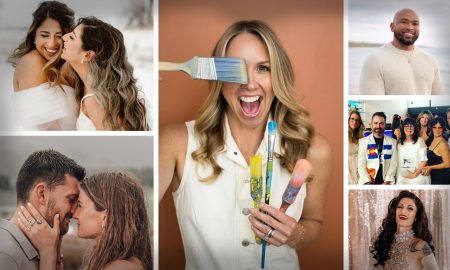


Today we’d like to introduce you to Kristiane Weeks-Rogers.
Hi Kristiane, so excited to have you with us today. What can you tell us about your story?
My story has always been rooted in language—its power to connect, to challenge, and to heal. I began as a curious reader and writer growing up near Lake Michigan, where the rhythm of the water and the quiet strength of the Midwest shaped my early voice. After earning my BA in English with a minor in Creative Writing from Flagler College, I pursued an MA at Indiana University, but it was my time at Naropa University’s Jack Kerouac School of Disembodied Poetics in Boulder, CO that truly transformed my creative and professional trajectory.
At Naropa University’s Jack Kerouac School of Disembodied Poetics, I earned my MFA in Creative Writing and Poetics, immersed in a community that championed experimentation, activism, and deep listening. The work I created during that time became a springboard for recognition. Shortly after graduating in 2018, I was honored with second place in the inaugural Poetic Bridges contest, hosted by Casa Cultural de las Americas and the University of Houston. The poetry collection that began as my MFA thesis ultimately found a home with Finishing Line Press and was published in 2021.
Parallel to my academic and professional writing career, after graduation, I found a home in the nonprofit literary world. I began volunteering with Small Harbor Publishing, first as a Senior Poetry Editor for the digital poetry and arts magazine, Harbor Review. Now, seven years later, I’m Press Director for Harbor Editions. Through our imprints—Harbor Review and Harbor Editions—I’ve had the privilege of editing and ushering dozens of books and poems into the world, from chapbooks to full-length collections and anthologies. This work is deeply personal to me. It’s about amplifying voices that might otherwise go unheard and creating space for stories that challenge, comfort, and inspire.
Can you talk to us a bit about the challenges and lessons you’ve learned along the way. Looking back would you say it’s been easy or smooth in retrospect?
It definitely hasn’t been a smooth road—but I’ve come to value the bumps and detours just as much as the milestones. After graduating with my MFA in 2018, it took a couple years of locating publishing houses and submitting slowly with the minimal funds I had before a publisher said yes to my book, Self-Anointment with Lemons. When the collection was finally published in 2021, it felt like a quiet but powerful affirmation of my creative journey.
At the same time, my volunteer work in the nonprofit literary world has been both humbling and expansive. Working with Small Harbor Publishing has meant navigating limited resources, tight timelines, and the emotional labor of supporting emerging voices. I’ve learned how to lead with empathy, how to build sustainable systems from scratch, and how to stay grounded in mission-driven work even when the path forward isn’t always clear.
And I’m still learning. Every day brings new lessons in nonprofit publishing—from managing finances and refining PR strategies to ensuring that every book we release is as polished and error-free as possible. It’s a constant balancing act, but one I’m grateful for. The road hasn’t been smooth, but it’s been meaningful—and I wouldn’t trade the lessons for anything.
Can you tell our readers more about what you do and what you think sets you apart from others?
As Press Director for Small Harbor Publishing’s Harbor Editions, I oversee the full lifecycle of our publications—from manuscript submission to final print. We’re a micro nonprofit feminist press, and our mission is to amplify underrepresented voices through poetry, prose, hybrid works, and anthologies. I specialize in editorial leadership, production coordination, and strategic communications, ensuring that every book we release is not only beautifully crafted but also aligned with our values of equity, care, and literary excellence.
What sets my work apart is the balance I strike between precision and empathy. I’m known for being the “final eyes” on every project—proofreading meticulously, managing galleys, and troubleshooting layout issues to ensure each book is error-free and publication-ready. But I’m equally invested in the people behind the pages. I lead a team of volunteers, offer mentorship, and create systems that support both creative freedom and operational sustainability.
I’m most proud of the books we’ve brought into the world—especially the ones that might not have found a home elsewhere. In 2024 alone, we published 12 chapbooks, 6 full-length collections, and 1 anthology. For 2025 and 2026, we’re doubling down on our commitment to prioritize new and marginalized voices—those whose stories challenge dominant narratives and expand the literary landscape.
What continues to drive me is the learning curve—whether it’s refining our timeline strategies, managing nonprofit needs, or adapting our digital infrastructure. I’m always evolving, and I think that willingness to grow while staying mission-focused is what truly defines my work.
Is there any advice you’d like to share with our readers who might just be starting out?
My biggest piece of advice is: don’t wait for perfection to begin. Whether you’re submitting your first manuscript, launching a creative project, or stepping into a new role, start where you are—with what you have. The learning happens as you take action. When I was starting out, I wish I had known that doubt is part of the process, not a sign to stop. It took me years after earning my MFA to feel like “a writer,” and even longer to trust my voice as an editor and leader. I still have doubts creep in. But every step—every misstep, even—taught me something valuable.
Also, find your people. Community is everything. When I left the MFA program, I thought I would be fine on my own, with the workshops and tools I was given from my time studying. But I really found myself craving connection with writers who are reading, writing, teaching, going to open mics, participating in virtual events—really anything to connect with other writers. So do that. Fill your social media with only these people and people you admire. Find the open mics in your town, at a coffee shop, anywhere. Surround yourself with those who believe in your work, challenge you to grow, and remind you why you started. And if you can’t find that space—build it. That’s how so many of the most meaningful literary communities begin.
Contact Info:
- Website: https://www.smallharborpublishing.com/
- Instagram: https://www.instagram.com/harboreditions/
- Facebook: https://www.facebook.com/smallharborpublishing
- LinkedIn: https://www.linkedin.com/in/kristiane-weeks-rogers/
- Twitter: https://x.com/harbor_review


Image Credits
Amber Hoadley
Casa Cultural de las Americas
Popular
-

The Trailblazers: Rewriting the Narrative
-
Celebrating the Spotlight: Kaytee Shashore Turns Milestones Into Momentum
-
Humanity in the Machine: Alexander Raye Pimentel’s Cyborg Recall Questions the Cost of a Data‑Driven World
-

Raemi Anderson on Courage, Caution, and Answering the Call of the Landscape
-

Hidden Gems: Local Businesses & Creatives You Should Know


