
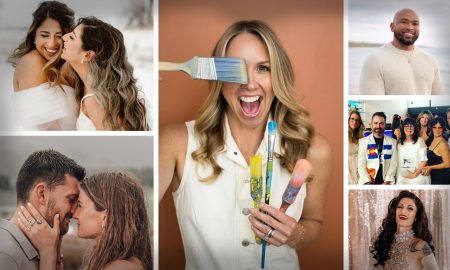


Today we’d like to introduce you to Lynn Schwebach.
Hi Lynn, we’re thrilled to have a chance to learn your story today. So, before we get into specifics, maybe you can briefly walk us through how you got to where you are today?
As a child, I watched my bohemian grandfather draw and paint. I call him “bohemian” because he lived an unconventional life. When you walked into what was supposed to be his kitchen, you found yourself in his frame shop. His entire house was his studio with easels and canvases and paints everywhere. The smell of linseed oil today takes me immediately back to my childhood. He taught me the benefits of travel for accepting and appreciating different cultures and for expanding my creativity. And he emphasized reading—the best form of travel for opening your mind and heart. Not only did he not live conventionally, but he also did not think conventionally. But that would take a book to explain!
Like my grandfather, I worked for many years in industry before devoting every day to art. As a communications professional, I worked as a journalist, public relations specialist and technical writer. I also married and had children, and always in any spare minute I could steal, I was drawing or taking an art class.
In 2015, tragedy hit hard as I lost my youngest son Jake, at age 22, to suicide. I could hardly function in the months after his death, and I found myself sitting in front of an easel, pushing paints around different papers and canvases. Eventually, my experiments in expression took a more commercial path as my paintings began to sell. These artworks started out abstract but eventually became a combination of abstraction and realism. I love abstract realism because I am constantly questioning what takes place beyond materiality — beyond the definable. Yet we live and work in the corporeal world that, on the surface, seems tangible and “real.” The best way for me to express myself straddles definitions of physical materiality and a reality that embodies possibility.
For the past 5 to 6 years, I have worked as a full-time artist and built a home studio—not exactly like my grandfather’s but always with his spirit as my guide. It is not an easy path, but it is the most meaningful work of my life.
Would you say it’s been a smooth road, and if not what are some of the biggest challenges you’ve faced along the way?
A full-time art career is never a smooth road—at least every artist I know would agree with that statement. Every time I start a new painting, there are challenges to overcome and problems to solve. And not every artwork is a success. Perhaps the greatest challenge in being a full-time artist is believing in the process and knowing that you learn more from your failures than your successes. And it is a career that requires constant learning if you want to grow and develop. That is a challenge but also a great joy. I believe one of the ways to navigate our demanding world is to simply keep learning.
Thanks for sharing that. So, maybe next you can tell us a bit more about your work?
I started out learning to paint with soft pastels, and for probably 10 to 15 years before I became a full-time artist I painted exclusively with this medium. But one day a friend brought over alcohol inks and Yupo paper, and I was hooked. Yupo is a photographic-type paper with a lot of plastic in it, making it durable. This paper is glossy and also brings out the vibrancy of inks, letting the artist mix colors right on the paper. This is where I learned abstraction because it’s almost impossible to control inks on Yupo paper. From there, I started painting with acrylics, inks, pastels, watercolors and resin on Yupo paper and now also use canvases and wood panels.
I am also taking classical art classes to become better at realism—and to learn how to paint with oils. My grandfather trained at an atelier in Europe, and he believed a classical art education was the best way to master any type of art. You learn drawing and painting fundamentals in classical schools from a rigorous curriculum that requires many hours of intense work and high levels of craftsmanship. I started out at The Boulder School of Fine Art learning from Elena Cantor who trained at the Florence Academy of Art in Italy. After a year, I switched to The REAL Art Academy in Denver, and I am now studying under Ali Ghassan, a Living Master accredited by the prestigious Art Renewal Center. Ali also trained in Florence and at ateliers in St. Petersburg, Russia and in New York City. To have two classical-art school options in one state along with two great teachers is a real gift. Both schools offer students an unprecedented opportunity to learn as the Old Masters learned.
What do you like best about our city? What do you like least?
I love everything about Fort Collins. It is a beautiful city with a growing arts community, great music, restaurants, and a world-class university. I only wish there were more public transportation options, such as a commuter train or light rail to Denver.
Contact Info:
- Website: www.schwebacharts.com
- Instagram: @schwebacharts
- Facebook: Schwebach Arts


Popular
-

The Trailblazers: Rewriting the Narrative
-

Celebrating the Spotlight: Kaytee Shashore Turns Milestones Into Momentum
-
Humanity in the Machine: Alexander Raye Pimentel’s Cyborg Recall Questions the Cost of a Data‑Driven World
-

Raemi Anderson on Courage, Caution, and Answering the Call of the Landscape
-

Hidden Gems: Local Businesses & Creatives You Should Know


