
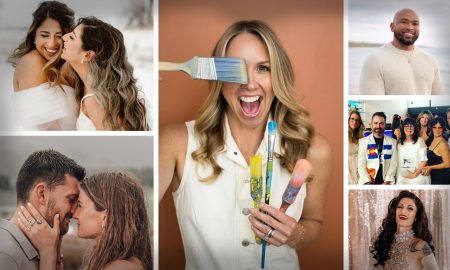


Today we’d like to introduce you to Gianna Beasley.
Hi Gianna, please kick things off for us with an introduction to yourself and your story.
When I was growing up, I never quite fit the societal norm for what bodies should “look like” despite living an active and healthy life my entire childhood. I played year-round sports growing up and into high school and ended up being a varsity swimmer whose nutrition was as “clean” as it possibly could be. I was always living in a body that was larger than almost everyone around me which shaped how I saw food/nutrition and how it impacted my health. The reality was I wasn’t like everyone around me, I found out at the age of fifteen that I had polycystic ovarian syndrome (an endocrine disorder) which significantly influenced my weight and overall health. As a teenager, it was a tough journey to be on when most days you don’t feel at home in your own body and are also being influenced by the society around you to be thinner, eat less, and move more. Now as an adult and a health professional, I wish I could go back and hug the high school version of myself and let her know that she didn’t have to be her smallest size to be loved or worth taking care of herself.
This journey with my own health led me to want to work in healthcare in some capacity and initially I decided to pursue nursing school. I realized after my first year of school that my calling wasn’t to be a nurse, it was to be a registered dietitian. I wanted to help others learn more about their bodies, their health, and their medical conditions to hopefully help them feel less alone in what they were experiencing and also have a trusted source for nutrition information that could support the life they wanted to live.
I am so honored to say my dream of helping others take back their health and understand their bodies has come true. I have worked with hundreds of women over the past two years to be able to transform their relationship with food, their bodies, and their medical conditions. After becoming a registered dietitian, I started working 1-1 with clients to change their lives while also completing my master’s degree in human nutrition. To pour back into my clients and give them the best experience I additionally have completed several additional training in functional lab testing to be able to get to the root of someone’s health challenges.
As a dietitian and personal trainer, my philosophy is to start from the inside out and address any and all concerns my clients may have to help rebuild their health to a spot where they can thrive. My methodology is a full-body approach, where we look into all areas of the body to be sure everything is as optimal as it can be. My goal is to help my clients understand their bodies so they never have to feel like an outsider in their own bodies like I once did. To be able to influence someone’s health in such an impactful way is an honor like no other, and I am so thankful to do what I do every day.
Would you say it’s been a smooth road, and if not what are some of the biggest challenges you’ve faced along the way?
The road to becoming a registered dietitian is not for the faint of heart. What most people don’t know is the process is not only academically challenging and time-consuming but it’s extremely competitive. To be eligible for the board exam to become a dietitian, you have to have completed your bachelor’s degree through an accredited program and then apply to a supervised practice program (dietetic internship) to complete 1,200 hours of supervised practice to take your exam.
The national match rate for a dietetic internship varies year to year but on average lands at a 60% success rate.
Starting in 2024, a master’s degree will additionally be required before being eligible to sit for the board exam.
Registered Dietitian are highly educated and are the experts on nutrition for that reason, however, not everyone realizes the process to become a dietitian. It’s been a rewarding experience and I will never regret going through it, but it’s important to highlight how much work goes into becoming a registered dietitian.
Can you tell our readers more about what you do and what you think sets you apart from others?
As a dietitian, I work in private practice helping women primarily with autoimmune issues, gut issues, or PCOS. As someone who has PCOS myself along with autoimmune challenges throughout my family, it’s really opened my eyes as a provider as to how much support other women with these conditions need but seldom gets. When you are predisposed to unwanted symptoms that come with medication conditions, it can be hard to live your life on a daily basis. My goal is to help my clients manage their symptoms and control their illness(s) so they can live their lives freely.
What sets me apart in my practice is that I fully believe that in order to manage chronic illnesses and the symptoms that come with them, you have to start from the inside out. What this actually looks like will vary from client to client but overall includes a comprehensive look at their health markers such as lab work, stool testing, saliva testing, etc.
As someone who has done a deep dive into my own health and felt like I had no control over my health at certain times, I can empathize and relate to my clients when nothing seems to be going in the right direction. I work with my clients as a teammate, friend, and confidant to help them feel like they are in the driver’s seat of their own health in the long run.
Is there a quality that you most attribute to your success?
I practice ethically. That has to be above all when it comes to helping others with their health. I always want the best outcome for my clients and sometimes that looks like referring them out to another provider or creating a collaborative relationship with other medical providers to manage their health.
In the current world, we are living in, many people are practicing with no credentials or education to back it up, they’re working outside of their scope of practice, or are capitalizing on social media and offering advice that can be dangerous and consumers fall for it. As someone who understands the impact that bad information can have on someone’s health, being ethical in my practice is the only way to go.
Contact Info:
- Website: www.giannabeasley.com
- Instagram: https://www.instagram.com/dietitian.gianna
- Facebook: https://www.facebook.com/dietitian.gianna
- Linkedin: https://www.linkedin.com/in/giannabeasley/


 Image Credits
Debbie Stockwell and Gabi Alves
Popular
-

The Trailblazers: Rewriting the Narrative
-

Celebrating the Spotlight: Kaytee Shashore Turns Milestones Into Momentum
-
Humanity in the Machine: Alexander Raye Pimentel’s Cyborg Recall Questions the Cost of a Data‑Driven World
-
Raemi Anderson on Courage, Caution, and Answering the Call of the Landscape
-

Hidden Gems: Local Businesses & Creatives You Should Know


