
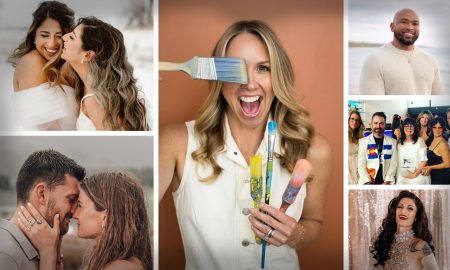


Today we’d like to introduce you to Heather Schulte.
Hi Heather, can you start by introducing yourself? We’d love to learn more about how you got to where you are today?
I grew up surrounded by creativity and curiosity. My parents are avid readers, and my mother taught me how to sew, knit and crochet at a very early age. I also have many memories of my dad meticulously assembling model airplanes at his workbench (an Air Force man, following in his father’s WWII footsteps). We spent many hours at the local public library, visited local museums, and always spent extra time sightseeing when we traveled. My parents encouraged and supported my creative interests, whether painting lessons, taking photography/darkroom classes, or summer writing camps. We also were fortunate to have a computer early on, and I spent a lot of time playing simple computer games and learning some BASIC coding. I started college as an engineering major, with interest in art, and quickly switched to pursuing a BFA (though I didn’t realize at the time how engineering and design thinking shapes my process). I focused on photography and some ceramics (both involve that magical element of chemistry), worked at the university newspaper and dabbled in writing.
We all face challenges, but looking back would you describe it as a relatively smooth road?
As much as my parents were supportive of my creative pursuits as a kid, they are also very practical people. Engineering has a much better prospect of financial stability than art (really just two different types of creative problem solving), so they weren’t too keen on my decision to change my major at the time. I ended up getting married right out of college (literally the same weekend I graduated) and having a baby two years later. We didn’t have space or the financial resources for me to have a darkroom or afford a “good” (re: 10 MP!!) digital camera, and with a baby chemicals were a bad idea, so I worked with what I had on hand: textiles. Our family spent the next 9 years in the Air Force while my partner worked as a dentist and became a specialist, moving every 2-4 years, twice overseas. We also had two more children in that time span, and I experienced two major medical traumas that directly impacted my ability to function on a daily basis, physically and mentally. I now have epilepsy, and must take care of basic needs like sleep, good food, and hydration, in order to manage my chronic condition. My brain just literally doesn’t work the same as it once did. All of this meant that I had very little time to dedicate to any kind of consistent art practice. I view those years as a kind of life research and experience. I read as much as I could and learned all sorts of textile techniques that I applied to making things for my kids, our family, or as gifts. It was a season of intake, learning, and absorbing my environment. Now that my kids are older, and we are rooted in one place, I have time and space to utilize this wealth of information and experience and express it through my work.
As you know, we’re big fans of you and your work. For our readers who might not be as familiar what can you tell them about what you do?
I take these elements (textiles, text, and technology) and mix them together in various ways. Sometimes this results in a weaving or embroidery, or a poem, or a code script that randomly generates a knitting pattern. Lately, I’ve been exploring codes and coded communication systems, like braille and binary code, to look at language from a visual and abstract perspective, looking for patterns that shape how we interact. This arose out of our highly polarized social arena, and feelings of frustration and wanting to understand how we got here, and revealed that these binaries are hardly as rigid or new as they seem, that rigidity is usually harmful to everyone, and that there are always more than two options. What started as “why this vs that?” has become. “what else is here, unseen?” that likely has been here all along. I am interested in how we, as humans, start with basic elements, whether they be sounds, letterforms, or sets of lines, and can create infinite iterations of widely varying results, from music and spoken language, to reams of writing and literature, to drawings, paintings, and sculpture, and how these overlap and interact with each other. Everything is interconnected and shapes and influences everything else. We are inherently never “alone” or able to be solely individuals–we are always participating in something bigger, whether the environment or human society or simply the various organisms that enable us to live. I like to highlight those intersections.
Right now, I’m in the midst of a big, long-term project that brings a lot of these themes together. It’s a collaborative embroidery project called “Stitching the Situation,” which I began in March 2020 as a way to hold in my hands the abstract and distressing daily reported COVID-19 data. I was overwhelmed and needed to break it down and touch what was literally, at the time, untouchable–the people and lives directly affected. Then, I lost my Uncle Joe to COVID on April 13, and it became a way for me to grieve while unable to gather with my family and to honor his life and all the others dying and living with life-altering effects (not only health) of the pandemic. This literally means all of us, as we have all been affected to varying degrees. That spring I invited my neighbors to stitch on the panel with me, out on our street, and this began the “stitching sessions” that are ongoing in our community and elsewhere when it is safer to do so. The first 6 months of the pandemic are represented on 3 panels of fabric, and in summer 2020 I started making individual kits for each ensuing day’s data. As of Nov 2021, there are about 200 “blocks” that are being stitched by people across the country, and 12 that are complete are on display at the Denver Art Museum until the spring of 2022. When the crisis phase passes, I plan to travel with the project, partner with organizations that are providing direct aid for people who have been devastated by COVID and its ripple effects, and continue to honor those we’ve lost and those who have worked in horrible conditions to care for our community. This project offers space to grieve, share our stories, and work towards equitable healing.
Alright so before we go can you talk to us a bit about how people can work with you, collaborate with you or support you?
I am thrilled to have landed in Colorado, as its art community is vibrant, mutually supportive, and quite accessible. There are amazing people who are eager to encourage and support emerging artists like myself, and many opportunities for showing work, seeing others’ work, and plugging into the community in general. I will say, the most difficult part is space, especially in Boulder, but really along the whole front range. Space to work is expensive, and often hard to come by. We could really use more studio and artist work spaces as part of the % for the arts state-wide funding programs. I’m grateful for the City of Boulder Arts Commission, and Boulder County Arts Alliance, as they’ve financially supported my work through grants and connected me with additional resources. RedLine Contemporary Art Center in Denver has been an amazing resource, too, from including my work in shows and connecting me with a larger community of artists, to being one of the biggest supporters of contemporary CO artists, by cheering us on, funding our ideas, and creating ever more space for us. I have to give a big shout-out to BLDG61, the maker space at the Boulder Public Library, as they are an amazing resource, offer FREE access to incredible tools, and are always excited about people who make things.
As I mentioned above, our stitching project IS collaboration. From gathering together the work of over 200 people, to wide-ranging funding support, to collaborating with local organizations, we’re always looking for more opportunities to center the stories of folks who have been devastatingly impacted and connect them directly with resources and support. Anyone is invited to participate, whether by stitching, giving funding support (now tax-deductible!), scheduling community stitching sessions, contributing stories that can be made into patterns to stitch, or partnering with us in to-be-determined ways.
Contact Info:
- Email: heatherdschulte@gmail.com
- Website: www.heatherdschulte.com; www.stitchingthesituation.com
- Instagram: www.instagram.com/heatherdschulte ; www.instagram.com/stitchingthesituation
- Facebook: https://www.facebook.com/stitchingthesituation
- YouTube: https://www.youtube.com/channel/UCMR5B-YuwA5UMAWOaHOks6A
- Other: https://www.bouldercountyarts.org/contribute/heather-schulte


Popular
-

The Trailblazers: Rewriting the Narrative
-
Celebrating the Spotlight: Kaytee Shashore Turns Milestones Into Momentum
-
Humanity in the Machine: Alexander Raye Pimentel’s Cyborg Recall Questions the Cost of a Data‑Driven World
-
Raemi Anderson on Courage, Caution, and Answering the Call of the Landscape
-

Hidden Gems: Local Businesses & Creatives You Should Know


