



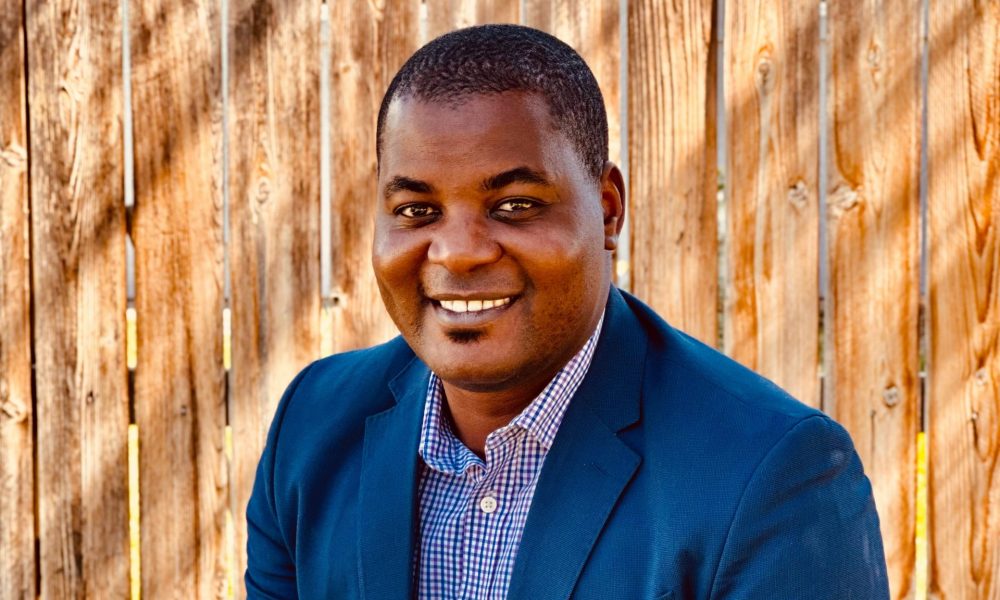
Today we’d like to introduce you to Mathias Mulumba.
Hi Mathias, can you start by introducing yourself? We’d love to learn more about how you got to where you are today.
I was born and raised in Uganda, East Africa. I grew up in extreme poverty and experienced homelessness at a young age. When living on the street, I was rescued by some good Samaritans, who helped me go to school, find purpose in my life by introducing me to God, and ultimately gave me hope that I continue to embrace today. When I was finishing high school, I met a young lady from America, and a couple of years later, I proposed and moved to the USA to get married.
In 2010, my wife and I founded a nonprofit organization called Father to the Fatherless International (see more at www.taata.org), and at a later time, Father to the Fatherless Uganda. This ministry focuses on orphans, street children, widows, and single mothers in Uganda – providing education and training so they can find relief from their past and hope for their future. We currently have two operating campuses that serve over 1,000 people in a rural community. In these villages, we are the major source of employment, we are supplying clean water and electricity, we have a primary school and a vocational school, we are focused on sustainability through agriculture, and we providemedical care and housing. We see ourselves as providing a hand-up, rather than a hand-out, in these communities. We want to see the people be empowered to pull themselves out of generational poverty.
Currently, I am going to college for a Bachelor’s degree in business administration, and am a proud husband and father of three amazing girls.
I’m sure it wasn’t obstacle-free, but would you say the journey has been fairly smooth so far?
It has never been a smooth road. As a child, I was abused by my aunt and then ran away to live on the streets of the capital city. Learning to trust people was one of the hardest struggles I had as a young adult. Coming to America, I learned that there is a much different struggle that people face versus the difficulties I had in Uganda. For example, there are a lot of charities here that make sure that you can always get food and clean water and sometimes shelter for the night; in Uganda, just finding food was a daily struggle.
After getting married, language/communication was a struggle for a long time (not with my wife, but with the people I worked with and associated with on a daily basis). Often my wife would have to interpret for me until I got the hang of American English. Visas, working permits, obtaining a Green Card, and then ultimately getting naturalized as a citizen in the USA were also some struggles I faced during my first decade in America. Before the pandemic, I took the time to study and pass the GED exam, just in case I ever wanted to try college. Once the pandemic started, I knew it then that I should go to school and pursue my dreams of holding a degree. College has also been a stretch for my family these past three years, plus operating the nonprofit in my free time on a volunteer basis.
Another struggle that I’ve experienced was to fill out documentation for a 501(c)(3) with the IRS to begin our African nonprofit. Since starting the organization in Uganda, it has been difficult to acquire leaders who are trustworthy and able to see the vision that I have for the ministry. The process of training leaders in the rural area has proven to be extremely difficult, as many of these people have never left their villages. But, at the same time, it has been a blessing to see the remarkable difference between where this organization started and where it is now.
Fundraisers, family, and finances have seen some ups and downs through the years, but it is starting to pay off. Just seeing children being able to read and comprehend English in school; orphans having a safe place to call home; single mothers and widows having employment and a place that they can come to be encouraged together; villagers having a glass of clean water and a chance at electricity; and young girls and boys being given a second chance in life to learn a trade and improve their futures… all of those things are huge! Those are the rewards for the difficulties that I’ve experienced through these years.
Appreciate you sharing that. What else should we know about what you do?
I have done many things in the professional world (landscaping, construction, photography, and music performances). Currently, I am in school and am a full-time student at Colorado Mesa University. The things that I most specialize in are administering human resources and delegating projects in Uganda and the USA through my nonprofit (Father to the Fatherless International). With human resources, I am in charge of interviewing and hiring individuals to do the work in Uganda, as well as performing the performance reviews for the current staff. The projects that I am involved with are conversed through different channels of meetings to get details handled correctly and determine the materials and labor needed for each job. In America, I am the president of the board of directors for this branch of the nonprofit, and I help organize fundraisers and speaking engagements wherever available.
People know me best for my love for the people in my community as well as contributions to my nonprofit via speaking engagements, fundraisers, and trips to Uganda with small teams. I have given presentations at Wayne State College in Nebraska, at Colorado Mesa University in Colorado, and at the Global Diaspora One Voice Consortium in Washington D.C. (where I won the President’s Choice award for the work and inspiration I do for the diaspora community). People know me for my charismatic personality, hugs, and a big smile. I am most proud of my wife for sticking with me this long and helping me through all the hard times. The thing that sets me apart from others is my love for God and people; I try to go far and beyond to make sure that I can make someone smile and find something good in their life. I have chosen love to be my compass in all I do everyday.
Can you talk to us about how you think about risk?
My view on risk-taking is that everything good requires some element of risk. That risk can be meeting a stranger for a date, planting 5 acres of corn while hoping for the rain to come on time, or estimating a construction project and hoping for no unseen obstacles through the process. As for me, my biggest risk has been operating Father to the Fatherless out of my home in Colorado, rather than in person in Uganda. This is my biggest risk because when I communicate with my workers in Uganda, I have to trust that they will go and do what we discussed, or spend money the way it was intended. Trust, in that capacity, is actually a major risk for an organization in a developmental country due to the poverty levels that people typically experience and how often money or food is a big temptation for people.
Contact Info:
- Website: father2thefatherless.org
- Instagram: @father2thefatherless
- Facebook: @Mathias Mulumba ak blessed man
- Linkedin: @Mathias Mulumba
- Youtube: @father2thefatherless
- SoundCloud: @Mathias Mulumba ak blessed man
- Reverbnation.com/blessedmanmathias
- Other: www.taata.org


 Image Credits
Malayika
Popular
-

The Trailblazers: Rewriting the Narrative
-

Celebrating the Spotlight: Kaytee Shashore Turns Milestones Into Momentum
-
Humanity in the Machine: Alexander Raye Pimentel’s Cyborg Recall Questions the Cost of a Data‑Driven World
-
Raemi Anderson on Courage, Caution, and Answering the Call of the Landscape
-

Hidden Gems: Local Businesses & Creatives You Should Know


