



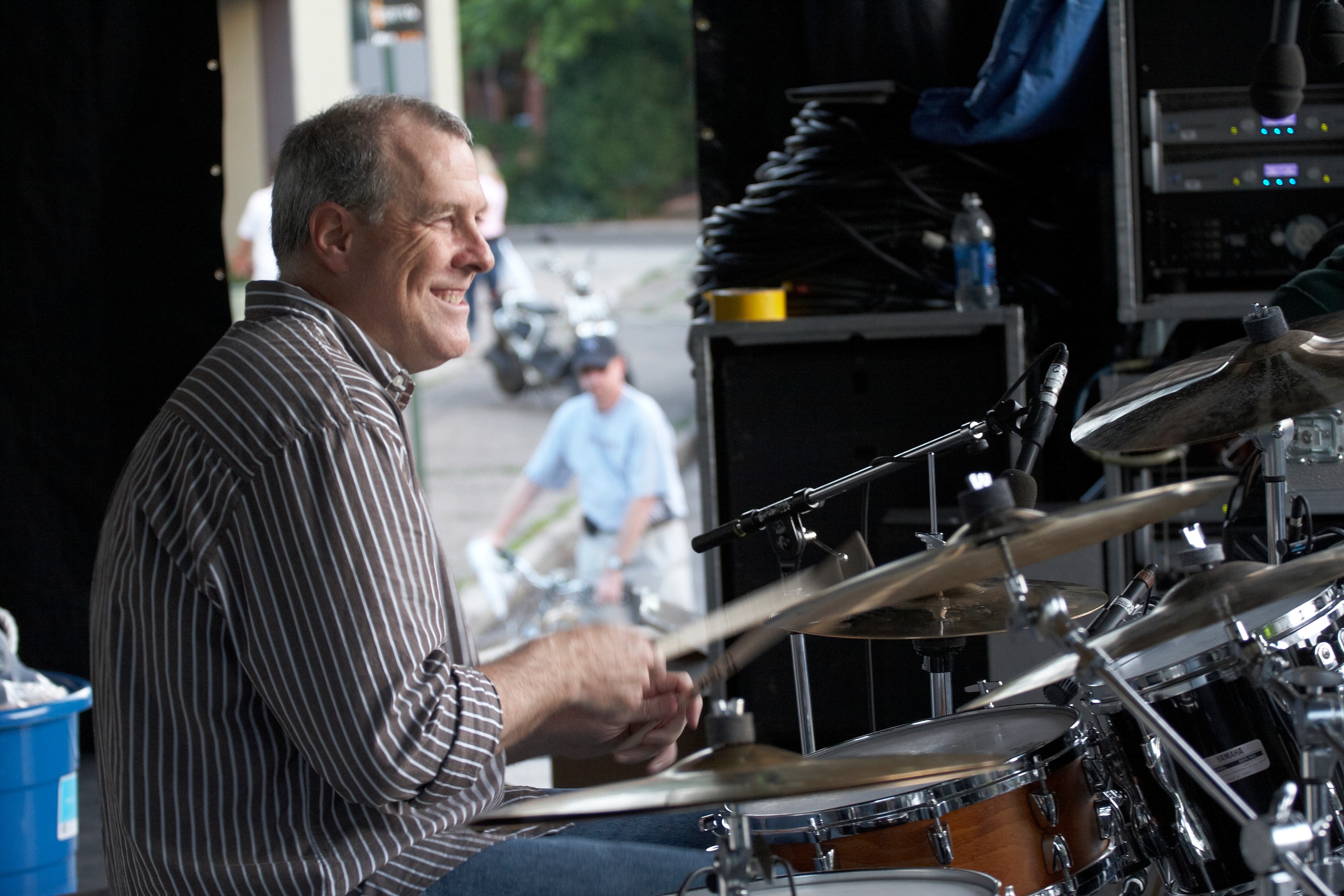
Today we’d like to introduce you to Mike Marlier.
Hi Mike, we’d love for you to start by introducing yourself.
I started playing drums at age 5 and haven’t stopped. My first public performance was in 2nd grade at Ontario Elementary School in Sandusky, Ohio. I played, “Little Drummer Boy” at the Christmas concert. After that I played drums and percussion in virtually every school band and orchestra program. Marching band, pep band, jazz band, the pit orchestra for the musical every year….if it included music, I was in. I started playing string bass in 5th grade, and trumpet my freshman year of high school. During my high school years, I also started playing shows and musicals at the theaters in northern Ohio. The summer of 1978 saw me playing drums in a live musical revue at Cedar Point amusement park in Sandusky. I had been studying both drums and bass privately, so I learned to read music at a very young age. After graduating from high school, I attended the University of Tennessee, majoring in music performance. I transferred to Bowling Green State University in Ohio afrer one year at Tennessee and finished up in 1980. I moved to Denver in August of 1981 and started playing in a show band, playing mostly drums, but also a couple of tunes on trumpet and bass. I played 5 nights a week in clubs all over Denver, Cheyenne, Albuquerque, and Phoenix, In 1984, my daughter Britt was born, and I quit the Top 40 scene and started free lancing around town. Since that time, I performed and recorded with singers Lannie Garrett, Jill Sobule, Robert Johnson, Diane Brown, Lorrie Singer, and also play in the bands Images, Dotsero, Nelson Rangell, as well as the Heritage Christian Center for 8 years, and currently at Mile Hi church. I was the Director of Drum Set Studies at the Lamont School of Music at Denver University for 29 years until my retirement in 2024. I’m currently performing with the Colorado Jazz Repertory Orchestra, at Mile Hi church, and and Nelson Rangell.
We all face challenges, but looking back would you describe it as a relatively smooth road?
The first “struggle” that comes to mind was when I decided to stop playing in touring cover bands and start pursuing more jazz adjacent music on a free lance basis. It would have been very easy to stay in the Top 40 bar band scene in the early 80’s, but I wanted to play jazz and play with a wider collection of people.
Can you tell our readers more about what you do and what you think sets you apart from others?
As a drum set instructor, it was never my mission to train students to be jazz players. I certainly introduced them to a lot of jazz players in the course of their lessons and studies, but I wanted to present to all my students the training and, ultimately, the ability to play any music they were working on with dynamics, good technique, and taste.
As a player, I’ve always tried to be well versed in every musical genre that I was interested in playing. Even as a young kid, I knew that if I could play as many musical styles as I’m interested in, I’ll make more money. For example, I would never consider my self a fan of country music, but I knew that if I could learn that style of playing it would bode well. As a result, I’ve played on lots of country recordings. Open mindedness is key in music, and in life, frankly.
If you had to, what characteristic of yours would you give the most credit to?
The ability to adapt is massively important. Drums are often too loud….I am always aware of the space I’m playing in, and strive to play at a proper volume. The density with which I play is based on the music at hand. I never want to play too much. Open mindedness, as I mentioned before, is an important trait. Of course, being professional is something that shouldn’t even need to be mentioned…..being early to gigs, looking good, smelling good, learning the music you’re supposed to know. I never wanted to be the guy to slow down or stop a rehearsal because I wasn’t prepared to play my part of the music..

Popular
-

The Trailblazers: Rewriting the Narrative
-

Celebrating the Spotlight: Kaytee Shashore Turns Milestones Into Momentum
-

Humanity in the Machine: Alexander Raye Pimentel’s Cyborg Recall Questions the Cost of a Data‑Driven World
-

Raemi Anderson on Courage, Caution, and Answering the Call of the Landscape
-

Hidden Gems: Local Businesses & Creatives You Should Know


