
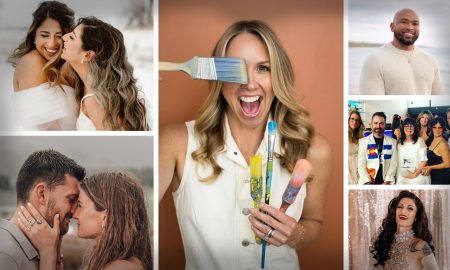


Today we’d like to introduce you to Abby Templeton and Courtney Morgan.
Hi Abby and Courtney, can you start by introducing yourself? We’d love to learn more about how you got to where you are today.
Sidewalk Poets is a nonprofit providing underserved communities and individuals with creative writing and art workshops—so they can share their voices, process pain and trauma, feel more empowered, and enrich their neighborhoods and the city. We teach writing workshops, hold readings and performances, create art installations, and lead nature writing and art retreats. We founded Sidewalk Poets together in 2022, but it’s been a dream percolating for several years.
Abby: I grew up in Park Hill Denver on the corner of 25th and Albion. I was always a lover of stories, spending hours playing with dolls, and making up songs, poems, and raps. At the age of 12, I fell in love with the Spanish language, which then gave way to a passionate study of not only language but the many stories that accompany etymology; the stories of immigration, travel, culture, activism, and voice.
This led me to 17 years of teaching in title one public schools. I loved my time teaching within the classroom but it also highlighted for me the many broken parts of our current educational system—the need for more autonomy, more creativity, and more student voice. As a writer and storyteller myself, I have always experienced the transformative power of owning one’s story and being able to share that story with others.
Courtney and I actually met back in high school playing soccer for Club Denver– when it still existed. We reconnected again years later after we had both moved away and back home a few times.
Courtney: Yes, like Abby, I have always had a passion for writing and the creative arts—and in particular their power to support processing, healing, and change, on both individual and social levels.
For several years (up until the beginning of the pandemic), I led a writing group at The Gathering Place Shelter in Denver for women and trans folks dealing with homelessness and poverty, and every Thursday, I would be just floored, just blown away by the stories, by the people in that room. Stories of what they’d lived or were living, stories of loss, of pain, of trauma, stories of overcoming, of resilience, of hope, stories set on other planets, stories about talking park benches, stories about love—about the richness and tapestry of human experience. Stories of fullness.
The talent in that room, the vulnerability, the willingness to both share and bear witness to each other. It brought me more and taught me more than I probably ever taught them. I think that’s our real work at Sidewalk Poets—we hold the container, the space—and the art, the writing, the imagination, the STORY—it does the work, it’s the magic.
We build our world through stories—the stories we tell, the ones we omit. The stories of a future we allow ourselves to dream into, or not. When someone tells their story, they realize they can change it, expand it, edit it, or write a whole damn new one. When we begin to hear new stories and to listen, the edges of our possible world grow.
Sidewalk Poets is a shared dream and vision with Abby; we started this nonprofit together to provide empowerment and healing-based creative writing workshops to communities typically underserved and ignored by arts programming, and mental health and therapeutic supports. We saw a hole, something that didn’t exist in a society that we thought should—so we decided to build something, to create what we could, to try to fill that gap.
Can you talk to us a bit about the challenges and lessons you’ve learned along the way? Looking back would you say it’s been easy or smooth in retrospect?
Abby: It is always hard to hold tight to your dream as an artist. Studying poetry, you can imagine the sort of questions people would come at me with: Why would you do that? What are you going to do with that? How are you going to make any money? But I always felt writing, not only my own writing but supporting others to tell their stories, has always been my life purpose, that if I continued to live from my heart that it might one day make sense.
Courtney: Yeah, I’d agree, we live in a society that doesn’t really value the arts, that has a very strange and strained relationship with artists. We get a lot of messages that it’s not really necessary or important. And I think we have faced similar challenges in trying to do this work toward social change. I know I felt really frustrated working in different institutional settings—from academia to the corporate world to other nonprofits—trying to do this work or get support for this work. Support for serving underserved and marginalized populations with arts programming in a therapeutic and empowering way. It doesn’t make “sense” to everyone, despite there being clear research that creating art and expressing yourself has a deeply positive therapeutic effect on people, empowering them to find their own value, strength, and purpose.
It was easier to find support to offer to programs more oriented toward traditional job skills and being “productive,” but Abby and I both knew the deeply transformational power of telling your story and expressing yourself through words and writing. So after fighting to make this work happen in other settings, we decided it was time to create our own organization, with the healing and empowering capacity of the arts at its heart and center.
Alright, so let’s switch gears a bit and talk business. What should we know about your work?
Abby: Courtney and I have over 28 years of combined teaching experience. We know what it feels like when participants are comfortable being their most authentic selves and telling their most vulnerable stories, and we know what it feels like when that space has not been created.
We started Sidewalk Poets because we want everyone in the room to feel safe and comfortable showing up as their authentic self and telling any story they might need to tell on that day. We love the craft of writing but what comes first is the focus on community and healing—that is why we focus on workshops within communities that have historically been underserved: people of color, trans communities, LGBTQ, refugees, immigrants, youth, elders, teen moms, people experiencing homelessness and poverty, survivors of sexual assault and violence, as well as people who speak languages other than English—these are not the exceptions to the rule, these are our clients and we feel they deserve to tell their stories and their stories deserve to be heard!
Courtney: Sidewalk Poets is really unique and special in that we focus specifically on the transformative power of the arts, and serving populations that typically get ignored or passed over for programs like this. Our society tends to treat art, imagination, writing, ideas, and creation—as something either childish, superfluous, and unnecessary, or something for the chosen few. It’s something we do on the side after our “real” work is done, something for when we have time, something for the privileged.
But the truth is art and story and creation are as vital to humans as food, as nourishing as family. For one thing, studies are showing that using the creative arts in therapeutic ways is associated with a significant reduction in symptoms of depression and anxiety and an increase in feelings of positivity and hopefulness.
According to Mental Health America’s annual review, Colorado ranked 51st in the nation for mental health when it comes to needing care versus access to care. And we’re not therapists, but offering accessible and free support through the arts is one powerful way to begin to close that gap.
And for another thing, we come to understand ourselves and each other through stories. We recognize our shared humanity and begin to see each other as a community rather than “other.” Mary Lou Kownacki said, “There isn’t anyone you couldn’t love, once you’ve heard their story.”
Abby: Not only are Courtney and I experienced teachers we are also both successful writers:
I have a Master’s Degree in Fine Arts in Creative Writing from Antioch University Los Angeles and a Bachelor’s Degree in Spanish and Latin American Studies from Gettysburg College, and I hold a workshop lead certificate from Amherst Writers and Artists. I am excited because my third book of poetry: A Blue House to Sleep In has just come out!
Courtney: I also have my MFA from the University of Colorado and my book, a collection of short stories, The Seven Autopsies of Nora Hanneman, was published in 2017. And I’m currently working on a novel.
What has been the most important lesson you’ve learned along your journey?
Abby: Back in 2017, a very good friend of mine passed away. He was an artist of many sorts. After he died I tattooed the word ‘create’ on my wrist. I think about this every day not just in terms of creating my own writing and art but to create the life I want to live, create the communities I want to be a part of, and create the planet I want to live on. To continue to create your dream, no matter how old you are or how many kids you have to make dinner for, to always continue to dream, is a lesson I keep learning.
I think Courtney said it best- how did you say it, Court? Look at the world and see if there is a hole or something.
Courtney: I think it’s scary to do the thing you most want to do, to do the thing you love, to try and create the thing that you look out and say, this isn’t here—and it should be. It’s scary to look at the world and see a hole, to say, this should be different, this should be better, this isn’t right, this should exist—and then to actually try to fill that hole, to build that thing, to make SOMETHING, imperfect though it may be. And to learn from that process, to make mistakes, to fail, to try again. To keep going. To be humble enough to learn your blind spots. It’s scary, and it’s also inspiring and motivating.
Contact Info:
- Website: www.sidewalkpoets.org
- Instagram: instagram.com/sidewalk_poets/
- Facebook: https://www.facebook.com/sidewalkpoetsnonprofit/


 Image Credits
Lynette Marie Photography and Eileen Roscina
Popular
-

The Trailblazers: Rewriting the Narrative
-

Celebrating the Spotlight: Kaytee Shashore Turns Milestones Into Momentum
-
Humanity in the Machine: Alexander Raye Pimentel’s Cyborg Recall Questions the Cost of a Data‑Driven World
-

Raemi Anderson on Courage, Caution, and Answering the Call of the Landscape
-

Hidden Gems: Local Businesses & Creatives You Should Know


