
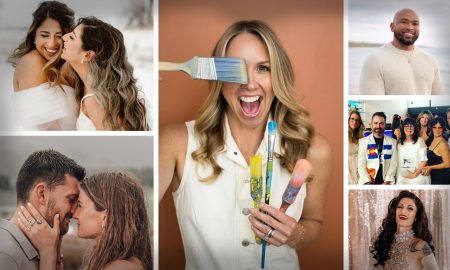


Today we’d like to introduce you to Kendra Hill.
Hi Kendra, thanks for sharing your story with us. To start, maybe you can tell our readers some of your backstory.
To think that my story could be an inspiration to someone is both honoring and terrifying. The part of me that finds this terrifying is the part of me that believes that to be an inspiration to others, you have to have arrived someplace that others wish to go. The part of me that feels honored is the part of me that gets to sit with people day after day and witness their healing process. This part of me knows that there is something sacred about sitting in awe of people in the process. Not people who have arrived, but people who are doing the hard work of looking at their pain and their joys, and learning how to navigate the landscape of themselves through it all.
My story is one filled with adversity that I am still working through daily. I grew up with a father who was ill and in and out of the hospital almost my entire life and a mother who was functioning as a single parent and primary caretaker of her disabled husband. My sister suffered from an unexplained stroke when she was just 22 years old, and I experienced several years of sexual abuse right during my most crucial developmental period. On one hand, when I look back, I see a lot of complex traumas and a lot of emotional needs that couldn’t be met in the environment I was growing up in. On the other hand, I see parents who loved me and a little girl who was determined to thrive.
I took my first psychology class at Mt. Gilead High School in my sophomore year. Intrigued only scratches the surface of what I felt as I began to make my way into the world of human behavior and psyche. I needed more. Not only was I interested in the subject, but I was also subconsciously drawn to finding answers for my own family and my suffering. The next year, I took a college psychology course at the community college 30 minutes away from my small town. I drove after school to Marion Technical College to complete an introduction to psychology course, and it set me on a course to dedicate my career to witnessing people’s pain and joy.
I previously mentioned I endured sexual abuse in my adolescence and this is crucial in understanding what brought me to my current career focus – Religious Trauma. I often reflect on the idea that purity culture (the movement in white evangelical churches in the 1990s and early 2000s promoting sexual purity, pushing promise rings, and treating female virginity like the ultimate prize for a future Christian husband) has been perpetuated by those of us who have histories of sexual abuse. For me, purity culture with all of its rigid rules around sex and modesty, promised a kind of safety in the aftermath of sexual abuse.
I was promised a savior who could touch me emotionally but not physically, and I was in an environment where “my brothers in Christ” were committed to rigid boundaries around physical touch as well. I could breathe, finally. It was safe, but certainly not empowering. What I didn’t realize at the time, was that the messages of purity culture were only the flip side of the same coin as sexual abuse. Women are objectified and blamed for men’s lack of control over their sexual desires, women are held responsible for covering their bodies so as not to “cause their brothers to stumble”, and for me, purity culture kept me from naming the truth that what happened to me was abuse rather than my impurity and sin.
Furthermore, any encouragement to disconnect from your body and its signals can set people up for further abuse. When I finally began processing my abuse during my graduate counseling program at Denver Seminary, I realized that experiences of sexual abuse were not handled well in my church context. There seemed to be a lack of willingness to listen to the stories of victims and themes of victim blaming. This was around the time the Access Hollywood video of Donald Trump was making its rounds on the news outlets and I was witnessing people I trusted, excuse and defend his predatory behavior. I was already questioning the Christian culture I found myself in, but this was a huge point of unraveling for me.
My passions and life experiences brought me full circle when in August of 2022, I met with Casey Bain to discuss starting a private therapy practice. She had started her practice the year before, focused on Religious Trauma and Deconstruction. I had visions to focus on those areas as well but had zero inkling that Casey would trust me enough to ask me to become her partner and co-owner of Unraveling Free. In October 2022, I leaped and partnered with Casey to provide the kind of space to others that I deeply wish I could have had when I was experiencing my unraveling.
While any therapist trained in working with trauma can help people wounded by the church or high-control religion do good work, it can be incredibly healing to sit with someone who understands the complexities of religious trauma, who is familiar with the patterns present in high-control religious environments, who understands the impact of purity culture, and who can create a balance between validating hurtful experiences and appreciating a faith that was once a hugely meaningful part of their lives.
I consider myself a trauma therapist because religious trauma is trauma. I also consider myself honored to be a compassionate witness to other people’s stories. It doesn’t make sense to me that I get to make a living doing something that so enriches my life. I think meeting with humans to hold space for their pain and grief, hope and joy, is one of the most creative and deeply meaningful things I could have chosen to do.
Can you talk to us about the challenges and lessons you’ve learned along the way? Looking back, would you say it’s been easy or smooth in retrospect?
Smooth is not a word I would ever use to describe the road my life has led me down, but I will say, that some of my fondest memories from childhood include summer walks down a dirt road picking wildflowers along the way. The road wasn’t smooth but there was always beauty along the way.
One of my biggest struggles throughout life has been grappling with the ambiguous loss of my dad. When I was seven years old, my dad had his first seizure-like episode which began a spiral into the mysterious medical world. Test after test and hospital visit after hospital visit could not tell us what was happening with my dad’s health.
Before I knew it, he was walking with crutches and we were moving into a one-story house from our split-level home. No more family bike rides, and no more certainty that my dad was untouchable by death. I feared losing him constantly, but in some ways I already had. I lost the dad I once had and struggled to accept the unpredictability and fear that accompanied my relationship with him over the next two and a half decades of my life.
Growing up with an ill parent brought a lot of uncertainty and fear, and on top of that, my parents were constantly fighting – silently or overtly – but I could feel all of it. As a highly sensitive person, I intercepted and stored the tension flying around my home in my body and I began to develop symptoms of anxiety, depression, and digestive issues. I didn’t know how to process all of the complicated emotions I had, so my body took them on for me. Interestingly, I recently learned that this is likely what my dad’s body was doing too.
I’ve experienced such complicated relationships in crucial developmental years and as a result, have struggled hugely with desiring closeness with others while also deeply fearing the potential of them hurting me, using me, or leaving – either literally or figuratively. I developed a lot of strategies to keep people at a distance so that I wouldn’t hurt as much. Thankfully, with the help of some wonderful therapists and friends, I’m finally starting to release myself from the prison of my past and welcome the beauty along the bumpy road.
I’ve always likened myself to a flower in that they can seem alluring but fragile at first glance. The first unexpected gust of wind ripped across the delicate petals and that’s it – destroyed. But what I’m coming to learn is that beauty endures any storm. Flowers have a great strength about them. I envy the flowers because all they know is how to just BE themselves in all their quiet beauty. They push through the dirt and open themselves to the sun. They offer such joy to the world without even knowing their power.
They drink what they need to thrive, and then stand tall, present, and beautiful to the world. I often feel like one of those wildflowers growing despite the external conditions. So many of the circumstances of my life felt like storms threatening to destroy who I thought I could be, my hope for any kind of life worth living on the other side of all the trauma. But like those flowers that grow wildly along the side of the road here I am, and here are you. We still bloom. And may we always be as stubborn as the beauty that makes itself known in the most unexpected places.
Great, so let’s talk business. Can you tell our readers more about what you do and what you think sets you apart from others?
Unraveling Free Therapy & Coaching is operated and run by Casey Bain, both licensed professional counselors in Colorado. Our specialty is in providing a place for the spiritually hurt or homeless to process, heal, and experience freedom.
Casey and I both see adults wishing to process the impacts of purity culture, religious deconstruction, religious trauma, childhood trauma, identity struggles/exploration, LGBTQIA+ experiences, and childhood trauma. I also enjoy working with couples around deconstruction and differing beliefs. It is rare to find a therapy and coaching practice focused so primarily on religious trauma and I am so grateful we get to offer such an important space for people to safely heal and process.
Casey and I offer one-on-one counseling or coaching sessions, occasional retreats, and education around deconstruction and religious trauma on our Instagram page @unravelingfree
Alright, so to wrap up, is there anything else you’d like to share with us?
I live in Aurora, Colorado with my partner, Lance (who is also a therapist), and our rescue dog, Betty.
Pricing:
- $140 per session for individual counseling or coaching sessions.
Contact Info:
- Website: www.unravelingfree.com
- Instagram: @unravelingfree and @wisdom_and_wildflowers


 Image Credits
Haley Hawn Photo
Popular
-

The Trailblazers: Rewriting the Narrative
-

Celebrating the Spotlight: Kaytee Shashore Turns Milestones Into Momentum
-
Humanity in the Machine: Alexander Raye Pimentel’s Cyborg Recall Questions the Cost of a Data‑Driven World
-

Raemi Anderson on Courage, Caution, and Answering the Call of the Landscape
-

Hidden Gems: Local Businesses & Creatives You Should Know


