



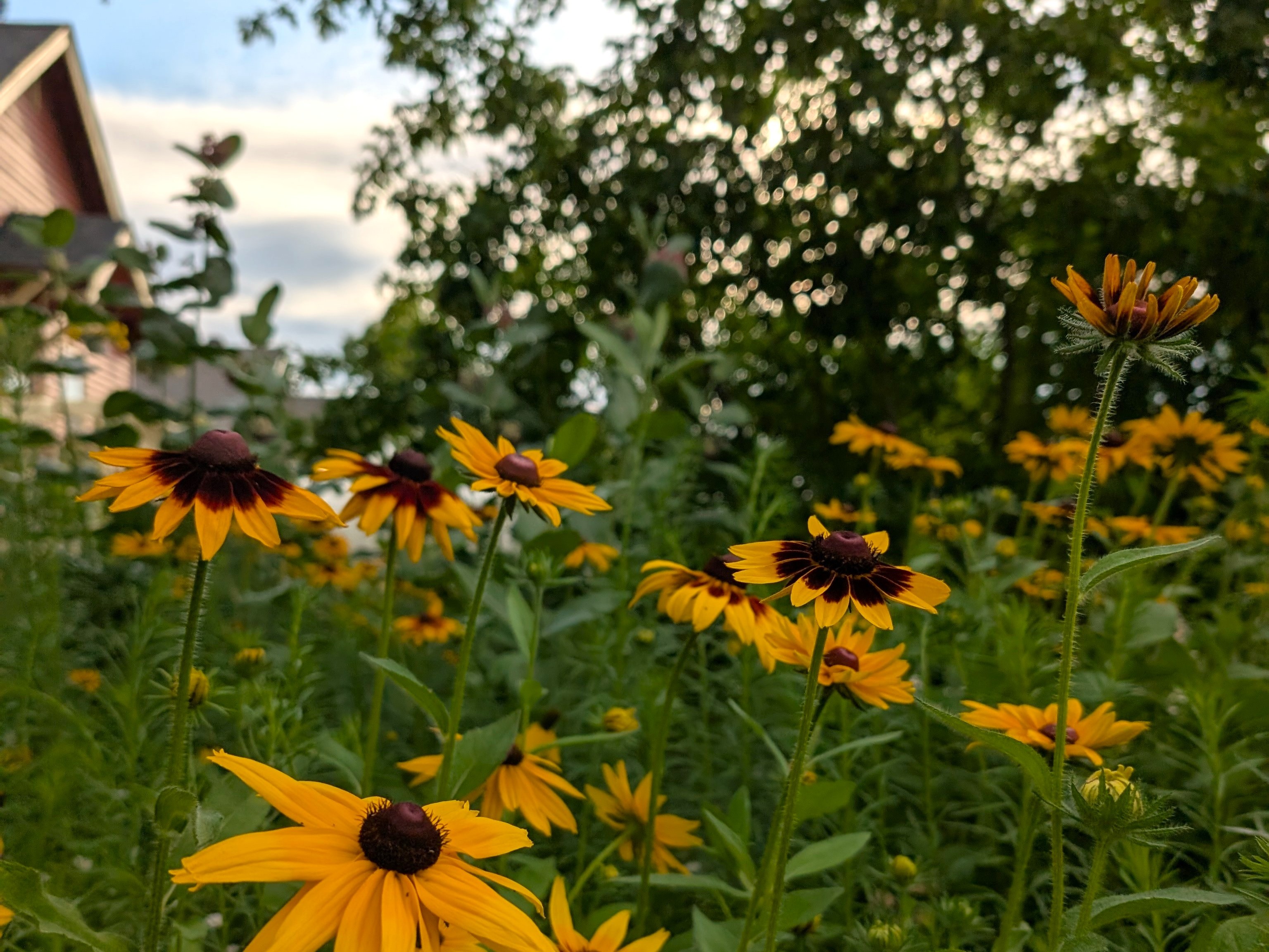
Today we’d like to introduce you to Matthew Fields.
Hi Matthew, it’s an honor to have you on the platform. Thanks for taking the time to share your story with us – to start maybe you can share some of your backstory with our readers?
A sunny spring Saturday is breaking in central Virginia in the mid 90’s. While most children are watching early morning cartoons and eating cereal. I find myself rushing to be outside and playing amongst the natural surroundings. Growing up, I spent many of my days outside, engaging with and noticing the connections of the world around me.
Spring and summer days were spent with my mother and grandmothers in their respective gardens; growing flowers and produce for the family. Alongside the colorful flowers and buzzing bees, these matriarchs shared lessons and experiences. I absorbed these teachings like parched soil after a slow, steady rain.
As a child, dirt was imbedded under my fingernails from playing in the garden. To this day, the smell of soil can trigger a cascade of memories of sunny days in the garden and recollections of these educational women.
Fast forward through a college degree in chemistry, a transcontinental relocation, a baking profession spanning 13 years, certifications in horticulture, and a career with a landscape design firm; I am now owner and lead designer of Fields Landscape Design, LLC.
When starting my landscape calling, I knew education would be a place to begin. College was a place for me to learn about the industry while networking with like-minded individuals.
A job was presented by my teacher in college looking for field labor for her Boulder landscape company. Through my working career, I had always started at the bottom. There is merit in beginning at the lower position. As one gains experience, they are more likely to have a working knowledge of more minute details that paint the bigger picture.
I started working in the landscape industry as a crewperson, digging holes, laying irrigation lines, and moving boulders. Through the physical and practical work, I was able to develop an understanding of what is feasible in landscape design and what requires a bit more engineering.
Quickly, I was promoted to become a landscape estimator and project manager. Though this was not my dream position, I knew it was an important measure to acquire a perception of landscape installation cost based on designs. These insights help when designing, so I am not designing unachievable.
Unexpectedly, my teacher, mentor, and the owner of the landscape company I was working for, passed. A void was filled in the company after the decision was made to keep operating. Leadership was needed and I was promoted to vice president. The other landscape designers at the company eventually retired and I was promoted again to lead designer now holding the role of vice president, lead designer, estimator, and project manager.
Having the opportunity to work in all these positions simultaneously, I realized I could make changes in my small town of Fort Lupton where my partner and I moved to for affordable housing. As we became acquainted with the community, we noticed the traditional methods of landscapes. Fields Landscape Design had prospects to develop and offer native alternatives to landscapes.
My story started with a craving to connect with the flora and fauna in the world. Through education and experience, I grew my understanding of the landscape industry. Fields Landscape Design offers designs and garden coaching to help others feel connected while providing sustainable landscape options.
Would you say it’s been a smooth road, and if not what are some of the biggest challenges you’ve faced along the way?
The journey of becoming an entrepreneur and designer has been steady and without any measure of extreme difficulty. I was fortunate to have the opportunity and privilege to be educated and be a part of a network of like-minded contemporaries that encouraged and inspired my professional advancement. This network provided exuberant knowledge and led the conversation on sustainability in Colorado landscapes.
Obviously, there are day-to-day challenges when operating a business, tracking down outstanding invoices or muddling through project delays. Unfortunately, not all these snags can be planned despite attempting. However, being able to be flexible and adaptable helps to overcome these obstacles.
Another challenge that can slow projects is unsure decisions amongst clients. Internal disagreements can lead to a thorny situation if a designer is brought into the conversation to function as a mediator. As a business practice, we give the client time to evaluate the design before we review together. This offers an opportunity to generate questions, thoughts, or concerns before we convene.
Being in seasonal dependent profession, winters can be challenging. When the weather turns colder, the days grow shorter, and nature goes dormant, most people are not pondering their landscapes. Time is spent indoors, especially with Colorado’s unpredictable winter weather. Seasonal work can mean slower or inconsistent workflows. When there is a slower period, we use the prospect to read current publications on sustainable design, attend native plant seminars, network with colleagues, or simply play with new software or design techniques. Winter is a brilliant time to prepare for the year to come.
Recession leads to tight purses, having survived through the baking business and landscape business over the past two decades. With the rising cost in materials and labor scarcity, the cost of landscape installation is increasing. A client may have grandiose ideas for their space, and from time to time, projects struggle to meet all the clients’ wish lists while staying within budget. We collaborate with clients to determine realistic expectations. With our design process, we prioritize the landscape needs and offer phasing plans to accommodate the budget.
When competing in an over-saturated market, it can be difficult to stand out from the rest. Finding a niche is imperative. At Fields Landscape Design, we specialize in creating bespoke designs tailored to each client’s individual needs and preferences while focusing on sustainability and xeric plant driven designs. Our collaborative approach ensures that you are actively involved in selecting plants that bring you joy, while still benefiting from water conservation and native plant expertise.
Great, so let’s talk business. Can you tell our readers more about what you do and what you think sets you apart from others?
Fields Landscape Design is a business dedicated to sustainable, water-wise landscape design in Colorado, particularly in the context of Colorado’s precious water resources. Our primary mission is to offer beautiful and native alternatives to conventional landscapes, focusing on water conservation that helps with the preservation of the rapidly depleting Colorado River. We believe xeric landscapes can be lush and vibrant, not barren rock yards.
Each of our designs is bespoke, created in close collaboration with clients to ensure their vision is realized while incorporating plants that provide multi-seasonal interest. We aim to design landscapes that connect people with their plants and local wildlife.
Our approach to landscape design breaks the design process into smaller phases allowing us to stay in alignment with the client and prevent larger projects from feeling overwhelming.
The design process begins with an initial site consultation where we discuss your goals and desires for your landscape. Following this, we develop a tailored design proposal outlining the scope of work, design phases, and fee structure. An initial landscape design will be presented that generalizes the landscapes before getting into the finer details. Next, we meet and review with the client. The design process covers a working revision to make any revisions and a planting plan used for client collaboration. As we work through the design phase, more details are determined. Lastly, a Landscape Design Package is presented that will include a multiple page document with details needed for bidding and installation.
Education is a cornerstone of our business. We provide clients with a realistic understanding of various landscape elements, discussing both the advantages and drawbacks to help set expectations and facilitate informed decision-making. As the landscape industry evolves, Fields Landscape Design remains at the forefront by integrating the latest native and xeric plant options available. We also prioritize supporting local Colorado businesses by sourcing plants from local nurseries.
Fields Landscape Design is committed to reimagining Colorado landscapes to conserve precious resources. Our designs aim to redefine Colorado landscapes, emphasizing the critical importance of resource conservation. Transforming our landscapes begins with informed choices and community engagement. We believe a thoughtfully designed landscape can foster a deeper connection between people, community, plants, and local wildlife.
Can you talk to us a bit about happiness and what makes you happy?
There is joy in creating a space for humans to reconnect and notice the nuances of landscapes. In this fast-paced world, noticing the mundane can add pleasure and whimsy to life. I find glee and delight when species are spotted in new landscapes where there previously were none; knowing the miracles and harmony need to sustain diversity.
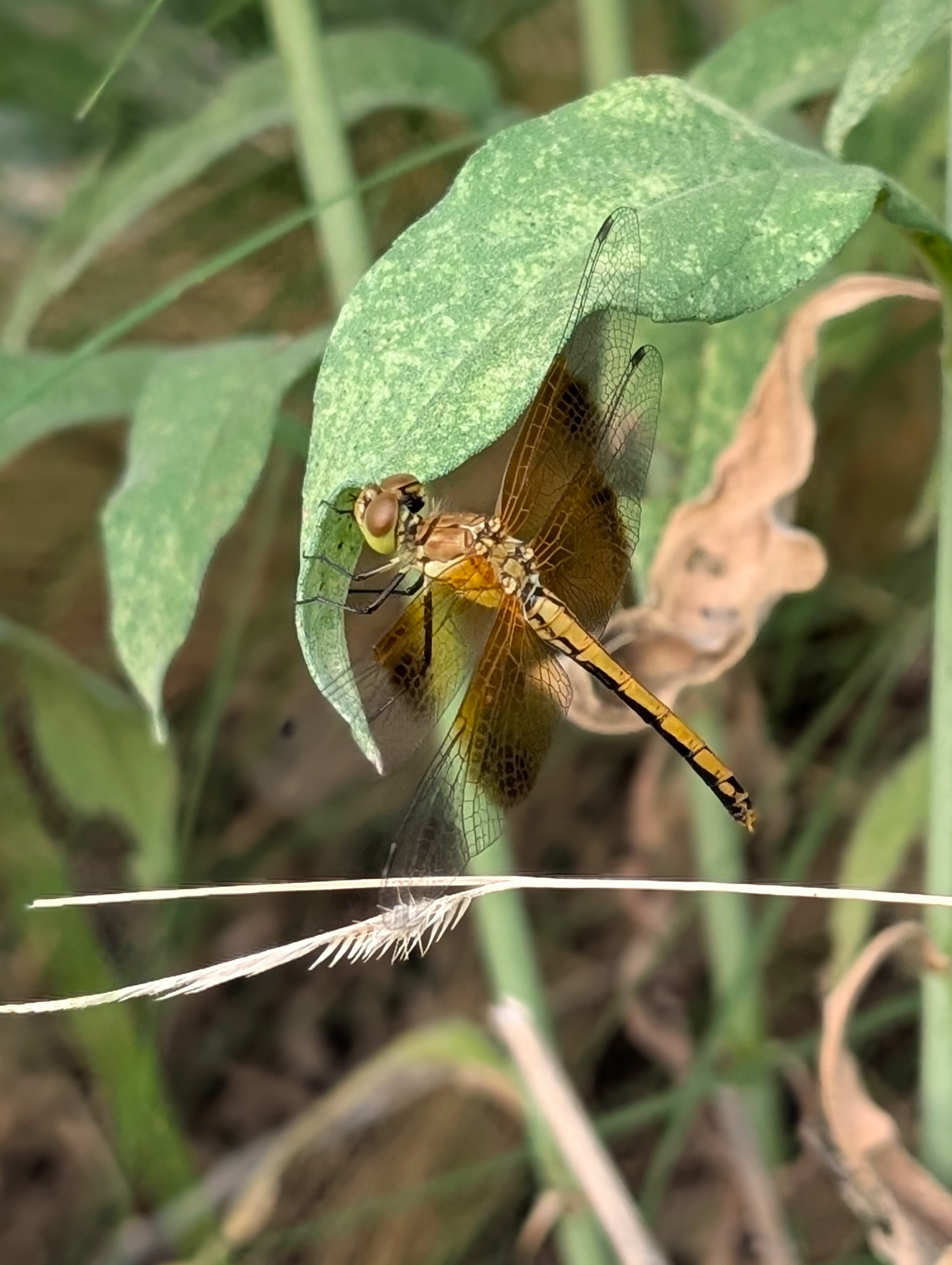
In a front yard meadow garden, a Band-winged Meadowhawk – Sympetrum semicinctum is on the Maximilian Sunflower – Helianthus maximiliani leaf. These insects are beneficial that are non-aggressive and often indicate a healthy and vibrant ecosystem. Most often found in meadows and woodlands, these meadowhawks are predatory and eat other harmful insects like mosquitoes.
In ecosystems, energy can be thought of as trophic levels. Using an over-simplification, the trophic levels start with plants and photosynthesis where they create their own food source as sugar. These plants can then use this sugar for consumption as an energy source with great efficiency.
The second trophic level would be herbivores (grasshoppers, rabbits, etc.) that eat the plants. The tertiary or more levels will have various predators (predatory wasps, meadowhawks, falcons, wolves, etc.) that then consume the herbivores. Imagine a food web from grade school.
As energy is passed through these trophic levels, much of it is lost to cell respiration, metabolism, or thermodynamics. This means that for a predator to be a part of the ecosystem, there needs to be sufficient energy from the lower trophic levels. Sufficient energy comes from healthy and diversified ecosystems that can host larger predators.
Healthy ecosystems can be created in our landscapes by introducing native plants that encourage lower trophic levels. When there is a food source, the predators will come. Seeing a meadowhawk land on a native wildflower indicates that the garden can sustain additional trophic levels and create a more diverse local ecosystem.
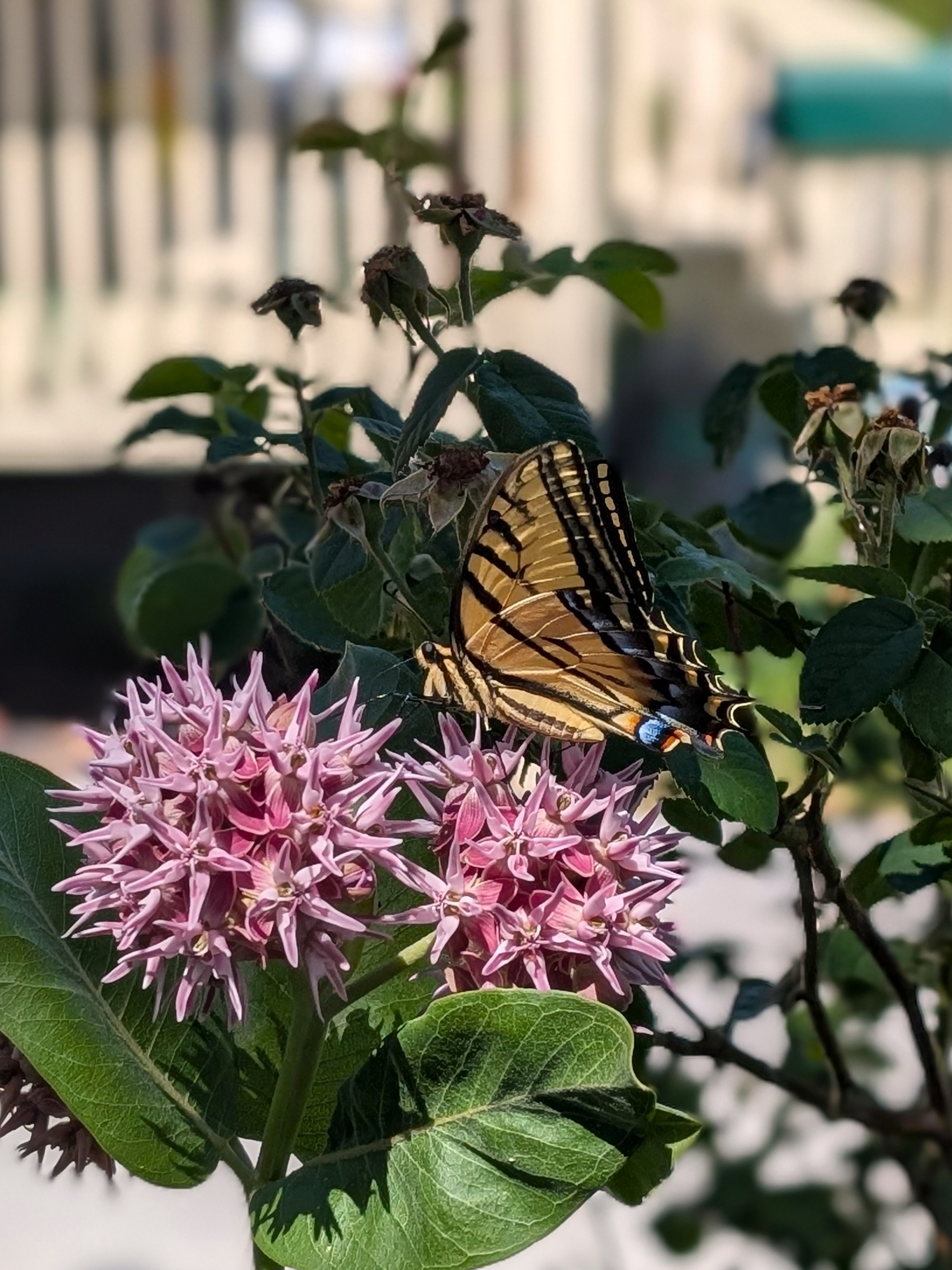
There is a sense of accomplishment and pride when a landscape design is installed and can offer abundance to humans and the natural surroundings. Encouraging landscapes and seeing the results of diversification of the small-scale ecosystem brings joy. When I witness a butterfly landing on milkweed, I feel bliss knowing the harmony of life and education.
Pricing:
- OVERALL: $1300-$2400
- Site Consultation: $80 per hour with 1 hour minimum, *credited on Landscape Design Package invoice
- Initial Landscape Concept: $275-$450
- Working Revision and Planting Plan: $375-$550
- Landscape Design Package: $650-$1400 (*with Site Consultation credit $570-$1320)
Contact Info:
- Website: https://www.fieldslandscapedesign.com/
- Instagram: https://www.instagram.com/fieldslandscapedesign/
- Facebook: https://www.facebook.com/FieldsLandscapeDesign
- LinkedIn: https://www.linkedin.com/in/matthew-fields-294226113/



Popular
-

The Trailblazers: Rewriting the Narrative
-

Celebrating the Spotlight: Kaytee Shashore Turns Milestones Into Momentum
-

Humanity in the Machine: Alexander Raye Pimentel’s Cyborg Recall Questions the Cost of a Data‑Driven World
-

Raemi Anderson on Courage, Caution, and Answering the Call of the Landscape
-

Hidden Gems: Local Businesses & Creatives You Should Know


