
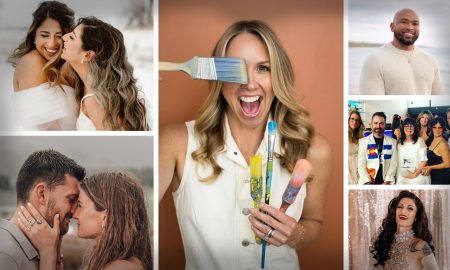


Today we’d like to introduce you to RACHEL Brownlee.
Hi RACHEL, please kick things off for us with an introduction to yourself and your story.
Rachel Brownlee was raised on a family ranch in western Nebraska. She is a fifth generation rancher, descended from Old Jules Sandoz, subject of the Mari Sandoz books, who originally emigrated from Switzerland. She was home educated with her six siblings. All their cattle work was done horseback and she and her siblings spent most of their life doing ranch work. There was no art education available and Rachel was essentially exposed to no other artwork than some books about equine composition until after college.
She attended college at the University of Nebraska at Omaha obtaining a degree in computer science. Rachel worked as a software engineer in Omaha for two years before returning to the Sandhills of Nebraska with her husband and daughter and son. The family ranch has 1200 cattle. From there comes her inspiration and motivation to document the living west.
From a young age everyone commented on Rachel’s early talent in drawing. It was a prominently God given gift. In 2019 she felt led to pursue artwork as an occupation after a local librarian encouraged her that her work “was actually quite good”. Her first professional show was September 2020 and her first national show was November 2021.
Rachel’s rocket ship career, going from doing nothing professionally to winning the best of show award at the Mountain Oyster Club Art Sale in one year, is evidence of God’s hand over her work. Since then, Rachel’s work is represented in five of the nation’s best western art galleries. Her work is in 14 shows every year, and has won many awards.
Would you say it’s been a smooth road, and if not what are some of the biggest challenges you’ve faced along the way?
No journey is smooth unfortunately! My road was going in a very different direction. I intended to pursue a career in software engineering, possibly software development management. Instead, I moved home to a family cattle ranch to work remotely. Then in 2021, several people encouraged me to start drawing more seriously. I knew nothing about the world of fine art. My career suddenly took off, but I had no idea how to “do” the business side of fine art. The last four years have felt like swimming across an ocean learning to navigate sales, legal matters, accounting, politics within the business, in addition to the technical skills of the artwork! I have learned so much and make mistakes along the way. Thankfully I was able to learn from them and find mentors to help me improve.
Thanks – so what else should our readers know about your work and what you’re currently focused on?
It is commonly said that an artist’s work reveals what is inside the artist. My work is precise; highly detailed; and exacting, both to create and to look at. In fact, I often feel my work is painful in a way. The detail I create requires such time and effort and mental exertion. Most of my pieces hanging on a wall don’t create a feeling of rest like much fine art does; instead, I feel that my work requires a response from it’s viewer. The content of my work is the living west as seen through my eyes, so almost all of my pieces feature people I know and my own family ranch. I want my viewers to see that the “historical west” is living and alive today participating in agriculture very nearly as it was 100 years ago. Technically, I have pushed the boundaries of charcoal artwork with my new style of drawing directly onto a gessoed panel and then varnishing it like an oil painting. It allows the viewer to be much closer to the work. It is more intimate. I love my work and I am blessed to be able to stand at my easel every day and depict living legends like my neighbors and the saddles that have worked nearly as long as cowboys have been running cattle in the Nebraska Sandhills.
Where do you see things going in the next 5-10 years?
Artificial Intelligence, AI, is bringing new opportunities and challenges to most industries right now, and that includes the fine arts. I think AI is a wonderful tool and will make many new things possible, but I am not worried about its affect on my industry personally. Fine art survived the advent of photography and Photoshop. People value the handmade creation of fine art and of seeing through an artist’s eyes. They value the lives and stories of artists as they weave those lives into a canvas or a painting. Fine art isn’t a life necessity; it is a luxury. I think it will continue to be so. As the older generation gives way to a coming generation, tastes in fine art will likely change, but ideally so will the artists and the stories they tell.
Contact Info:
- Website: https://rachelbrownlee.com
- Instagram: https://instagram.com/rachel.l.brownlee
- Facebook: https://facebook.com/brownleefineart


Image Credits
All images are mine.
Popular
-

The Trailblazers: Rewriting the Narrative
-

Celebrating the Spotlight: Kaytee Shashore Turns Milestones Into Momentum
-
Humanity in the Machine: Alexander Raye Pimentel’s Cyborg Recall Questions the Cost of a Data‑Driven World
-
Raemi Anderson on Courage, Caution, and Answering the Call of the Landscape
-

Hidden Gems: Local Businesses & Creatives You Should Know


