



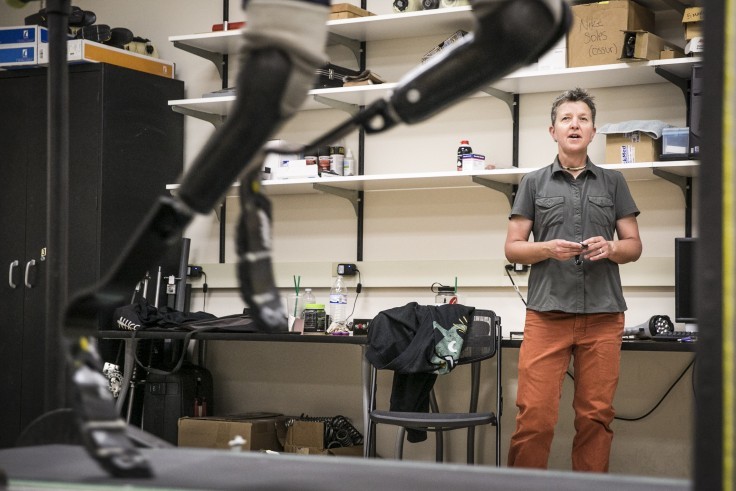
Today, we’d like to introduce you to Alena Grabowski.
Hi Alena, can you start by introducing yourself? We’d love to learn more about how you got to where you are today.
I moved to Colorado about 30 years ago to follow my passion for skiing. At the time I was a music major in my third year of my undergraduate education and an athlete. After establishing residency in Colorado, I had intended on finishing my degree in music.
During the year of establishing residency, I worked part-time as a trumpet player in a Mariachi band at Casa Bonita! That experience was pivotal on a number of levels. However, I learned that earning a living as a musician was not for me, so I decided to go back to school to study kinesiology, which captivated my love of sports. I graduated from CU Boulder with my undergraduate degree in Kinesiology and went on to pursue a Ph.D. in Kinesiology and specifically Biomechanics from CU Boulder.
After graduating with a Ph.D., I took a position as a postdoctoral fellow at MIT in the Biomechatronics Group with Hugh Herr to work on research related to the use of lower limb prostheses and exoskeletons. During this time, I was fortunate to work with and conduct a research project on Oscar Pistorius, a sprinter from South Africa who ran a 400 m time that qualified him to compete in the Olympic Games. Oscar had both his legs amputated below the knees at an early age and used running prostheses.
The research that we completed with Oscar allowed him to compete in the Olympic Games in 2012. However, there were still many questions that arose related to the use of running prostheses and whether athletes using running prostheses should be allowed to compete in internationally sanctioned events.
The questions about how the use of running prostheses affects performance set the course for my research career, and I moved back to Boulder to pursue a position as a professor at CU, which is where I am today.
Would you say it’s been a smooth road, and if not, what are some of the biggest challenges you’ve faced along the way?
As a scientist, I never dreamt that I would be testifying in the Court of Arbitration for Sport (CAS), which is the highest court that hears cases regarding international competition in the Olympic Games.
However, I have served as an expert witness and testified twice in CAS on behalf of Blake Leeper, a US athlete who had to have both legs amputated below the knees at a very young age. Blake uses running prostheses to be able to run and sprint and has run a faster 400 m time than Oscar Pistorius. Blake qualified to compete in the Olympic Games in 2020.
In order for an athlete with below-the-knee amputations who uses running prostheses to compete in the Olympic Games, they must show that the use of prostheses does not provide them with an advantage compared to an athlete not using prostheses.
Despite the scientific evidence and data that were presented to the highest court in track and field that showed that the use of running prostheses does not provide an advantage in a 400 m sprint, Blake was not allowed to compete.
I appreciate you sharing that. What else should we know about what you do?
I have always been passionate about running and skiing and am lucky enough to blend my passion with my work. I’m a professor at the University of Colorado Boulder in the Department of Integrative Physiology and a researcher for the Department of Veterans Affairs in Denver. I study biomechanics and physiology, which means that I study how people move and the energy required to move.
I’m captivated by how the use of mechanical devices affects the way that people move and have completed research experiments that determined the effects of using lower limb devices like prostheses, exoskeletons, and footwear on walking, hopping, jumping, running, sprinting, cycling, skating, and soccer. I’ve also had the opportunity to work with a large range of people, from those who are barely able to walk to the fastest sprinters in the world (with below-the-knee amputations).
I’ve presented my research to the governing bodies of the National Collegiate Athletics Association, the Boston Marathon, and World Athletics. Numerous athletes with leg amputations have been allowed to compete in track events within the NCAA as scholarship athletes, and there is now an adaptive athlete division within most major international marathon competitions.
The crisis has affected us all in different ways.
How has it affected you, and can you share any important lessons or epiphanies with us?
My experiences with testifying in the CAS have served as a learning experience and continue to motivate me to keep publishing scientific research.
I also plan to continue to work with people and athletes with and without physical impairments to better understand how the use of different mechanical devices affects performance. I hope to see the day when devices such as running prostheses can outperform biological legs, but we are still a long way from that day.
Contact Info:


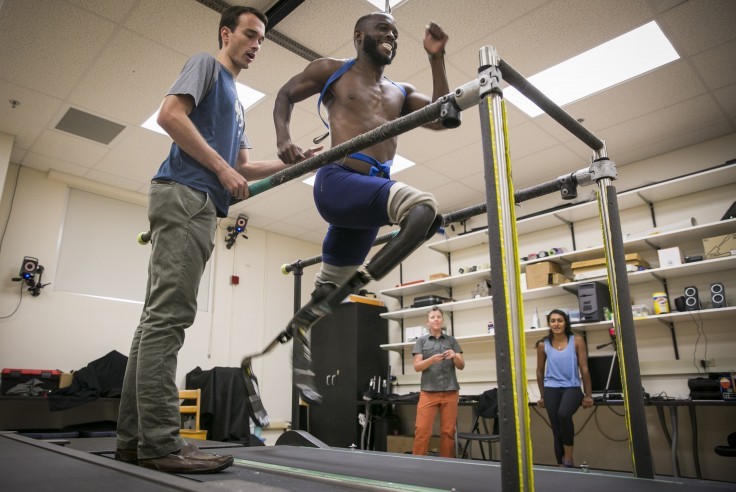


Image Credits
Blake Leeper, Nathaniel Minor/CPR News, and Glenn Asakawa/University of Colorado Boulder
Popular
-

The Trailblazers: Rewriting the Narrative
-

Celebrating the Spotlight: Kaytee Shashore Turns Milestones Into Momentum
-

Humanity in the Machine: Alexander Raye Pimentel’s Cyborg Recall Questions the Cost of a Data‑Driven World
-

Raemi Anderson on Courage, Caution, and Answering the Call of the Landscape
-

Hidden Gems: Local Businesses & Creatives You Should Know


