
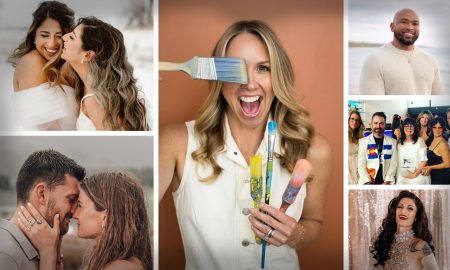


Today we’d like to introduce you to Brittnie Ayres.
Alright, so thank you so much for sharing your story and insight with our readers. To kick things off, can you tell us a bit about how you got started?
My mom and I used to color with crayons together (cerulean was my favorite color)–that’s where it started. Fast forward to college (CSU FoCo), and I started off studying art history and painting. A little voice told me I should switch my focus to graphic design, and I’m grateful I did. In college, I wasn’t ready to express myself or create my own products through visual arts. What I was called to do, instead, is creative problem solving and visual storytelling. The stories we tell and the experiences we have make up the meaning of life. I’m passionate about spending my time crafting stories and experiences that delight, inspire, and activate audiences through thoughtful design and copy.
As a competitive and ambitious 22 years old, I hit the ground running before graduating. To climb the ladder from humble beginnings to early retirement, I knew I was going to have to work really really hard to build my skills and stand out in a competitive design field. There were internships, clubs, and eventually, I started making connections that would be the groundwork for building my client base. After freelancing and interning a bit, I got my first full-time job at YS Magazine, a Boulder County regional magazine, as a graphic designer and, eventually, art director. This was a juicy period of learning and flexing my passion for being as wildly creative as possible, no matter how tight the budget or deadline. It was also a great opportunity to work on a team and manage many moving parts. After two years of overnights and 70-hour weeks, I left and enrolled at Front Range Community College to pursue some videography and editing skills, and to find some work/life balance. In so doing, I tripped and fell into freelancing for 3.5 years. Kim Kelley of Ali’i Marketing was the first to take a chance on me. We still work together to this day on some of the best radiology branding the world ever did see. Others followed and freelancing just fit.
The management of a design business, and the variety of projects therein, gave me the chance to use both sides of my brain, and feel truly engaged. Eventually, I missed working closely with an in-person team and accepted a design position at Gaia, where I got to work alongside very talented marketers, product engineers, and video production teams. I branded new series, designed covers and related art (like you see on Netflix), and helped with set design from time to time. I even did criminal-style sketches and renderings of aliens, as described by a man who claimed to be abducted. There was never a dull day, and no two days the same. Gaia is a place where meditation, walking the labyrinth, and moon ceremonies with your coworkers are part of a normal day. It was awesome.
When career growth was no longer possible at Gaia, I leapt back into the arms of my own business, rebranded as Ayr Creative, and began taking on brand projects again, in addition to websites, presentation decks, events, and more. I really felt like I had ‘made it’ when I was flown to an event in Miami just so I could see my work in environment graphics and set design from the previous year in action. It was a proud moment, and lovely to meet all the wonderful people I had been in constant communication with only virtually. I think past Brittnie would have been proud.
My passion and preference is to work with companies and organizations that are environmentally and socially conscious. I’m driven to contribute to thoughtful, focused brands and campaigns in a way that authentically connects audiences to their brand and product communities, without cluttering marketing platforms and mindshare with noise.
We all face challenges, but looking back would you describe it as a relatively smooth road?
Some struggle is normal. Sometimes it’s too much or not enough. 2021 was too much. A couple of years ago, I worked with an amazing business and life coach, Sierra Goldstein, in order to focus on my business goals, and craft my day-to-day life in a way that would maximize my engagement with work, and allow me to be of greater use to the world. No big deal right? In an attempt to focus more on creative direction and innovative projects, I started bringing on other freelance designers to help accomplish my client’s day-to-day needs and more junior projects. I also brought on a bookkeeper because the admin was sucking up too much of my time, as finances became more complex with the addition of new contracts and contractors. About six months later, I was more miserable than I have ever been in my career–even compared to watching the sun come up on deadline–though, that, too, would be harder in my thirties than it was in my twenties. Trying to manage contractors effectively while trying to be brilliant in my own projects proved to be derailing my end goal and was energetically unsustainable. The speed at which I had to work each day rose and rose until finally, I started having panic attacks for the first time in a decade. It was a wonderful, proud feeling to have enough momentum in business that I could grow it on a whim. But it was one of the most humbling experiences of my life. Though I was playing to my strengths, they didn’t all play nice together. I’m a mentor and a creative director at heart—not an account manager. The same coach who helped me ramp up my business also supported me in ramping it down. That being said, the bookkeeper stays forever. Shoutout to Evan Olson, who repeatedly pays for himself by finding things I forgot to charge for.
I even took a month off last summer to do a yoga teacher training intensive, which was oh so good for my mind, body, and soul. The level of support I received from clients because they cared about my long-term effectiveness over short-term inconvenience, made my heart swell. Brian Owens, CIO of Bendcare, tells me “If this is good for you, it’s good for me…You’re stuck with me for life.” This is the kind of codependence I desire with my clients.
The lesson I learned these last couple of years, though I’m still unpacking it all, is that if I want to keep designing AND growing my business, I need additional creatives, as well as an account manager or partner. Perhaps this will be in store for 2023.
As you know, we’re big fans of you and your work. For our readers who might not be as familiar what can you tell them about what you do?
What I live for day to day is working with clients to define parameters for projects, inside of which I get to strategize and play toward an end product that suits their needs, goals, budget, timeline, tastes, and any other myriad of factors. This dynamic constantly pushes me as a creative professional, because I’m always learning about new industries and challenges, and never get to use the same styles and techniques twice. What I’ve found over the years is that I’m pretty decent at creative writing (for marketing) as well, and am unable to separate copy direction from art direction–they are united as one beast. Throughout my career, my role in projects has flip-flopped between creative direction and design, or some combination of the two. And by starting Ayr Creative, I get to manage projects to my standards, get close to my clients, and grow and shrink my team as needed. Ayr Creative works with organizations big and small all over the country. Some local past and present accounts include: Rocky Mountain Institute, University of Colorado, Gaia, Dancing Pines Distillery, What We Love Winery, Thunder River Theatre Company, Western Colorado Radiology Associates, and Mountain View Fire Rescue.
My day-to-day has looked very different over the years. These days, I’m usually working on fundraising decks, research reports with infographics, web designs, and logo designs. My favorite days this year involve diving deep into user flow strategy or hand lettering. Other things that historically get me salivating include set design or art direction, and packaging design. And I will never stop being obsessed with logos, logos, logos!
What has been the most important lesson you’ve learned along your journey?
As a competitive and ambitious creative, the most important lesson I’ve learned is to avoid burnout. I’ve learned this the hard way twice in my career. The most important tools a designer has are their mind, body, and soul. My toolkit includes sleep, yoga, meditation, gardening, cooking, and cat naps (usually with my actual cat). Winding up with coffee and winding down with whiskey in order to work long hours may have helped establish me as a designer, but is not sustainable. To make a good living as a designer without sacrificing other areas of life, it is important to know one’s worth and strategize accordingly. My focus in the last few years has been to get paid more to do less. It’s important to transition from getting paid for activity, to getting paid for your talent and your mind. When non-work areas of my life were sacrificed, like sleep and connections, my work, and I, suffered. It took my husband and some dear friends to help me realize I wasn’t getting paid enough per hour or per project. Once I believed them, I discovered there are accounts out there that are more than happy to pay good money for a well-rested and professional designer who gets results.
Another lesson I’ve picked up along the way is that no one gets anywhere alone. At the center of my career and creative philosophy is that nothing is created from nothing. I didn’t build success alone; there were mentors, support systems, nemeses, and plenty of people willing to take a chance on me. Same goes for my art and my work–every single creation is inspired by something else. I believe honoring and having gratitude for the people, places, events, and evolutions that took place so our minds could be sparked with creative energy is an important part of the creative process. Sort of like praying to some sort of deity of creativity. Read “Big Magic” by Elizabeth Gilbert for her uncommon insight into harnessing the elusive and wild ways of creative energy.
Important note: Being inspired by someone else’s work is different from stealing someone else’s work. When you aren’t sure whether you are inspired by or copying someone else’s work, check copyright laws, as well as your conscience. When in doubt, throw it out.
One lesson I’ve learned but have yet to even begin to resolve is the importance of showing my work. Furthermore, it’s best for designers to set up projects for eventual portfolio use as we go, lest we end up with 80 hours of portfolio updating to do each year. Check out Adam Vicarel’s Instagram for inspiration on how to do this REALLY well!
Contact Info:
- Email: BRITTNIEA@GMAIL.COM
- Website: ayrcreativellc.com
- Instagram: https://www.instagram.com/brittnieayres/


Suggest a Story: VoyageDenver is built on recommendations from the community; it’s how we uncover hidden gems, so if you or someone you know deserves recognition please let us know here.
Popular
-

The Trailblazers: Rewriting the Narrative
-

Celebrating the Spotlight: Kaytee Shashore Turns Milestones Into Momentum
-

Humanity in the Machine: Alexander Raye Pimentel’s Cyborg Recall Questions the Cost of a Data‑Driven World
-

Raemi Anderson on Courage, Caution, and Answering the Call of the Landscape
-

Hidden Gems: Local Businesses & Creatives You Should Know


