
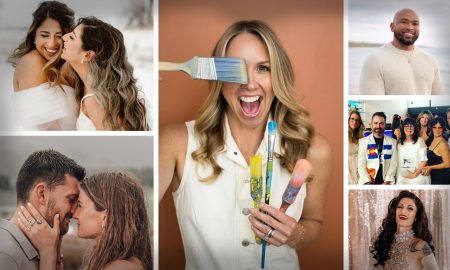


Today we’d like to introduce you to Trish Gans.
Hi Trish, we’d love for you to start by introducing yourself.
I studied art and art education in undergrad. As one of my work study jobs I was sent to the “ceramic department” on campus. No idea at the time what this was
(I was thinking of being a French major?) My job consisted of dumping the slop buckets from the kick wheels in to a pug mill and recycling the “clay”. Again, had NO IDEA what “clay” meant to say nothing of throwing. At least it was a lot more fascinating then working the college switchboard or…I was earning money to compensate for the tuition cost.I was hooked.
Upon graduation I taught at an elementary school and continued teaching all grade levels, teachers, workshops until I retired. Since then, I volunteer for art teachers in public schools.
Once I left teaching full time, I decided to take clay classes to start my own work and loved working in artists’ studios learning from their clay practice and developing my skills. I have always been fascinated by the many properties of clay. Surface treatments, cold finishes, hand building, throwing, practicing numerous firing techniques are just some examples of my passion.
I have my own studio in my garage and now mostly do slab building and press molds. Not being afraid to experiment and “relook” at work is my mantra. I also love creating multiples of the same form.
Alright, so let’s dig a little deeper into the story – has it been an easy path overall and if not, what were the challenges you’ve had to overcome?
It has been a great trip- my students I taught always had their own “answer” they would create in response to a project I introduced. Several years in to my career I realized the importance of sketchbooks. As I emphasized this in my classroom I also practiced this more frequently myself. I was adamant that each child had his/her own sketchbook. The use of sketchbooks also became a great reflection and documentation tool for them and “pushed me” to make sketchbooks a daily practice.
I have never thought of my development as an artist as a struggle. I was VERY challenged in the daily routine of the demands of a teacher with high standards. I was so busy thinking through how to teach various techniques effectively to so many students daily that my own work was my classroom demonstrations. Once I left the classroom it was very easy for me to stay open to working freely with the many facets of clay. Again, I have my elementary students and numerous others I have taught to thank for observing their work process. I have NEVER found clay to be intimidating or boring. I embrace the numerous possibilities directions and potential of each concept. I LOVE making multiples of forms to investigate the clay.
For the past 10 years, my work has included lots of materials. Again, I found various alternatives and considerations in constructing and reworking my “idea” for a piece.I find creating takes practice and reflection.
Appreciate you sharing that. What else should we know about what you do?
I think what sets me apart from others is my openness to create using so many different materials. Another aspect of my work practice is that I am constantly searching for new techniques to try, ways I can learn as an artist. The standard question I am asked is “so, what are you working on now?” because I have done such a wide range of projects throughout my career. A collector of my work commented as follows “I’ve aways been impressed with the diverse pieces of art and media that Trish comes up with. What comes to mind is truly an array of originality from painting, to clay, to mixed media.” Another collector commented that what she thinks what sets my work apart is my ability to use materials that I have collected to create stories. Her thinking is that my pieces are very successful in making interesting connections with my viewers.
As mentioned, after undergraduate, I entered the field of art education and was fascinated by students’ approaches to one problem or one project. I also was constantly fascinated by master artist’s approaches, their “reasons” to create in a certain manner. I think having that thirst for technique and trying to understand their thought processes I have explored and worked in numerous media which in turn strengthens my approach. I welcome various opportunities to work in artist’s studios, take classes, try numerous “hands on” workshops from very reputable artists. Recently I enrolled in a class on Abstract Expressionism. I have never been attracted to or understood abstract art. However, I decided I wanted to leave myself open. Consequently, I have been applying the knowledge from these classes. As I approach my current work, I see how this knowledge is affecting my way of thinking in a fun, affective way.
A student has described my teaching style as “inspiring both children and adults to tap into their creative talents in ways they never thought possible.” I enjoy sharing my love of experimenting with art and exploring new techniques with students and in that way my students grow in their abilities to express themselves.
We love surprises, fun facts and unexpected stories. Is there something you can share that might surprise us?
I love to create with lightheartedness and experimentation. In this manner I often create work that tells a story. As I mentioned earlier, I also love making multiples. I find many possibilities in say, creating the same form in many different ways using many different techniques.
I am very intuitive. Often, when thinking through how to go about creating, I can predict some of the challenges but they don’t phase me. I don’t mind working hard and/or working through challenges.
My family is known for manufacturing vanilla extract. Our business was started in 1888. Each bottle is hand bottled, labeled, sealed, and boxed. Very repetitive, tedious work. My work space was in the back of my family store. I started working every day after school since the third grade. I hated the work (very dark room and very boring.) I learned early on to use my imagination to create diversions and make up scenarios.It was expected.
In addition, I lived in a chaotic household with four siblings and a very creative mom. We were more often than not surrounded by “projects in progress”. Many chairs had stacks of fabric, upholstery pinned on to overstuffed chairs. My mom taught me my love of sewing, how to “construct” using fabrics.
Contact Info:
- Instagram: @trishgans
- Facebook: Patricia Moffatt Gans


Popular
-

The Trailblazers: Rewriting the Narrative
-

Celebrating the Spotlight: Kaytee Shashore Turns Milestones Into Momentum
-

Humanity in the Machine: Alexander Raye Pimentel’s Cyborg Recall Questions the Cost of a Data‑Driven World
-

Raemi Anderson on Courage, Caution, and Answering the Call of the Landscape
-

Hidden Gems: Local Businesses & Creatives You Should Know


