

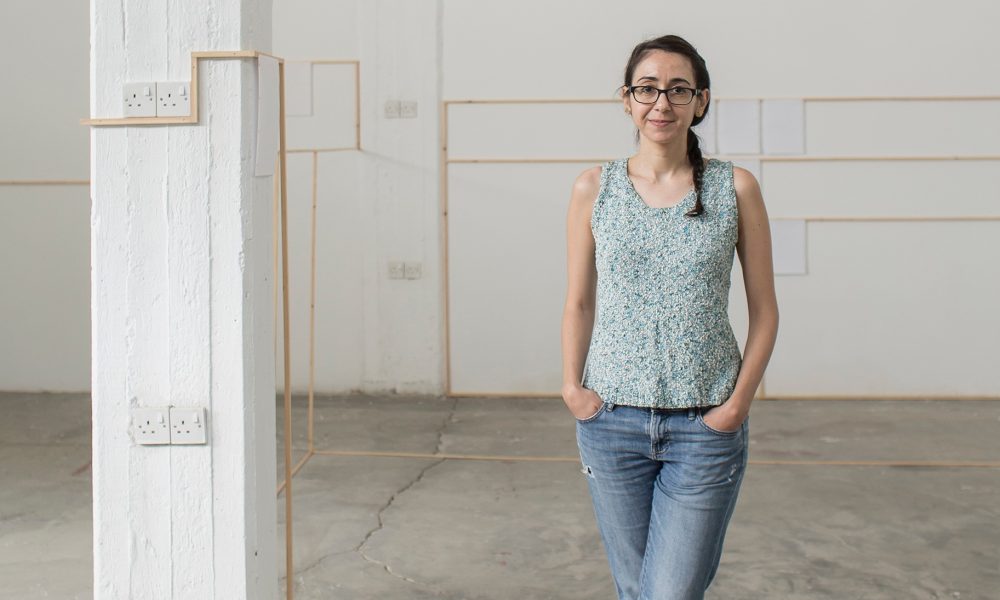
Today we’d like to introduce you to Marina Kassianidou
Hi Marina, so excited to have you with us today. What can you tell us about your story?
I am a visual artist and an Assistant Professor in Art Practices at the University of Colorado Boulder. I was born and raised in Cyprus, a small island in the eastern Mediterranean. Ever since I was little, my family encouraged me to draw and paint, and that’s how I spent most of my time. Both of my grandmothers painted, embroidered, and crocheted, and one of my aunts is an artist, so I grew up surrounded by their works. At some point, I began taking art classes at the studio of a local artist, Andreas Cleovoulou, and I did that until college. When the time came to college, I didn’t know what I wanted to major in–I enjoyed art, but I didn’t know if I wanted to pursue it professionally. I also enjoyed other subjects, such as history and computer science. My mom, a high school teacher, suggested I look at colleges in the USA since the educational system here is more flexible and allows you to choose a major in your second year and pursue a double major. I applied for and was awarded a scholarship through the Fulbright Commission, and that’s what enabled me to come to the US in 1998. I went to Stanford University, where I double-majored in Computer Science and Studio Art. While at Stanford, I realized that I wanted to be an artist professionally and that I wanted to teach at the university level. I think that realization came about through interacting with people like Enrique Chagoya, my advisor. He and the other professors, who were both practicing artists and educators, became my role models. Enrique encouraged me to go to graduate school and get a Master of Fine Arts (MFA) degree. I decided to do that in London, UK, partly because of immigration reasons and partly because I always wanted to experience life in London–the city has an extremely vibrant and diverse art scene with lots of galleries and museums.
After completing my graduate studies at Central Saint Martins College of Art and Design, I found out about a relatively new program, the practice-based Ph.D. in Fine Art. This degree seemed to offer the perfect blend of creative and intellectual stimulation, so I decided to do that next at Chelsea College of Arts. Working on the Ph.D. was a great experience, and it enabled my practice to mature. That happened in part through my interaction with my advisors, the artists Jeffrey Dennis, Bernice Donszelmann, and Rebecca Fortnum. Their close attention to my work and our long and challenging conversations allowed me to think deeply about what I wanted to do. While working on my Ph.D., from 2006 to 2015, I was also making and exhibiting work internationally and participating in several artist residencies worldwide. At the same time, I traveled back and forth between the UK and Cyprus, teaching at various schools in both countries, from high schools to universities. I always had the US in the back of my mind–I had greatly enjoyed my time at Stanford and wanted to teach at a university in the US. Towards the end of my Ph.D., I began applying for academic jobs in both the US and Europe. CU Boulder had an opening for an Assistant Professor in Painting and Drawing, I used, and that’s how I ended up in Colorado in 2016. At first, being here was challenging, and it took a while to get to know people and become involved in the various art communities. I think a turning point came when I was nominated for and received the Joan Mitchell Foundation Painters and Sculptors Grant. The wonderful support I received from the Joan Mitchell Foundation allowed me to connect with people in Colorado and all over the US. Moreover, my colleagues and fellow artists at CU have been a great source of support and inspiration. I’m fortunate to be part of that community.
I’m sure you wouldn’t say it’s been obstacle free, but so far would you say the journey has been a fairly smooth road?
It has been a lot of very hard work, but I wouldn’t necessarily call that a struggle. I am extremely fortunate in that my family has always been supportive. In general, becoming an artist is not particularly easy. You have to persist and put in a lot of work, both in developing your own artistic practice and finding and pursuing opportunities. I spend countless hours every year applying for grants and residencies, putting together exhibition proposals, and so on. I am extremely thankful and grateful for all the wonderful people and organizations that gave me opportunities along the way. I’ve also learned to deal with rejection–and there has been a lot of it. Over the years, I gradually learned to quickly move on to the next thing and not let rejections stay in my head for too long. Finally, working in the studio and developing my ideas can often be a struggle, but that’s a good struggle that I find nourishing.
Appreciate you sharing that. What else should we know about what you do?
My current work includes painting, drawing, collage, site-specific installation, and writing. Most of what I make revolves around the process of creating marks on a surface. I spend a lot of time observing marks and surfaces found in my surroundings: cracks on pavements, growth rings on wood, scratches on floors, patterns on furnishing fabrics, printed lines on daily writing paper… I see the process of marking a surface as a fundamental way of communicating meaning as well as a way of declaring our existence in the world–it’s like saying, “we were here.” Moreover, the action of making a mark on a surface can quite literally embody an encounter through touch. When a marking tool, such as a pencil or brush, touches a surface, it leaves behind a mark and that mark acts as the trace of the encounter between tool and surface. I’m interested in the relationship that the trace suggests. How do the tool and the hand that holds it relates to the surface? What is the relationship between the person making the mark and the object they mark? And, ultimately, what are the possible relationships between us and the surrounding world? I work mainly with surfaces found in my immediate surroundings, such as furnishing fabrics, vinyl flooring, lined writing paper, and actual walls and floors. Rather than being the physical support or background for my marks, these materials become an integral part of my work. I study each surface closely and experiment with marking it, looking for marks that respond to its appearance, use, or history.
For example, I may recreate pre-existing marks on a surface, such as cracks on a floor, or make marks that one would expect to find there, such as growth rings on wood. I sometimes paint over parts of readymade patterned fabrics to change the patterns and unearth alternative narratives. Other times, I use the material of the surface itself as a mark. For example, in the series of collages “Dotted Lines,” I glue paper chads on lined paper, recreating or disrupting the pre-existing printed lines. The responsive approach to marking that I follow while doing each work persists in installing the work, with the walls and floors of the exhibition space being the surface and the works becoming “marks” in space. In most of my works, my marks are difficult to discern. They recede into the surface or they become confused with accidental, natural, or mechanically made marks. Paradoxically, my work both retains and effaces the artist’s hand since my meticulously made marks become partially invisible. This paradox or tension is something I find fascinating. Through my work, I want to challenge the artist’s idea as the sole creator and foreground instead of the collaboration between artist and materials. I approach marking as a gesture towards something other–initially, the surface being marked–and as a way of relating with that other. On a broader scale, I think of it as exploring who we are and how we interact with materials, objects, and the world at large. What kinds of marks do we leave on the world and how? My work examines modes of relating to the world that does not involve imposing our presence but rather becoming attentive to what is already there, responding to it, and finding ways to work with it.
If you had to, what characteristic of yours would you give the most credit to?
“Success” is a difficult word and can mean different things to different people at different times. For me, right now, professional success involves being able to do what I love, getting my work out to the public, and contributing to my community, whether that is the academic community, other artists, my students, the public, and so on. In general, I would say commitment and hard work are important qualities. I’m committed to my practice and to the ideas, I work with, and I’m always sketching, experimenting, researching and reading, in an effort to develop my thoughts and work. As I said earlier, I’ve been given opportunities by many amazing people and organizations, and all of those opportunities contributed to my being here today. So, “success” is not a solo pursuit but a collaboration.
In the same way that I’ve been helped and encouraged along the way, I try to do the same with my students and with other artists. I also believe in art’s potential to touch and transform the world, as idealistic as that may sound. Art is not only a reflection of who we are. It can also be a reflection on who we want to become. In that way, it can allow us to imagine different futures and, in the process, transform ourselves and the world. I think this faith in an art keeps me going both as an artist and educator.
Contact Info:
- Email: contact@marinakassianidou.com
- Website: https://www.marinakassianidou.com/
- Instagram: https://www.instagram.com/marinakassianidou/
- Facebook: https://www.facebook.com/Marina-Kassianidou-318219718197401/


 Image Credits
Portrait photo by Panagiotis Mina and Thkio Ppalies, Nicosia, Cyprus. Photo o1 by Panagiotis Mina and Thkio Ppalies, Nicosia, Cyprus. Photos 02-04 by Vassos Stylianou. Photos 05-06 by Thkio Ppalies, Nicosia, Cyprus. Photos 07-08 by Yes Ma’am Projects, Denver, CO.