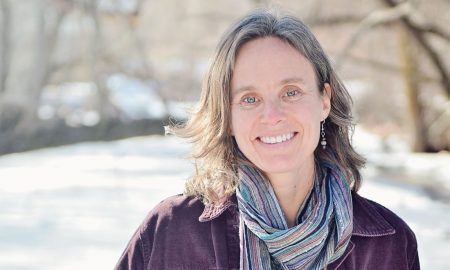


Today we’d like to introduce you to Kate Perdoni.
Kate, please share your story with us. How did you get to where you are today?
I remember pretending to be a journalist by the age of 3 or 4, sitting under my writing desk in my bedroom in Pennsylvania, scrawling “answers” to fake questions to my imaginary interviewees in squiggles across sheets of notebook paper. I was intrigued by Barbara Walters, who was somewhat of an anomaly on television, stylish and fierce in her long silk dresses and classic pencil skirt suits. I found even the fashion of journalists alluring. I noted how she placed in-depth yet concise inquiries, then would pause to listen with the absorption capacity of a Buddhist monk. Under my desk, asking fake questions to nobody, I practiced this kind of listening.
I’ve always been a writer, media creator, and musician. My love of the arts was nurtured in rural Minnesota, where grant programs, theatre camps, and summer intensives at the local University exposed me early on to professional-level participation. The convergence of these passions took many years to actualize and make fluid. As a young person, especially readying for college, I remember finding it a little impossible — “How am I going to weave all this together?” Interdisciplinary degrees were then fairly experimental. My generation’s parents had the residue of “pick something and stick with it,” and although this mentality was pushed on me ad nauseam, it never fit. I felt antsy that I would have to choose just one profession or vocation. I started college at 16, and went on to three more undergraduate schools in three states over seven years. I quit school multiple times to tour with a band, or to pursue another artistic project that I felt was stifled by the collegiate mold. I changed my major from English to Theatre to Music to cross-discipline studies as that way of thinking emerged into the college sphere, and graduated with a Journalism and Communications degree at 23. By then, I had already cut my teeth working for university, commercial, and public radio stations across the country. I had tenure as News Director with my own weekday morning show at an NPR affiliate based in Northern New Mexico and Southern Colorado, and I was freelancing heavily for newspapers and magazines. Officially obtaining my degree seemed a little “after the fact” or even supplementary to the real-life experience I was already living; however, it was ultimately the legitimacy of having this degree that earned me the opportunity to converge my passions and live the dream job I have today!
Now, I am an arts and culture reporter for Rocky Mountain PBS. I co-host on-air and write a weekly half-hour statewide program called Arts District, as well as producing, directing, shooting, writing, editing, and otherwise creating an assortment of television and digital content for the network. I genuinely love every aspect of media production. I also work on the Colorado Experience team for RMPBS, creating documentary-style episodes about local history. Our Culture Content department at RMPBS is dynamic, thorough, engaged, and incredibly talented, and is posed to truly respond to the needs and interests of communities across the state. We have offices in Denver, Colorado Springs, Grand Junction, Durango, and Pueblo, with more underway. We are organically building a framework of content partnerships and delivery that is highly representative and on-the-ground in each of these communities, an endeavor I am proud to contribute to.
A few years ago, my Aunt sent an image of a high school yearbook containing photos of both her parents — my grandmother, and her future husband, my grandfather. In typical high school fashion, their photos were underscored with a narrative about “what they would become” and their “greatest strengths.” My grandmother, paraphrased, had ‘the talent to become a premier journalist;’ my grandfather could ‘hold his own on a trumpet, pinning him to become a fine jazz musician aligned with the greats.’ These were revelations because my grandfather became a businessman, nary a trumpet in sight; and my grandmother, a clerk, then a house wife. It took a couple of generations for passion to equal vocation. Yet it was work set in motion long before I arrived.
Has it been a smooth road?
As a super-sensitive and highly empathic person, I have always felt things a little extra. Balancing this delicate input system with emotional, mental, and physical health has been a lifelong learning process of boundary setting, evolution, and adaptation. As a kid, I moved from a close-knit east coast family circle to the empty, barren drifts of rural Minnesota, effectively disappearing my Jersey accent and roots, and any semblance of personal identity. Life was very different in Minnesota, and because of this extreme shift, and the resulting alienation, I developed a feeling of being “other” or “different” that fueled itself into a pre-adolescent identity. And I grew up in poverty, working the fields of my family’s 40-acre organic vegetable farm and selling vegetables at farmer’s markets in nearby small towns. I took care of a host of farm animals, including my own goat herd. From a young age, I was tasked with adult responsibilities, as is customary of farm life, including helping to raise my little brother, clean and maintain the home, cook meals, and engage in chores like 5 a.m. livestock waterings in sub-zero pitch-black arctic frost before school!
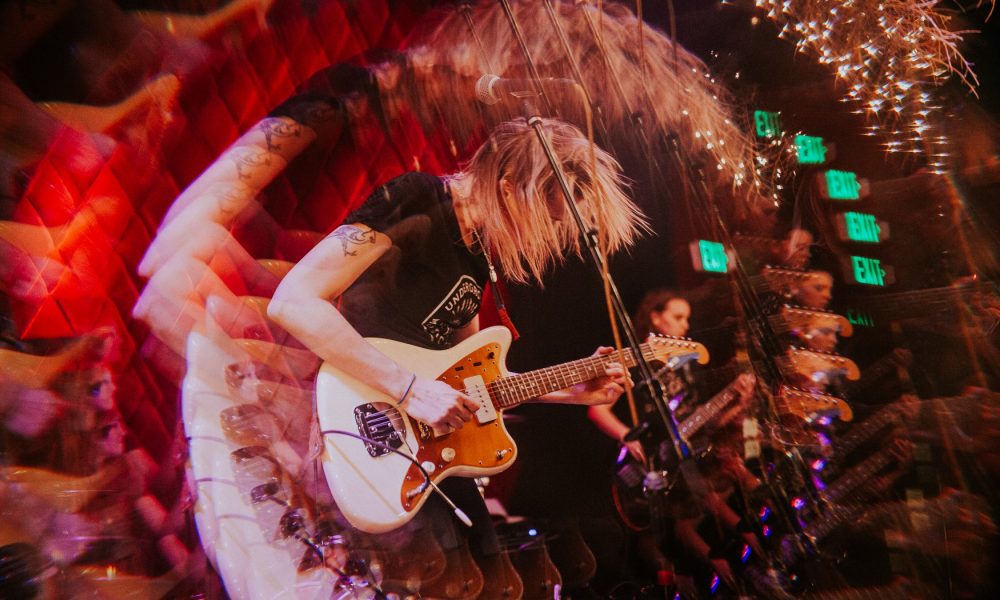
Again, this was all fairly typical for children of farmers in the region where we lived. But I was lonely, and coping with early onsets of depression and anxiety, with no support system. Left to my own devices, I had nothing but time and space to create. I wrote books, taught myself how to read music and play the keyboard, mandolin, and guitar, and got lost in a daydream world of performing arts. While I was scrubbing the kitchen, I was also imagining being on stage with Mary Chapin Carpenter or Neil Young, singing duets and playing guitar in the comfort of my mind. I read voraciously, checking out a dozen books at a time. I was a weird and scraggly tomboy with no access to friends and no real connection to any kind of pop culture or outside influence. By the time I was in my early teens, I was hoofing it to Minneapolis, three hours away, to see shows and just to sit in real coffee shops. I started disappearing on weekends to play open mics and have passing conversations with mysterious college students that showed me there was a world beyond the one I knew, a world that perhaps I could even belong to. At 16, in the midst of my parents’ divorce and continued volatile home life, I received early entrance to University. Necessity bred invention, and I started a new life, one of my very own. Because I had nothing to lose, I was courageous and brave. I moved out and held up to three jobs at a time to pay rent and maintain my independence. When I turned 18, I moved to Los Angeles to pursue a career in acting and music, attending Whittier College on a combined academic and theatre scholarship.
Although I now have my literal dream life, and an established, professional career, my road here was atypical, and I felt essentially “written off” along the way by some of my family as a transient, wayward artist (which I was). For those who equivocate personal worth with salary, my lifestyle was maybe vaguely threatening; and my many years of entertaining an overt sense of adventure, touring, traveling, house squatting, hitchhiking, and being led by my soul almost certainly seemed a dare in the face of cradle-to-grave consumerism. Adventure, I learned, is much more palatable to people in hindsight! While you are living it, it makes many very uncomfortable. Some of my immediate and extended family seemed ashamed at my choices, as my non-linear path of learning and discovery did not, in their worlds, equate to stability or success. I never felt accepted for who I was, which was exasperating, and sad, because I felt I had so much to offer, even if it didn’t look like they wanted it to. Luckily, as I became stronger in my vision and purpose, it hardly mattered what anyone thought. I came to rely on my own circle of mentors and friends to provide support and encouragement. This often looked like strong surrogate parental relationships — professors, usually, who took me under their wings, fed me literally and figuratively, let me watch their children for extra cash, and let me crash on their couches over the holidays. Over the years, I created a gracious web of role models who must have recognized my need for nurture buried under a slightly wild exterior.
I think this is why, now, although I have my dream job, I do not feel that it contains my identity nor that I am so wrapped up in my title or position as to make it reference or define who I am. My work is an extension of myself, another creative outlet fueled by Source and what I hope is some relatively self-aware manifestation.
Learning healthy coping mechanisms for routinely debilitating depression and anxiety has taken most of my life. Although you maybe wouldn’t consider a television host as someone with social anxiety, it took until my mid 20’s to even begin to come out of my shell of incapacitating shyness. I think, as a young artist, when your inner world is not validated by those around you or necessarily reflected in your environment, you can turn inward to an overcompensating degree. Performance emerged as a singular way to express myself authentically. I used songs, roles, and art to say and explain what I could not yet convey in conversation. Over the breadth of my 20s, I became able to express through language and life what only my art had previously stated.
I recognized very early on that as a white American, my equation was totally skewed, and I could do nearly whatever I wanted. While I was maybe flippant and crass with handling this freedom early on, as many teenagers are, it did alchemize in my early 20s into a push for reporting on social justice. I was at the cusp of a generation of women that had finally reached critical mass in not asking for permission if we were brave enough to both identify and work for what we needed. As I began reporting on the vast issues of politics, environment, health, development, natural resources, immigration, foreign policy, and more, my mind rose in frequency to the reality of the systems in place. I didn’t feel I had a choice but to use my power and privilege as a white person and a journalist to uplift undersold and underrepresented communities and voices. I began collecting and publishing oral histories of Native people in New Mexico and Mexico, writing heritage articles to help capture the legacy cultural traditions of the American Southwest, and spent even my personal time taking part in initiatives to document local culture via media. Eventually, I traded my tape recorder and radio frequencies to simply live in the mountains among these folks, digging ditches, growing crops, returning to my agrarian roots, and working with local farmers on issues of land and water rights. At one point, I took the LSATs and applied for law school to become land and water rights legal counsel. I thought customs and lifestyle relating to tradition and heritage to be obscenely more enriching and interesting than anything in the contemporary American experience. Although we as a culture have nearly completely eradicated anything outside of chain stores and white bread cuisine, there are traces of something else, something different, that barely remain, and my calling has always pertained to the documentation of this swan song of actual soul.
It is exhausting to be a trailblazer, because the work, once you see it, can never truly be finished. But I think there are ways around that. A support system is crucial. Rest is crucial. Vision and intention time are crucial. Never feel like you are up against an invisible timeline, or timeframe, or outward expectation; particularly in relation to your age. The reality is that only you will know if your path is whole and if it serves you. Aligning yourself to any expectation, desired result, mile marker, or milestone other than those that originate from within you is going to cause discordance with your being. You are not average, so there is no average to compare yourself to. Aggregates exist to make people feel better, “normal,” even, and to offer a relative node of comfort and assurance that you are “doing it right” or are “on the right path.” Again, nobody can discern this for you except yourself, alongside maybe a few keen friendships that can offer perspective and awareness to your blind spots.
I see many people of all ages frustrated that they are not “further ahead,” and irritated that they are unable to express themselves fully through their daily activity. Often, weirdly, these are people with the most access to resources. I do think there are cultural myths, particularly through academia and also through institutions like the music business, that there is some sort of refined algorithm or check-box list that eventuates a universally agreed-upon definition of “success.” I find this a great farce that ultimately infringes on forward motion. With this mentality, you could also give up very easily. There is no formula to any of life. Just do your thing; that’s what you are here for. You are poised to live the truest expression of your own self, in your own time, in your own place. That’s the very coolest thing about life. It’s not dependent on anyone else’s definitions. As hard as that is to get past, once you carve out your unique space, and honor the world to which you belong, you may find that time no longer even exists.
What else should our readers know?
Public media is where it’s at! I am grateful each day that my passions for storytelling, social justice, history, culture, the arts, and media production cumulate into my daily work. This is all because Rocky Mountain PBS has made a rare and valuable point to advance statewide arts and culture content, and is committed to telling stories from the communities where they originate, to mirror the Colorado experience back to those who live and work here. Last year, I created an hour-long documentary about Fannie Mae Duncan, a Colorado Springs luminary who owned the first non-segregated business in Colorado Springs. It happened to be a night club, The Cotton Club, that brought jazz greats to the city for over 30 years. The City forced closure of this business, then tore the building down, in a burst of racial gentrification in the mid-70s, and we in Colorado Springs feel the resounding echos of that legacy now. The film has been shown locally many times and was used as part of a Fannie Mae Duncan tribute on the State House floor this year. The film has also been nominated for a regional Emmy. This was a passion project that took many months to accomplish and is a very singular example of work feeding your spirit and soul, as well as contributing to something you want to give power to, and appropriate representations of underrepresented experiences. Rocky Mountain PBS as an organization is set up to allow for an unencumbered dedication to local storytelling.
What’s the most important piece of advice you could give to a young woman just starting her career?
Using others around you to measure your success, or to inform your trajectory, is an empty road. What if they’re just posturing? You will be imitating a farce. You need to clarify your own goals, which will lead you to do more innovative work. Figuring out what you want is actually more difficult than going after it. I think women in the generation after me are much more inclined to own their own truth and reality and to not be as intent on setting their needs aside to please others. As someone who grew up choking on the chemtrails of standardized women’s oppression, it is a huge relief to witness young women naturally fulfilling their intuitive authority. There is grace and power even simply in existing as we are, without apology. We have come a long way, and have discovered that we can work further and harder together. Just keep going. The world will catch up. Be inclusive. Please remember that privilege most certainly exists, though that life is not inherently easier for anyone — relatively speaking, that is, all humans will face conflict and internal apocalypse authored and engineered to provide them with the most growth and space for evolution. If your time is hard or unbelievably dramatic, the lesson and opportunity that await you to advance as a human are tenfold.
Contact Info:
- Website: rmpbs.org/fanniemae
- Email: kateperdoni@gmail.com
- Instagram: @kateyslvls @MamaLiberada @LiteLvL @Spirettes @ArtsDistrictRMPBS
- Facebook: facebook.com/
spirettesmusic
facebook.com/mamaliberada
facebook.com/litelvl


 Image Credit:
Main Horizontal Image – Julianna Photography, Terrace portrait – Lio Hawkins, On set photos (2) – Courtesy Rocky Mountain PBS, Playing guitar – George Blosser, FAC Podium – Brian Tryon, Group CBCA Awards Shot – Courtesy Colorado Business Committee for the Arts
Getting in touch: VoyageDenver is built on recommendations from the community; it’s how we uncover hidden gems, so if you know someone who deserves recognition please let us know here.