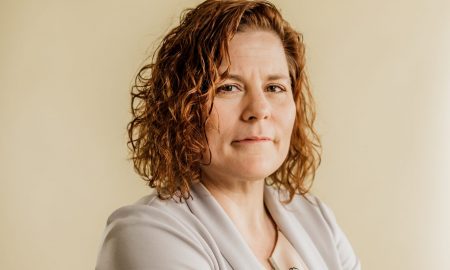


Today we’d like to introduce you to Christi Turner.
Christi, let’s start with your story. We’d love to hear how you got started and how the journey has been so far.
Living in a series of apartments and condos in Denver, I was deeply frustrated, and troubled, that I couldn’t get access to composting in any of them. I spent more than two years mulling over this frustration, and over time, I began to not just imagine, but to actually design a service that could create options where none existed – particularly for others like me, living in apartments or condos.
As someone who has devoted my life and work to sustainability, community development and the environment, and whose job at the time was not satisfying my desire to directly address tangible, solvable problems, I became quietly obsessed with taking on this composting issue. It struck me then, as it still does now, that composting is a fantastic way to create a number of positive impacts through one simple action.
Plus, composting is someone that just about everyone can do! It doesn’t require a certain infrastructure (like a suitable rooftop for solar, or a charging station for an electric car), nor does it require a hefty investment, nor does it require highly specialized knowledge.
It is a simple behavior change that individuals can adopt, which, when multiplied by the thousands, creates a meaningful shift in our city’s poor waste diversion record. In researching the issue, I had learned that the city had no plans to tackle this market or this issue itself, because the city’s jurisdiction for trash, recycling and compost collection extends only to single family homes (or multi-unit homes with up to seven units), and MFUs are actually considered businesses.
In Denver, businesses are responsible for contracting their own private waste haulers, and businesses aren’t even required to recycle in the City of Denver, let alone compost. I learned that policymakers were a very long way from enacting any new policies to change that. Even the City’s 2020 Sustainability Goal regarding waste diversion (i.e., keeping as much recyclable, compostable waste as possible from ending up in the landfill) was to simply reach national average – which struck me as an objectionable, if not embarrassing goal.
After all, who strives to be average? A world-class and fast-growing city, filled with people who ostensibly care about their environment and their community? It just isn’t enough. At first, I honestly didn’t think I had what it takes to be a small business owner or to turn my mild obsession with trash into an expertise worthy of an entrepreneur in the waste sector. So I hoped, and waited, for someone else to address the issue, and for a service to come along. But as I grew tired of waiting, I built up my confidence and dove deeper into waste issues.
After a series of disappointments at work, and then the ultimate disappointment of the Trump election, it struck me that there was no better time to do what I could, with what I had, where I was – and I had a solid idea to address an issue impacting our City and community. So in February 2017, I quit my job and founded Scraps. Scraps is all about filling in gaps to compost service.
We pick up where the City’s service leaves off, and we offer composting solutions that the City’s one existing commercial compost hauler, Alpine Waste & Recycling, isn’t set up to offer. We take an innovative approach to compost pickup service – one that is focused on staying small-scale, low-carbon, high-density, and pedal-powered in order to provide more people with the option to compost in Denver.
And through it all, we actively partner with Alpine and with the City, as well as with commercial businesses and non-profits, to maximize our effectiveness and our reach.
Everything we do is aimed at creating the most appropriate service for our customers, from the size and type of our bins to our use of compostable bags, to our pickup location and frequency, to our pricing. We take a highly personalized, hands-on approach to creating the most effective, sustainable service for each type of customer.
The gap that was particularly frustrating to me was, of course, the lack of service options for multifamily buildings – called MFUs, or any residential building with more than seven units, whether condominiums or apartments – in no small measure because I was living in one, but also because tens of thousands of Denverites were too! I knew that I couldn’t be the only apartment-dweller who was jumping through hoops to covertly compost, using neighbors’ bins, businesses’ bins, my friend’s backyard across town, etc. And I was certain there had to be thousands of others like me who couldn’t understand why living in a multi-family building meant they had no means of keeping their home compostables out of the landfill.
Along the way to building Scraps, we discovered that other businesses, including restaurants, were also experiencing a lack of composting service options. While we built our business infrastructure worked toward our first batch of multifamily customers, our first customer actually turned out to be a restaurant – a busy, popular, award-winning establishment called Work & Class. We picked up their first bin-full of compost on June 16, 2017, and son we were inundated with hundreds upon hundreds of pounds of compost each week. I didn’t necessarily want to service restaurants at first – I wasn’t sure we’d be able to! – but we took that leap, and Work & Class leapt with us.
In close collaboration, we figured out the optimally sized bins, the most sensible pickup spot, the best pickup frequency, the best approach to training and education, a price point that made sense, and all the other factors needed to make the service hum. Before long, we had more than a dozen restaurants on our roster, and they were quickly helping us to influence the thousands upon thousands of Denverites who come through their doors to enjoy their food, and who could appreciate the care they put into it, from sourcing to composting.
Restaurants have become a key part of our business, helping people to break through the “yuck factor” that can surround the topic of composting, and instead connecting them to the food on their plate, the farmers who grew it, the farms where the ingredients were grown, the soil that nurtured those ingredients, and the need to keep that soil healthy, rich, and bountiful for the long-term, through compost.
And in the meantime, in August of 2017, we finally got our first residential customers (and their property managers!) to leap, too. What started as just a handful of customers in a single building in a single neighborhood has grown to people in dozens of buildings across more than 22 neighborhoods, even including some full-building contracts. The core of our business model is our residential service to folks who live in condos and apartments, and in two years our residential customer base alone has grown to more than 400.
We also started servicing other businesses – who typically have office space, or even occupy multiple floors in a larger building that doesn’t offer composting, but who want the option to compost in their own office space – determining the optimal way to fill that gap, as well. Now, in just two years of running our pickup service, we compost for more than 500 residential and business customers across Denver.
Our first pickup from Work & Class was just 28 pounds (!!), and it took us a month to collect our first 1000 pounds. Now, we collect more than 7000 pounds a week, and that number is growing all the time. We’ve collected more than 280,000 pounds of compostables since we started, and we’re on track to top 500,000 pounds by 2020. That means we’ve helped keep nearly 100 metric tons of carbon dioxide equivalent (MTCO2e, a measure of climate impact) from entering the atmosphere, by not sending compostable material to the landfill, where it produces methane, a powerful greenhouse gas.
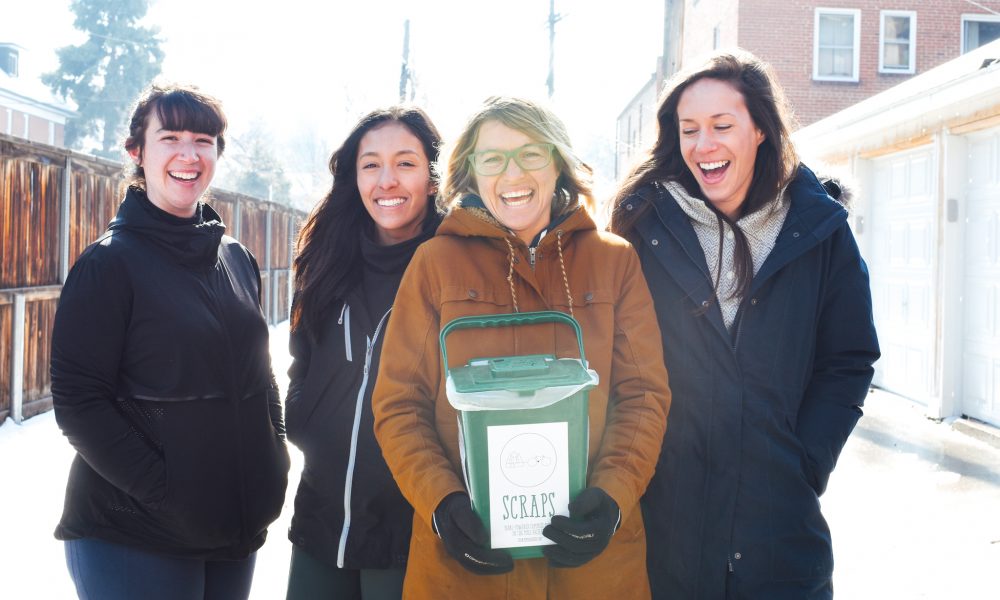
We have three trikes, and six trailers that we pull with our bikes. We have a team of five amazing women, and a whole roster of folks who work for us during event season to keep events zero-waste – another gap that needed filling in Denver. And we’re fairly certain that our work is partly responsible for turning the tide on waste in Denver, as we get closer to adopting policies that will truly prioritize waste diversion for our city.
I’m honestly not sure quite what I expected Scraps to have grown into in this amount of time, but I’m so very proud of what we have achieved.
Great, so let’s dig a little deeper into the story – has it been an easy path overall and if not, what were the challenges you’ve had to overcome?
Oh my goodness – all sorts of struggles and obstacles! We started out with very little money – my own personal investment, and a $5000 crowdfunding campaign. That’s not all that much to work with, in terms of investing in the basic necessities of the business as we got started – but we are nothing if not scrappy!
A trike was stolen. The recovery process was long and arduous. Finding the right people is critical. Paying them what they deserve is essential – but offering them the suite of benefits they truly deserve is hard to do as a small, growing business. Working outside is fraught with challenges. Winter brings bitter cold, icy roads, dangerous conditions, low morale on long, frigid days. Summer heat can bring delirium! 🙂
Not to mention intensifying smells, making it crucial that we stay on top of our operations and our customers’ habits to ensure that bags are tied, bins are closed, things are kept clean, and smells and flies are kept away. We want a highly visible and highly palatable program, one that even the doubtiest doubters can get on board with! Smells and flies can kill that possibility.
The cost of trash/landfilling in Denver is artificially low. This is in part because, only relatively speaking, our landfills still have “lots of space.” This is in part because long-term contracts with waste haulers managing landfills have locked in low disposal fees for the long term. There are other factors as well. It makes it more difficult for composting to compete, from a cost perspective.
Composting costs money. There is labor involved, transportation, expensive bins and lids, marketing costs, cleaning products, etc. Far too many folks expect that it should be free. We use this expectation to try to get people thinking about policy, and supporting city-wide policy that could potentially make composting free someday (at least for single-family homes), and bring the disposal cost for compostable material closer to the disposal cost of trash.
Perhaps most frustrating, property managers and HOAs can too often act as barriers to people who want to compost. They often say no to a resident’s request to try composting with us, offering no explanation. Or, their rationale is irrational, and not based in fact.
Although many property managers choose to allow their residents to compost with us, and many of them consider it a valuable amenity to celebrate and spread among their community, managers/HOAs also have a de facto power to keep their residents from trying composting.
We are working to change this. There are so many challenges. We’re all about taking them as they come and finding a way over, around or through them.
Alright – so let’s talk business. Tell us about Scraps – what should we know?
I think I’m most proud of how we’ve spread the love & passion for waste diversion & composting among so many Denverites. At our core, it feels like a supportive, devoted, warm and caring family of people, who truly believe that our actions can and should have a positive impact on our urban community.
Is there a characteristic or quality that you feel is essential to success?
Scrappiness! 🙂
And by that, I mean, flexibility, ingenuity, the ability to make the most of scarce resources, the knack for finding the most appropriate tool for the job at hand – and thus creating a compost pickup service that works for those we’re trying to serve.
Pricing:
- Our residential pickup service starts at $15/month. That includes a three-gallon household bin and a once-weekly pickup.
- Our restaurant service starts at $90/month. This includes four 10 gallon bins and a twice-weekly pickup.
- Our office/business service starts at $75/month. This includes a 16-gallon office bin, with a vented/charcoal filtered lid, and a once-weekly pickup with a new bag at each pickup.
Contact Info:
- Website: www.scrapsmilehigh.com
- Phone: 4012070562
- Email: christi@scrapsmilehigh.com
- Instagram: instagram.com/scraps.mile.high
- Facebook: https://www.facebook.com/scrapsmilehigh/


Image Credit:
Kenzie Bruce, Christi Turner
Getting in touch: VoyageDenver is built on recommendations from the community; it’s how we uncover hidden gems, so if you know someone who deserves recognition please let us know here.