

 Today we’d like to introduce you to Mary Ann Keatley.
Hi Mary, please kick things off for us with an introduction to yourself and your story.
My life has been very fluid with many wild adventures along the way and I can see how each of those major events and the people I’ve met have contributed to my metamorphosis.
I was born in Manila, PI where my Father was a mining engineer and we lived in the mountains and jungles of Bagui0. That seems to have shaped my love of the tropics and the beauty of different cultural lifestyles.
We always had a house in Boulder, Colorado, and would return to the States to stay intermittently. However, my mother hated to fly so we sailed from Manila and across the Pacific for 42 days to make it back and forth to the US. My Father, being much like an Indiana Jones-type character would go into the jungles for long periods, coming out with gems and other geological finds in his pockets.
Boulder, CO, on the other hand, is a beautiful little city nestled amongst the Flatirons and the mountain environment couldn’t be more different from the tropical island ambiance of Manila. Boulder is oftentimes described as “45 square miles surrounded by reality.” Our city is surrounded by greenbelt, or land owned by the city that cannot be developed, which allows us to keep a more rustic environment with bears, mountain lions, coyotes, deer, foxes, etc. in our backyards. The Boulder Valley was said to have been cursed by Chief Niwot, the Southern Arapahoe Chief, who said that people who saw the beauty of this valley would want to stay, and if they left, they would return.
A large part of my desire to advocate for others was borne from taking care of my mother, who was agoraphobic and didn’t leave her home much from the age of 30 until she died at 75. She was dependent upon me and this instilled a sense of independence and compassion for those who need care. She infused our home environment with an artistic talent for beauty and color, which has led me into painting and the arts.
When I was 20 years old, I moved to southern California to continue my college education and was working as a secretary in the Government Department of Pomona College. I had been there 6 months when I went to pick up the mail from the Director’s mailbox and when I touched the edge of a package it detonated. It was a pipe bomb that was wired around the edge. I later learned that another bomb detonated in a woman’s restroom up the street several minutes before this. I was blinded by the blast, had shrapnel in many parts of my body, and lost both eardrums and half of my right hand. I was unconscious for quite some time and had a dozen surgeries over the next 2 years.
The process of being injured and sensory deprived of vision, touch, and sound all at the same time seemed to open doors to the etheric world–things that I couldn’t ordinarily perceive about others before the injury became apparent. Fortunately, some vision was restored in the right eye, which one doctor described to me as being “A Queen amongst the blind.” I now live in a world of soft focus. Because I have no lens on my left eye and partial vision on the right, my paintings oftentimes reflect a very surrealistic quality.
I did return to the University of Colorado and completed a teaching degree in English, but just as that was complete, I had a serendipitous event, seeing the English teacher who set me on that life path. He had just returned from the Mayo Clinic after completing post-doctoral work in Speech-Language Pathology and he suggested I see his next patient with him. This patient was recovering from a stroke and had almost no intelligible speech, but my mentor could communicate with her. I found it compelling and he suggested I complete an undergraduate and a Master’s Degree to become a Speech-Language Pathologist. I followed that path and completed those courses went on for a Ph.D. and started to work in hospitals with the neurologically impaired.
For 13 years, I worked in inpatient rehabilitation which allowed me to not only help others but use the experience I had with recovery and a knowing of what it meant to move beyond disabled thinking. Every individual has a pretty interesting history and connecting with them and their life stories facilitates their recovery and seeing themselves as whole again. While working I also became certified in Biofeedback and Neurofeedback, which are scientific fields establishing a mind-body connection by placing electrodes on the body or scalp and measuring muscle tension, temperature, brain wave patterns, etc. to establish voluntary control of the body and mind. These skills empower individuals to move through the world by changing the way they perceive and respond to their environment.
Another crossroads occurred when I realized that the hospital system, I was working in was holding me back from providing the care I was interested in giving. I opened a private Speech-Language Pathology and Biofeedback/Neurofeedback business and specialized in seeing individuals with traumatic brain injuries as well as other neurological problems. I trained in Reiki and other forms of Energy Healing, which satisfied a form of knowledge I already had but didn’t have the words or skills to perform. My work for the next 30 years combined all of these modalities to help others heal their shattered lives. Recovering from a traumatic brain injury takes time, patience, and persistence, all of which I learned from various unexpected and amazing life experiences. Walking that path with others was a gift. Advocating in the justice system and courts for the disabled and underserved has been one of the biggest challenges for me, but very rewarding.
25 years ago, I started a nonprofit with a colleague called the Brain Trust, DBA The Brain Injury Hope Foundation. After seeing so many individuals with mild to moderate traumatic brain injuries (TBI) lose their jobs, homes, families, and independence, we decided to start a foundation that would provide funds for food, rent, and utilities. Computers help them stay in touch with the outside world. We have helped thousands of people, with funding that comes from donations and grants. We provide monthly Survivor’s Series of educational information with experts in the field. These are attended on Zoom by individuals locally, nationally, and internationally.
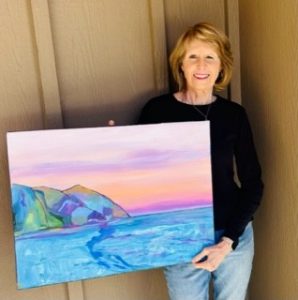
As I’ve moved through life, I’ve always expressed myself with painting and started participating in acrylic painting classes with Jacque Michelle Artworks in Boulder, CO. Being able to express oneself through color, form, and light is a path of continued healing in a world that doesn’t always make sense. Being able to use imagination and create through various art forms allows for personal growth. By the way, they never found who set the bomb, but new clues are still emerging 54 years later. You know the old saying, “It’s not what you carry through life, it’s what you leave behind” And, I’ve tried to trust the invisible way, and pay attention to the synchronicities that lead me forward in life and painting. The only constant in life is change and I’ve always believed that if you can think it, you can create it and change the world around you.
Would you say it’s been a smooth road, and if not, what are some of the biggest challenges you’ve faced along the way?
It has not been a smooth road. Caring for a parent with mental illness and having to travel through the outside world as a child without support is a challenge that makes us stronger. Being blown up by a bomb and having to deal with the pain, multiple surgeries, and the lifelong accommodation of physical changes has been an interesting learning experience. Perhaps one of the most relevant things I learned is the necessity to not provide the full story to everyone. The nuance of our language and how we express our life stories is particularly important when there is violence involved.
When people ask what happened to my hand, I always say “It’s a bit of a show stopper, do you want to hear it?” It is an opportunity for others to listen and have a little compassion for a fellow life traveler. When treating individuals with brain injury I would always try to ask two questions at the end of their treatment: One, what do you believe the purpose of this injury was? and two, if you had the opportunity to live through the same event again, would you do it? The answers weren’t surprising to me. The majority of individuals said it led them to a spiritual awakening where they learned about their courage to persevere and they developed compassion for others with life challenges. Except one person, said they would live through the event again because what they gained far outweighed the negatives despite the suffering they endured.
I would say that the struggles were mostly from the protracted pain from a dozen surgeries, the lack of accommodations in the educational settings when I was trying to write left-handed, and couldn’t see well enough to read efficiently. I believe that many of these issues have changed over the years with the advent of the Americans with Disabilities Act. There were emotional challenges with this violent act, even though the bomb was not intended for me. But the great part is that I was able to put what I learned to work, advocate for others, teach them to advocate for themselves and start a foundation that has served many individuals with traumatic brain injuries for 25 years.
Thanks for sharing that. So, maybe next you can tell us a bit more about your business?
I am mostly retired from this business, but I work as a Speech-Language Pathologist and Biofeedback/Neurofeedback therapist, treating individuals with traumatic brain injuries and other neurological problems. My specialty is Cognitive and Language rehabilitation, teaching people how to rewire their brains to work for them following an injury.
The concept of neuroplasticity and the ability of the brain to make connections that allow for functional life changes is very exciting. Re-learning to use your memory, process information rapidly, attend for periods, retrieve words efficiently to communicate ideas, to be able to use logic, and solve problems are all skills that I was able to teach to others. Beyond this, I’m most proud of the Brain Trust, doing business as The Brain Injury Hope Foundation, which is a nonprofit foundation that I started with a colleague 25 years ago that provides funds to individuals with mild to moderate traumatic brain injuries. This Foundation gives funds for basic needs–food, rent, and utilities, along with computers.
We also provide a monthly Survivor’s Series on Zoom that touches on topics such as pain management, nutrition, caregiver panels, resources for active military, veterans, and families, etc. Last year, we started the first Spanish-speaking Survivors Series with treatment experts who are fluent in Spanish. Now, all sessions are translated into Spanish. Our organization is funded by donations and grants and our Survivor Series is attended locally, nationally, and internationally.
What would you say has been one of the most important lessons you’ve learned?
The most important lesson I have learned is to make lemonade out of lemons! If you’ve had a bad life experience, use what you have learned. Share your story, help others with what you have learned, and always maintain hope for a better future and give hope to others.
Be able to find humor in situations and be an eternal optimist–it goes a long way! Have patience and compassion for those trying to find their way and try to see through the superficial into the souls of others.
Contact Info:
- Website: Braininjuryhopefoundation.org
- Instagram: @MaryAnnKeatley