
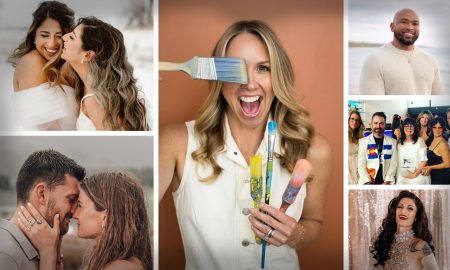


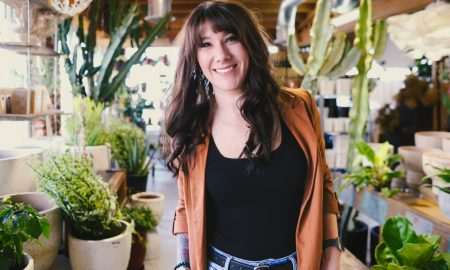
Today we’d like to introduce you to Tania Dibbs.
Tania, can you briefly walk us through your story – how you started and how you got to where you are today.
I was an artistic kid and expressed myself through art since childhood. Art was never really encouraged as a possible career path for me, but after graduating with a degree in biology and moving out West, I still harbored life in art as a sort of daydream and possibility. I worked a lot of jobs: cooking, teaching skiing, and as a carpenter, but realized that without committing myself fully my dream life would never happen. I moved into a little tool shed in Aspen that had no plumbing in order to save on rent so I would not spend all my working hours supporting my housing. I desperately wanted to make it as an artist. The shed was my home for about 6 years. I put in weeks of labor to make it habitable, adding windows, a closet, insulation, and heat. I had no plumbing so worked a couple of nights a week as a maid at The Aspen Club so I could use the facilities there, otherwise I put on a coat and walked to the main house across the yard to use the bathroom. It took me a while to get my nerve up to state my goals publicly. Even to me it sounded fantastical to say “I am an artist.” I shared my goal with a ski school client who had become a friend, telling him that come summer I was not going to get another construction job but was going to work on a portfolio of art. He wrote me a check for six thousand dollars and said he would pick a few pieces from the resulting collection at the end of the summer. Eventually I showed these pieces in a solo show in Aspen at a well-known gallery. By trial and error and doggedness, I slowly developed my work and learned the business.
Great, so let’s dig a little deeper into the story – has it been an easy path overall and if not, what were the challenges you’ve had to overcome?
The struggles for an artist are constant and there is no road map. Even a higher degree in the arts does not set you on the path to being successful in this field. Developing strong art is only one factor in the equation. One has to have an infinite well of determination to keep turning over stones in the face of seemingly constant rejection and failure. One has to learn to work alone without supervision, direction, praise or suggestion, being one’s own arbiter of what is right and what is cool with respect to the artistic decisions you are making. One must be comfortable in this day to day isolation but then be able to speak coherently and confidently about the work in the public sphere, to sell, and to translate. An artist has to continually find ways to monetize their work as opportunities come, go and change, and to learn to navigate the very cliquish and capricious art world should they reach that level of play. There are the frustrations of learning business and of having an uncertain future and uncertain income. It is not an easy path and not a way of life that most people would be able to tolerate. I wish I had found mentors to show me how to work smarter, not harder. I look back and see that I spent years feeling my way in the dark. My advice for someone who wants to pursue an art career is to forego isolation as much as possible and to start early. Work on building cultural capital by associating with art movements and other artists, building relationships, and by living in an area that reduces artistic isolation. Practice believing in yourself, and learn to be discerning when accepting criticism. Learning to maintain your enthusiasm and excitement about your work in spite of disappointments will either leave you feeling invincible or like you are losing at a game you aren’t cut out for anyway. In my experience, those on the business side of art are cut from a different cloth than artists. Don’t be surprised by that, count on yourself, keep going, and let the process be the reward. You eventually realize that the opinion that counts the most is your own, and that is a powerful place to be.
Please tell us about Tania Dibbs.
I am a painter, a sculptor and a maker. My work examines the intersection between the natural world, humanity, and culture. The screens and overlays that I paint over idyllic scenes both highlight and obscure the landscape beneath, speaking to the beauty of nature as well as to the conflicting yet fantastic constructs of man. My abstracted drawings reflect the changes in the environment and capture the poignancy of nature and time. The sculptures combine symbols of wealth and culture with their opposites, highlighting a bigger discussion about our fast-changing relationship with the planet and with nature. My work seems very diverse in style at first glance, but upon consideration of my body of work as a whole the viewer can see that it is unified by its intent, devotion to exploration and connection to nature. My work can be found in private collections across the United States, Europe, and Australia. I am proud to have forged a nice life solely from doing what I love, proud to have continued artistically exploring and growing when the market pushes you to remain in a recognizable stasis and am grateful to have finally reached a point where I believe most completely in my own artistic voice.
Are there any apps, books, podcasts or other resources that you’ve benefited from using?
I love looking at the work of other artists online and follow quite a few on social media. It makes me feel like I am part of a larger artistic community, and although I am not seeing their images live it is still a window into what is going on with other artists that I respect. I also love podcasts that get my mind thinking. Radiolab has long been a favorite, as well as Hidden Brain and Invisibilia. I also enjoyed Malcolm Gladwell’s Revisionist History.
So much of the media coverage is focused on the challenges facing women today, but what about the opportunities? Do you feel there are any opportunities that women are particularly well positioned for?
Renee Adams from Oxford did a study in which she found that affluent people looking at computer generated art, especially men, rate art as less compelling when they have been told it was painted by a woman (men have traditionally have more money and therefore constitute more of the collecting public). In permanent collections of prominent museums over 85% of the of the represented artists are male and white. Nationwide women receive far fewer solo shows and make less money than their male counterparts. No major international exhibition of contemporary art has achieved gender parity. The trends are moving in the right direction though. Women run almost half of the museums in the US, female artists are not likely to experience “the motherhood penalty,” and women are earning 70% of the Bachelors of Fine Arts degrees. I hope the whole Me Too movement helps focus our attention on these inconsistencies in the art market, and I feel that if we continue fighting for gender parity across the board, women in the arts will benefit as well.
Contact Info:
- Address: mailing address: 266 Mountain Court
Basalt, CO 81621 - Website: www.taniadibbs.com
- Phone: 9709484075
- Email: tania@taniadibbs.com
- Instagram: taniadibbsart
- Facebook: taniadibbsart
- Other: https://www.linkedin.com/in/taniadibbs/


Image Credit:
images of Tania only – Lem Bolanos
Getting in touch: VoyageDenver is built on recommendations from the community; it’s how we uncover hidden gems, so if you know someone who deserves recognition please let us know here.
2 Comments
Leave a Reply
Popular
-

The Trailblazers: Rewriting the Narrative
-
Celebrating the Spotlight: Kaytee Shashore Turns Milestones Into Momentum
-
Humanity in the Machine: Alexander Raye Pimentel’s Cyborg Recall Questions the Cost of a Data‑Driven World
-
Raemi Anderson on Courage, Caution, and Answering the Call of the Landscape
-

Hidden Gems: Local Businesses & Creatives You Should Know


Michele Joseph
July 8, 2019 at 10:02 pm
I don’t remember a time when I didn’t know Tania. Our families socialized, took ski vacations together, and we attended the same undergraduate university. While her artistic capabilities astound me and change the way I see the world, the qualities I have most admired in Tania are her persistence, her bravery, and her kindness. Tania is genuine, authentic, and humble when discussing her enormous talent and accomplishments. This world, my world, is a better place because of Tania Dibbs.
Tania Dibbs
July 27, 2019 at 7:53 pm
Aww, thank you so much Michele.