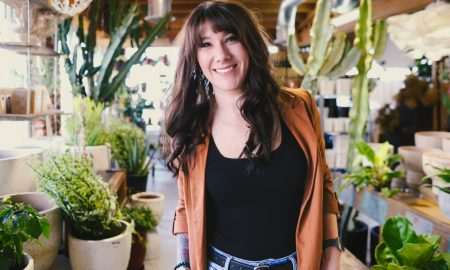


Today we’d like to introduce you to Callie Weldon.
Callie, can you briefly walk us through your story – how you started and how you got to where you are today.
I’ve been drawn to natural fiber and materials my entire life. Growing up, my grandmother (who was born in England) would have crates of British fashion items shipped over for the long winters in upstate New York. I would watch in wonder as she would reveal gorgeous woolen sweaters, cashmere jackets, and silk pajamas. She inspired and encouraged me to enter the Design Management program at Parsons School for Design when I was 18 and I immediately fell in love with the process, production, and execution of making apparel items.
After working for a few different high-end designers in NYC, I didn’t feel fully content with the amount of work and materials that went into creating one collection. Resources used up, materials discarded, and poor treatment of factory workers inspired me to seek something more. In 2014, I landed a job in the Sacred Valley of Peru working as the Global Sales Manager for Awamaki, a non-profit that works with Indigenous women weaving cooperatives to empower them through business training. This was my ‘AHA’ moment. Seeing a group of women who were so connected to the land they worked on, raising sheep to shear and spin into yarn for their naturally dyed woven textiles. It was the most powerful year of my life. The group exemplified a model of apparel production where the environment, the people, and the animals involved in the process were celebrated and valued. Something I had not seen before in the fashion industry.
I went on to work for another non-profit in a similar space and quickly realized that in order to scale this model of excellence from a non-profit project to a viable business opportunity for the masses, there were a few parts and pieces that needed tweaking. In 2016, I went back to school at Colorado State University (CSU) to earn my MBA in Global, Social, and Sustainable Enterprise. Here, I began to dream up my own version of an impactful apparel business model. For two years during the program, I, along with my business partner Lucas, built Fair Fiber.
Fair Fiber is focused on creating a shared positive impact in the alpaca apparel supply chain. We work with Peruvian alpaca farmers to help them gain market opportunities and build sustainable income for themselves and their families. From there, we connect the dots of a traceable and sustainable supply chain all the way to the finished fabric level. In 2019, we produced the first alpaca blend performance material available. Currently, we’re working with a number of large US outdoor brands who are interested in including these materials in their collections.
We’re definitely still growing and learning a lot every day. Reinventing the way a traditional business is done isn’t always an easy feat but I couldn’t imagine being part of an organization that had anything else but the planet, people, and animals as a top priority.
Great, so let’s dig a little deeper into the story – has it been an easy path overall and if not, what were the challenges you’ve had to overcome?
Some of the most common bumps in our path have been convincing our supply chain players to take a chance and do something differently. Sustainability is not something that offers an immediate ROI and alpaca is not often a material that is blended or even used in non-knitwear luxury applications. Making a business case for these factories to work with this material and obtain earth-friendly certifications has been tough, but the brands and their customer base demand helps a lot in that regard.
Fair Fiber – what should we know? What do you guys do best? What sets you apart from the competition?
Fair Fiber is creating a new category for performance apparel. We’ve engineered an entirely new material made from alpaca wool that is ethically sourced from farmers in Peru. Our unique blend uses both alpaca and recycled polyester to make Fair Fiber’s material warmer, dryer, and more durable than sheep’s wool, less impactful on the animal compared to down, and much less water-intensive than cotton.
It is our mission to source these fibers in a sustainable way that benefits all humans and animals involved in the transaction. This is why we’ve partnered with a cooperative of small-scale farmers in the Andes of Peru. We work directly with this group to cut out the middle man and increase wages for their families.
What moment in your career do you look back most fondly on?
The proudest moment of our path with Fair Fiber has been receiving our first fabric sample and being asked to fly to the headquarters of our largest outdoor brand partner to show them the material and plan the launch. It felt like all of our hard work was finally coming together and we could share with the farmers that their product is gorgeous and has demand in the US and beyond!
Contact Info:
- Website: www.fair-fiber.com
- Email: callie.weldon@fair-fiber.com
- Instagram: FairFiber
- Facebook: https://www.facebook.com/fairfiber


Suggest a story: VoyageDenver is built on recommendations from the community; it’s how we uncover hidden gems, so if you or someone you know deserves recognition please let us know here.
Popular
-

The Trailblazers: Rewriting the Narrative
-

Celebrating the Spotlight: Kaytee Shashore Turns Milestones Into Momentum
-

Humanity in the Machine: Alexander Raye Pimentel’s Cyborg Recall Questions the Cost of a Data‑Driven World
-

Raemi Anderson on Courage, Caution, and Answering the Call of the Landscape
-

Hidden Gems: Local Businesses & Creatives You Should Know