

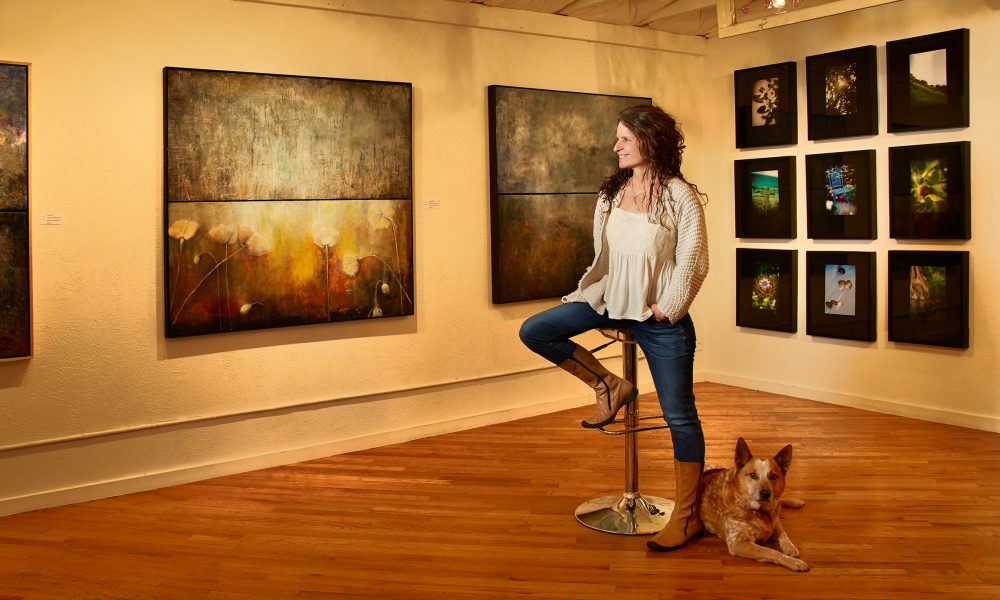
Today we’d like to introduce you to Dona Laurita.
So, before we jump into specific questions, why don’t you give us some details about you and your story.
As an artist, documentary photographer, visual storyteller, and former community gallery director, I help people be seen. My art since 2013 depicts individuals as anonymous, faceless forms while simultaneously incorporating elements of their character. More specifically, I use the silhouette in my photography projects to portray the power of the shadow voice. The photos and accompanying stories evoke emotion while highlighting the beauty and heartache of the human experience. Viewers are drawn in and challenged to discover the story within the shadows. This has become an ongoing template for me to connect with fellow humans in different situations and to share their stories and circumstances artfully. In like manner to poet and novelist Frederick Buechner, I am drawn to where my “deep [passion] and the world’s hunger meet.” This means I focus on different topics at different times ranging from young people and their challenges to immigrants and refugees to now include contemporary matters such as the Black Lives Matter movement.
My art and business expertise have grown and developed over the decades. I intertwine my heart and passion for social justice with the pragmatic aspects of paying the bills. To begin with, I spent most of my childhood moving around from place to place. From archetypal suburbia white flight San Fernando Valley in the 1960s, up and down the state of California, to rural farming communities in Colorado in the 1970s. In the 1980s, I intentionally planted myself in Boulder to attend the University of Colorado. I was one of just a handful of female photographers in the area in a mainly male-dominated field. I grew my business, Laurita Fotografia, by documenting rites of passages and creating portraits. I enjoyed success and had many amazing assignments such as photographing the Dalai Lama in 1997. While doing commercial work, I always had a side hustle with my creative work. I felt proud that I came from a working-class, uneducated family, and plowed through to get somewhere. Through these experiences, I became the observer of life, especially and including racism and other personal and social injustices. This foundation continues to inform and impact my work. Thus, social justice issues have captured my mind and heart professionally and personally my entire life yet especially in this latest multi-project work, The Silhouette Project.
Fascinated with silhouettes, I began incorporating them in my photography while working as an artist-in-residence in 2013 with an NEA-funded (National Endowment of the Arts) project called Stories Matter. High school students worked to deepen their understanding of the many factors and stories that shaped who they were and shared their voices through art. I then began to more overtly address social issues in 2016 with the first incarnation of The Silhouette Project, Stories of Immigrants and Refugees. This visual-story expose addresses the suppression and invisibility of immigrant and refugee voices, bringing forth their unique and immensely different stories and backgrounds in America today. In 2017, The Silhouette Project added another focus: the stories of “Dreamers” within the ever-present threat to Deferred Action for Childhood Arrivals (DACA). In 2018, I started the most recent manifestation, “Lens of Love,” targeting public awareness as well as bringing together adolescents and young adults (AYA) whose lives have been impacted deeply by serious health or physical challenge.
In all phases of The Silhouette Project, my subjects are given a safe forum to share their personal stories. The process is collaborative, beginning with an interview and then a photoshoot. These compilations of photographs, graphics, and first-person stories are accessible and installed at urban and rural community venues and featured in permanent online exhibitions. In our current cultural and political climate, the silhouette serves as a profound modality of portraiture and personal stories for the subject and the community. Art motivates people to change their perspectives or, at the very least, to contemplate deeper meanings. My work serves social justice by fostering understanding, openness, and empathy in viewers.
Great, so let’s dig a little deeper into the story – has it been an easy path overall and if not, what were the challenges you’ve had to overcome?
The major technical challenge I’ve encountered and overcome was the mega shift in my industry from traditional photography to digital. I started out with my 2 1/4 Hasselblad film camera. Quick and stealthy with this cumbersome piece of gear, I worked at a black and white custom photo lab and learned fine art archival printing from a master printer. At the height of my career, motherhood presented itself to me, and in 1999, I gave birth to a beautiful daughter, Julietta Luna Natalia. My world became focused on her. I went into hibernation and worked on memoirs (“Casa di Vita” project) for a couple of years while caring for this lovely being. When I finished the project, I felt like Rip Van Winkle: I emerged from a dreamy sleep to find my industry had changed greatly. How I loved the darkroom and its mysteries. With the older equipment, I also reveled in moving about and then mixing chemistry, watching an image emerge. It was a shock to have to learn a new medium to keep up commercially. Then in late 2004, another beautiful being came into my life, my son, Nikolai Vincenzo was born. The experience of mothering and learning a new part of my industry was busy and rewarding. I continue to be proud of my work and appreciate the expanded opportunities digital allows and am grateful that I have traditional photography as my baseline.
Notwithstanding this industrial shift, my biggest challenge was my beautiful 17-year-old daughter’s battle with terminal cancer which placed her on the other side of my lens as part of a disenfranchised community. With her life severely hijacked and then cut short by this devastating diagnosis of brain cancer, I turned to my photography to help her, myself, and other adolescents and young adults (AYA) experiencing serious health or physical challenges. Through this third manifestation of The Silhouette Program, “Lens of Love,” I created a community in 2018 for Julietta to replace the one that she was losing. At the same time, this ongoing project helps others going through something similar along with raising public awareness of this little-known AYA cancer community. Adolescents and young adults tell the stories of their experiences fighting, surviving, and living with disease or trauma. Julietta’s and the others’ stories are unique while also contributing to the tapestry of courage, pain, hope, and despair shared by far too many young people today. My life is forever changed. I miss her from the depths of my being every moment of every day. The grieving, at times, is incapacitating, but I carry on. This project remains as a testament to my beloved daughter and the struggles of all these young people whose lives have been tragically cut short or forever changed.
We’d love to hear more about your work and what you are currently focused on. What else should we know?
I provide opportunities for people to share their stories, individually and in groups such as my Silhouette Project. I have worked as a photographer and personal historian in Boulder County for nearly thirty years bringing my artistic vision to hundreds of life’s rites of passage from births to deaths and everything in between. I’ve collaborated with the Boulder Sister Cities Project involving Lhasa, Tibet, and Jalapa, Nicaragua, furthering the understanding of life, beyond language and cultural barriers, through visual art. Naropa University retained as the exclusive photographer documenting the visit of the Dalai Lama in 1997. I’ve received numerous local, state, and national grants to continue my rewarding social-justice work. As a visual artist and teaching artist, my workshops and curriculum successfully fulfill academic standards and expose students to a multitude of media and creative experiences. I encourage participants to “see” what already exists within and around them. I facilitate the expressions of their impressions, intuition, and imagination through visual, written, and auditory media.
I have facilitated experiential learning programs as an artist-in-residence in many schools and institutions throughout the state of Colorado, including Children’s Hospital, the Denver District Attorney’s Office Restitution Project, and the Summer Migrant Worker’ Leadership Institute (SMYLI). I’ve also been fortunate to collaborate with organizations such as Thing 360Arts, Young Audiences, the Mizel Museum, Eco Arts Connections and the One Action: Arts+Immigration Project. I, along with my family, have operated a fine art studio, gallery, and music performance space showcasing along with a consistent outpouring of personal work, visual art, film, and music of some of the most creative and adventurous working artists of our rich and blossoming art scene here in Colorado. Currently, alongside many talented national and international artists, I create in my personal studio at the stunning Eldorado Springs Art Center (ESAC).
What moment in your career do you look back most fondly on?
I am most proud that my work moves people, participants, and observers. A testimonial from a Silhouette Project participant affirms these vital aspects of my career:
Participating In the silhouette project has been an uplifting experience. I’ve not only had the opportunity to meet other immigrants in similar circumstances but also many allies; like-minded individuals, who don’t necessarily share the same backgrounds as we do (immigrants) but have been there to listen to our stories and support our journeys. It has been heart-warming seeing the amount of support that is present within my immediate community; a feat I was quite unaware of prior to the project. I’ve been to numerous events surrounding the project and have grown fond of my interactions, as I leave each event feeling like I’ve gained either a new friend or a new perspective. My life is very much the same as it was then, exasperated by recent Covid-19 shockwaves, but it’s much more comforting living with the knowledge that there are real people that care out there–and that my life matters.
Contact Info:
- Address: Dona Laurita, Eldorado Springs Art Center, 8 Chesebro Way, Eldorado Springs, CO 80025
- Website: thesilhouetteproject.com
- Phone: 303.818.1616
- Email: dona@donalaurita.com
- Instagram: @donalaurita
- Facebook: facebook.com/dona.laurita
- Twitter: @ImmigrationSP, @DonaLaurita
- Other: donalaurita.com


 Image Credit:
Marylynn Gillaspie, Dona Laurita
Suggest a story: VoyageDenver is built on recommendations from the community; it’s how we uncover hidden gems, so if you or someone you know deserves recognition please let us know here.
Popular
-

The Trailblazers: Rewriting the Narrative
-

Celebrating the Spotlight: Kaytee Shashore Turns Milestones Into Momentum
-
Humanity in the Machine: Alexander Raye Pimentel’s Cyborg Recall Questions the Cost of a Data‑Driven World
-

Raemi Anderson on Courage, Caution, and Answering the Call of the Landscape
-

Hidden Gems: Local Businesses & Creatives You Should Know