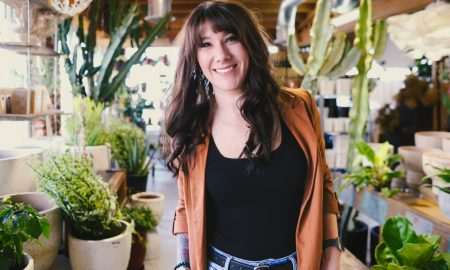


Today we’d like to introduce you to John McVey.
John, can you briefly walk us through your story – how you started and how you got to where you are today.
I was a singer/songwriter. I toured A LOT, won a few festival contests (most notably Kerrville), did some wonderful shows and put out 3 CDs.I’d always had a recording rig at home. Mostly this was for writing and recording my own stuff. People began asking me to help them record things. Then they began asking me to produce their projects. I started doing more of that and completely fell in love with it! Then I started working in established studios, in Nashville, Utah, Virginia, and finally in Boulder. I worked for 14 years at a well-established studio in Boulder, and finally decided it was time to go out on my own.
In fall/winter of 2016, I built a small studio into my garage. Cinder Sound Studio was born. It was just a control room and one booth, plus a coffee area and a bit of space to store stuff. I researched like crazy and figured out how to make it sound good. It really did sound amazing. On Jan 3 of 2017 we opened the doors. We recorded a record number (for me) of projects that first year; Yonder Mountain, Gasoline Lollipops, Thunder & Rain, Monocle Band, Lucas Wolff, Chris Daniels … a bunch of local heroes came in.
My business model was that I wanted to help make records for people with small budgets. I wanted to use great equipment and all of my experience to make records that sound amazing, but keep overhead low and be able to offer the sound of a big studio in a more affordable way. There are plenty of places in the area to go and track a full band, or basic tracks (drums, bass, piano), and that doesn’t take long. But being able to bring those tracks back to my place and do overdubs, edits, mixing … that was the way to do great work in a comfortable, great-sounding room for less. This worked a little too well! People started asking if they could record their full band or at least the core rhythm section at Cinder Sound. We did it, and it sounded great. But it wasn’t the optimal space to do it in. Sightlines weren’t great, there was some bleed. So I began to fantasize about expanding.
In April 2019, I moved into my current location in Longmont. There’s a small barn behind the house that I built a brand new studio into. Cinder Sound 2.0!!! We now have five rooms: An A control room, three playrooms (2 of which are large), and a B control room that doubles as another playroom. We can do multiple projects simultaneously. We can record full bands easily and comfortably. The sightlines are great between rooms, and there’s minimal bleed. And the rooms sound really good!
We also bought an Audience 4816 console. This helps workflow a lot, and the channels sound fabulous. We’d always worked “in the box”, with a few choice pieces of outboard gear, but mostly working in ProTools. Now we have an amazing console that we can record through and mix through.
A bit of explanation on my use of “We”: I had an intern at the Boulder studio who I really liked and who was hungry to work. When I built the first Cinder Sound, he came to continue working with me and began doing sessions. Now he’s full time! His name is Ethan Fang. He helped build this place and is a great engineer and sweetheart of a guy.
We’ve been working in this new version of Cinder Sound Studio for about a few months. It’s everything we planned and hoped!
Overall, has it been relatively smooth? If not, what were some of the struggles along the way?
Oddly, when I look back on my path to being a Producer/Engineer, it’s hard to imagine a better way to get here. I didn’t intend to be a music producer. I’ve always had recording gear, and always had a passion for figuring out what makes music work; what makes a song work; what makes a great performance. Earlier, that was for me to become a better singer/songwriter. Now it’s for other artists/bands.
When I was in college, I heard about a family friend who had become a piano tuner. I introduced myself to the piano technician at my school, and we hit it off. I became his apprentice and learned how to tune and repair pianos. Later I put myself through music school with this business. Then I started playing all over the place with my band. Then I started doing studio work (as a player/singer). I toured my ass off in an attempt to make being an artist my living. I then got asked to do MORE studio work and to help people produce their projects.
All of this happened naturally. I didn’t plan any of it. I worked hard at it. But each next thing happened as a natural result of the thing I’d been doing. And ALL of it taught me important tools: Tuning pianos honed my ear for pitch; being a singer/songwriter kicked my ass to become better at writing and performing, and much about the music industry; being a studio musician taught me how important a studio performance is, how the equipment worked, how producers work. All of this gave me invaluable tools that help in what I do now. I couldn’t have planned a better training trajectory if I’d tried.
Let’s face it … learning can be challenging; starting a business can be hard; the music industry can be whacky and disheartening. Has this all been easy? Hell no.
But I wouldn’t trade it for anything.
Alright – so let’s talk business. Tell us about Cinder Sound Studio – what should we know?
Cinder Sound Studio is about doing really good work within a set of limitations. I’m someone who thinks that limitations can be good. If you had endless money and time to do a project, I suspect you’d use it. I’ve seen it happen. But by having a budget, you have to make good decisions about what you’re gonna try to accomplish. By having a deadline, you have to do this efficiently. Sure, this can be challenging. But to me, art … all of art is about working through a set of problems. Making a three-dimensional image on a two-dimensional surface; making a poem say something more than the words a capable of saying; doing a dance in gravity. All of this involves working through a set of problems. To me that’s cool. So we’re aware of that here. We try to create a comfortable environment where artists can come work through their process, not have to think about how great it’s going to sound, not have to watch the clock too much, create without stress, and get an amazing product at the end.
If I had a specialty, it’s singer/songwriters. Partly that’s because it’s what I love, and it’s a world I’ve lived in most of my life. But also, it’s a medium I love. Songs in this genre can be stylistically wide-ranging. I like a record that has a bit of Rock, a bit of Country, and bit of Funk, some jazzy elements, and a bunch of world instrumentation! I Like it when I get led on a journey. The singer/songwriter is a good venue for that. It’s exciting when we find a new expression for a song or lyric, and suddenly there’s a whole new creative energy around it and in the room. That’s the bomb-diggity.
We treat everyone the same here at Cinder Sound. Whether you’re a successful, nationally touring artist/band or a beginner hoping to reach world domination, our goal is to help your music sound great. We’re known for being easy to work with, having LOTS of ideas, helping you to express what you most want to, having fun with it, sticking to your budget and timeline, and giving you an amazing product at the end.
Any shoutouts? Who else deserves credit in this story – who has played a meaningful role?
I’ve had a lot of help along the way. I have a friend named Jerry Mahler, who is now the head audio guy at NFL Films. He also used to be the head engineer at Caribou Ranch. (My god, the stories he has!) He got interested in my music and helped me make my first real recordings in his spare time. He also taught me a lot about mixing and sound and equipment. Just watching him work was a marvel. I didn’t know I wanted to be an engineer back then. But looking back, there’s a wealth of knowledge that he passed along.
I also had the good fortune to work with Jonatha Brooke. I started opening for her and Jennifer Kimbal when they were just a duo. I got to sing on her Plumb cd after The Story broke up and she started doing solo projects. She too taught me a lot. She taught me about creativity and stretching boundaries and timing. And she is such a brilliant performer! I learned so much just watching her.
There are two others I owe debts of gratitude to: Scott Roche gave me my first real studio gig. He’d sort of been brow-beaten into it by our mutual SESAC rep, Tim Fink. After learning that I wanted to come back out west, Tim recommended I stop in Boulder and talk to Scott about an engineer position at his studio. Apparently, after that phone call, Tim got right on the phone to Scott and threatened to fire him as a client if he didn’t hire me. I proceeded to have one of the best, easiest job interviews I’ve ever had. I got the job.
All of these people helped me become the engineer/producer I am. But they also taught me a lot about how to BE in this industry. I’ve learned a lot about customer service, efficiency, and fun because I had good models.
Contact Info:
- Address: Longmont CO
- Website: www.cindersoundstudio.com, www.johnmcvey.com
- Phone: 303-250-2864
- Email: cindersoundstudio@gmail.com
- Instagram: @cindersoundstudio
- Facebook: https://www.facebook.com/cindersoundstudio/


Image Credit:
Megan Burtt
Suggest a story: VoyageDenver is built on recommendations from the community; it’s how we uncover hidden gems, so if you or someone you know deserves recognition please let us know here.
Popular
-

The Trailblazers: Rewriting the Narrative
-

Celebrating the Spotlight: Kaytee Shashore Turns Milestones Into Momentum
-

Humanity in the Machine: Alexander Raye Pimentel’s Cyborg Recall Questions the Cost of a Data‑Driven World
-

Raemi Anderson on Courage, Caution, and Answering the Call of the Landscape
-

Hidden Gems: Local Businesses & Creatives You Should Know