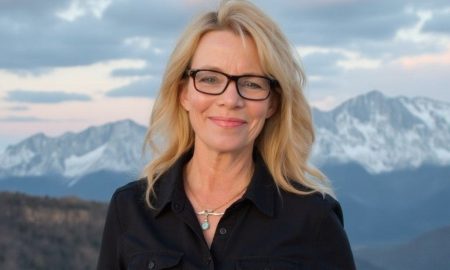


Today we’d like to introduce you to Caitlin Wadman.
Caitlin, please share your story with us. How did you get to where you are today?
The story of how I made Colorado home is a colorful, unexpected, and bittersweet journey. I was born in Virginia and raised in a suburb outside of Houston, TX. I am so grateful to Texas for providing me a great education and lifelong friends. That said, Texas never felt like home to me. I always had an understanding that there was a big wonderful world out there waiting for me. Even though I felt this pull, I never made serious plans to leave Texas, because my relationship with my mother was too important.
I had a complicated upbringing marked by a strenuous relationship with my father and the greatest relationship with my mother. My mom was diagnosed with stage 4 cancer when I was 13 and was given just a year and a half to live. During my mom’s long battle with cancer, I became her primary care-taker, a role that I will hold dear for the rest of my life. While attending countless appointments, treatments, and hospital stays I became aware of music therapy. My mom had seen a music therapist at the hospital and excitedly told me about the profession, as neither of us had ever heard about it. That first mention of music therapy from my mom set me on a path that eventually became my career. My mom went on to live for nearly 6 years post-diagnosis. Those 6 years gave us earth’s greatest currency: time. Time to laugh so much we cried, time to make memories of her attending every choir, theater, and piano performance. Time for both of us to grow together in ways we never could have expected. When I was 18, two months before high school graduation, I lost her.
That graduation marked the first important event that my mom wouldn’t be able to attend in a long list of big moments. The thing that people don’t tell you when someone dies, is that you grieve for them on the unimportant days, the quiet moments when you hear their favorite song. Losing my mother was the most difficult, devastating thing that has ever happened to me, and yet it led me to Colorado.
After my mom died, I found that I had been accepted to Colorado State University. I didn’t want to apply there but my mom had encouraged me to anyway. My father tried to forbid me from leaving, and I spent weeks trying to convince myself that I shouldn’t go. I remember a dark spring night where I was driving, crying, hoping for anything to help me make this decision. As I looked up through my tears, the car in front of me had a Colorado license plate, and I’ve never looked back.
During my time at CSU, I made incredible friendships, learned how to grieve, lived with a broken heart, and pursued my passion, music therapy. In my senior year, I met my future husband, and we adopted our first rescue pup together. After a roundabout journey, we settled in Denver and I started my music therapy practice, Mountain Sound Music Therapy (MSMT).
Music therapy is an evidence-based profession that requires a Bachelor’s degree in Music Therapy, a 1200 hour internship, and a board certification exam. At MSMT, we serve people with neurological differences, psychological needs, and people who are grieving throughout the Denver metro area. Starting this business was a huge leap that has challenged me, filled me up, and kept me on my toes from the beginning. It is my greatest joy to be able to impact someone’s life with music therapy. The practice has grown, and we now have two clinicians with many exciting projects in the works.
Has it been a smooth road?
Although I don’t have children yet, I imagine that running a business is a bit like having a child. There are moments of pure joy, and there are times that challenge you to evolve into a better version of yourself. Running a traveling therapeutic practice is challenging because oftentimes, you are the main service provider; There are no products, or, brick and mortar storefronts. We operate in schools, community centers, and client homes so we are constantly driving around the metro area on our way to a session. You may have seen one of us on a drive, it’s hard to miss us with cars full of instruments everywhere or a xylophone serenading you at a stoplight. Given the nature of the travel, and physicality of the job we have to be mindful of burnout, as all helping professions do. We also have to remember how to create music for ourselves. Although there have been many struggles along the way, I am beyond grateful for the ability to own private practice. I’ve tried diligently to view each challenge along the way as an opportunity to grow and to learn. I had no business knowledge when I stepped into the field and have been learning on the go since I started.
Tell us more about your work.
Mountain Sound Music Therapy is a music therapy practice that serves individuals with neurological differences and psychological needs. We work with people in individual sessions and in group settings. Our background is a person-centered approach meaning that we see each client as an individual and create a treatment plan not only based on their goal areas and room for growth but also based on their strengths and their unique abilities.
I am also a certified yoga instructor and work to implement mindfulness and breathing techniques when it is beneficial to the client. Both my employees and I have extensive backgrounds in performance. Although not necessary to be a music therapist, I believe that having a background in performance helps assist our clients in opening up and showing up for their lives.
Often when describing what we do, I find it most helpful to give an example. Here is an example of working with a new client.
Initially, we come in to meet the client, their family and perform an assessment. In our assessment, we gather a wide variety of information, specifically on what their goal areas should be. After we determine their goal areas we create a treatment plan. The treatment plan is a road map for where we want to end up. Some example goal areas are:
Speech/communication- articulation, fluency, length of phrases, expressing wants/needs
Cognitive- academic skills, attention, memory
Social/Emotional- building self-esteem, teamwork, expression
Motor- gross/fine motor, range of motion, gait
We use musical interventions to accomplish these goals. An example of a musical intervention would be songwriting to assist the client in processing something in their lives or using a drum to help with motor planning by moving the drum into different spatial planes and having the client hit the drum successfully to the beat.
How do you think the industry will change over the next decade?
We hope that in the next decade, music therapy will be a service that is as readily accessible as other therapies. At MSMT specifically, we aim to broaden our reach across the Denver metro area to serve a greater number of people with intellectual differences.
We are also branching out to include the grief and loss population, which is very dear to my heart. I’ve lost my beautiful mother, a best friend, and my father. Grief has changed from something I know nothing about, to an ever-present shadow reminding me of the ones I’ve loved and lost. I have learned so much over the past 10 years in my grieving process and am hoping to share what I have learned with others. MSMT is proud to be collaborating with an amazing local Buddhist Psychotherapy practice, Humble Warrior Therapy, in creating a space for people who are experiencing grief. Stay tuned for more information!
Contact Info:
- Website: www.mountainsoundmt.com
- Phone: 9706828499
- Email: caitlin@mountainsoundmt.com


Suggest a story: VoyageDenver is built on recommendations from the community; it’s how we uncover hidden gems, so if you or someone you know deserves recognition please let us know here.
Popular
-

The Trailblazers: Rewriting the Narrative
-

Celebrating the Spotlight: Kaytee Shashore Turns Milestones Into Momentum
-

Humanity in the Machine: Alexander Raye Pimentel’s Cyborg Recall Questions the Cost of a Data‑Driven World
-

Raemi Anderson on Courage, Caution, and Answering the Call of the Landscape
-

Hidden Gems: Local Businesses & Creatives You Should Know