

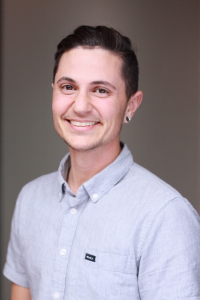
Today we’d like to introduce you to Sorin Thomas.
Sorin, before we jump into specific questions about your organization, why don’t you give us some details about you and your story.
I think it’s important to start by saying I grew up in two cultures living in Europe with my immediate family, and traveling to the US to visit my extended family. So I grew up moving between worlds. I also grew up with a blended family and a family of mixed socioeconomic status. That contributed also to who I am, how I move through the world, and what I value.
I was assigned female at birth. When I was a child, I was socialized as a girl but didn’t feel like a girl. The only other thing that I knew was “boy” and that also didn’t feel right to me, but I didn’t yet have a language to describe my gender. So, I moved through a lot of my life into my twenties as a girl and a woman and ignored a lot of the messages that I was receiving about what that meant, in order to found my own way.
I don’t belong and don’t feel like things apply to me often, and I’ve also found a way to integrate into lots of different cultures and communities. If I were to describe my identity, I would say that I am somebody who belongs nowhere and can find myself everywhere.
I came out as queer in college, and then as transgender in graduate school. When I was in graduate school, I met the first out of the nonbinary person that I had ever met. That person became my mentor personally and professionally. I began to develop the language for a gender identity that I didn’t know existed, and that felt the most congruent of anything I’d heard before. I began to transition socially and medically.
I became very interested in providing queer mental health services because of the experience I had while I was transitioning. Transitioning required a psychological evaluation – I had to prove my sanity in order to have access to medically necessary procedures. I felt humiliated by that process. And I didn’t want other trans people to experience that if it could be done differently. I started to think, what would it be like to do that process differently?
I had the idea of starting a mental health organization where queer & trans professionals were the counselors. Maybe the clients’ entire experience wouldn’t be understood by the counselors, but there would be a foundation already built for more compassion and grace and understanding.
Then this mentor of mine helped me to conceive of it. They gave me a crash course in the work that they’d been doing, and effectively passed the baton, saying, “If you want to do these educational training, there’s a need and a community.” I began to offer training, using aspects of my mentor’s curriculum and what they taught me both through their knowledge and their embodiment. Since then, I’ve further developed the Queer Asterisk education department, built around my idea of what it means to queer therapy.
After graduating from Naropa University with an MA in Somatic Psychology, I started as a private practice counselor seeing trans clients, working in this queer lens.
We incorporated as a nonprofit in 2016 and have since expanded our clinical services to provide supervision, counseling, and peer mentorship. I became a Licensed Mental Health Counselor and a Licensed Addictions Counselor. And I continued offering more and more educational training about queerness & inclusivity for local organizations, social services agencies, hospitals, and schools.
Our education department has moved away from disseminating knowledge, and developed into a therapeutic transmission of the seed of a new culture, a new paradigm. This is a radical shift. My passion over the past few years has been with developing through my clinical work, my mentoring of others, and the training I offer a new framework for therapy that I refer to as “queering therapy.”
With the incorporation as a nonprofit, we added community gatherings and ongoing group therapeutic programming. Queer Asterisk now offers groups and sober, family-friendly events to the community, where the focus is really on deep meaningful connections. Something that makes our organization unique is that we’re not an LGBTQ organization, we’re a queer organization. To us, that means we’re inviting people to participate who resonate with queer culture, regardless of identity, which encourages communication across similarities and differences.
That’s where my upbringing in Europe has been influential. I grew up in an area of the world where lots of countries are very near to each other in proximity, and it seems to me that there is more of a capacity to relate across difference. In my opinion, the US struggles with that. Many people here have said to me that they don’t feel safe unless they’re with people who are similar to them in experience and presentation.
That feels sad to me and seems to be the opposite of our intention in this country. There’s a lot of craving to be able to be closer and celebrate difference and love thy neighbor all of these messages. But I feel like we don’t always have the skills to do that. It’s something that a lot of us value, but not everybody always knows how to do myself included. So we need to practice doing that holding onto our unique identity, and also connecting with someone who doesn’t have the same experience and voice as ours.
Another thing that makes Queer Asterisk unique is that we are giving queer folks a meaningful platform for sharing their gifts with the community. We are part of a cultural shift that’s allowing for the unique gifts of queer people to be better recognized and received. All this work we’re doing around nonbinary thinking…what it highlights is that folks with intersecting identities and nonbinary identities have a lot of lived experience and practice and wisdom for the larger culture, around how to move away from black-and-white thinking, good vs. bad. This is about liberation. (That’s where our tagline “Freedom to Transform” comes from.)
To me, there are two parts: empowering queer & trans individuals to find their gifts and really believe in themselves, and then also tilling the earth and tending to a cultural paradigm shift, so that the world can be more ready to welcome those gifts.
Overall, has it been relatively smooth? If not, what were some of the struggles along the way?
On the one hand, a lot of doors have opened up for our organization, I believe because of the time and place in which we’re doing this work. For our educational training programs, there are so many mental health practitioners out there who are recognizing the need to fine tune their skills to meet the needs of queer & trans clients. Companies recognizing the need to do the same for their employees, schools to do that for their students. We don’t need to go out there and wake people up. It’s been a pleasure to give training to people who are already really wanting them.
That speaks to all the work that’s been done by the elders in my community. The culture is more ready than ever for the services we’re providing.
Our clinical services have also really taken off because there are a lot of people right now who are questioning binary sexuality and gender, the heteronormative road map. People are coming to us wanting therapeutic support around their gender and sexuality, or they’re wanting to work with a counselor who has a base-level understanding of what it means to be queer. There are not a lot of queer mental health organizations out there. I’m grateful that we found our niche.
On the other hand, there have been a lot of bureaucratic struggles. There were hurdles to face as a counselor fresh out of graduate school, working to accumulate status as an organization providing mental health services to the community. I’m trained as a therapist, not as a business person, and so I’ve learned how to be an executive director while on the job.
It was really important for us to take insurance as a nonprofit, and getting credentialed with insurance panels took a long time. That was initially a huge challenge. In the beginning, we relied almost exclusively on money from services provided. It took us a while to develop the infrastructure to be able to expand and reach out to donors and apply for grants.
I think people expect to hear that we’ve received hate mail, or not been welcomed. Fortunately, none of that has happened.
We’d love to hear more about your organization.
I’m really proud of our peer mentorship program. Our peer mentorship program provides an affordable therapeutic service that isn’t therapy which some people are intimidated by, or don’t need, or can’t afford. The mentee receives guidance and mentorship from someone who is established in their identity and the community. This is SO IMPORTANT because not everyone has access to queer & trans role models. Historically, there hasn’t been a lot of good portrayal of queer & trans people in the media. A lot of us are still operating in survival mode, and don’t have opportunities to be mentors. Being a mentor provides a sense of purpose and belonging. There’s a lot of queer & trans people who want to nurture the next generation of queers (which doesn’t necessarily have to do with age).
Something else I’m excited about is the way we give educational training. We are helping people work with their shame, their fear and their learned defensiveness around this topic. We invite curiosity and strive to be welcoming and inviting so that people can learn more, listen more, and be included in this paradigm shift.
In our clinical program, we are working with queer and trans people to support their mental and emotional help. That’s extremely important, and all people need that. We’re also working within that setting to uplift queer and trans people to bring their unique gifts to the world. I’m excited about moving away from a stereotype in which queer folks are constantly the recipients of services. Indeed, there isn’t equity yet in this world. But, we want to not only serve queer and trans people better…we want to shift our culture so that all of us belong better, including queer and trans people. We want to create a world in which queer and trans people are seen as valuable members of society, with valuable gifts to give. And we want to create environments that nurture queer & trans folks, encouraging them to share their unique gifts with the world.
In our community gatherings, I’m really excited about working to change the stereotype of queer & trans people as sexually deviant, pedophilic, and hypersexualized. It’s been really important for us to have everything that we do be sober and open to families. If as queer people, we feel like who we are should be relegated to bars and hookup culture, Queer Asterisk gatherings are actively countering that limitation by bringing ourselves more into the light.
Any shoutouts? Who else deserves credit in this story – who has played a meaningful role?
Freeda is the co-founder at Queer Asterisk. Freeda Be (Brett Adamek) reached out to me as soon as our website was launched. He expressed interest in being part of the organization right away and has been working alongside me as a clinician and co-director. Freeda has been with me behind every creative idea that has set Queer Asterisk apart….Freedom to Transform, Queer like Water, our signature Queer Evolution t-shirt design. He has balanced out the leadership as a true visionary at Queer Asterisk, and he has brought a level of spiritual depth to the organization that would otherwise not be there. His presence has been essential to the continued development and growth of our organization.
Patti Kay has been our volunteer accountant and financial advisor from the start. She is Freeda’s mom, and her unofficial role has been to look after us, to take care of us, and to help us take appropriate risks while being conservative about our business. We wouldn’t be here without her. Because of Patti, our organization feels like a small family business.
Gus Spheeris is our legal advisor. When we were started, I tried to incorporate it as a nonprofit through a corporate legal entity, and it didn’t work out. Someone recommended attorney Gus Spheeris, and it turns out he is the perfect fit for our organization. He has become a dear friend and has volunteered a tremendous amount of time to this organization to help us establish ourselves. His legal council has substantially strengthened our organization. As a young organization, it’s been so important to move forward with ethical integrity as we find our way. Gus has played a big role in making that possible.
Avani Dilger has been my mentor since I moved to Boulder 15 years ago. She played a significant role in encouraging me to study somatic psychotherapy at Naropa University. She has run her youth substance abuse prevention organization called Natural Highs for many years, which I used to volunteer at. Avani was my supervisor and provided guidance as I was starting this organization. I moved quickly from being a therapist to being a supervisor and director. In the beginning, I was very nervous about being a relatively new clinician, taking on all this responsibility. She encouraged me that I should be the one to do the job, and she believed in my ability. Avani is such a like-minded and like-hearted person who has given me lots of advice over the years, encouraging me to keep doing this valuable work in the world.
Diane Israel is a beloved professor at Naropa University who is the chair of our board. She has been a friend and mentor of Freeda’s for a very long time and has become a friend and mentor of mine. She has been a fierce supporter of our vision, even in the shaky moments. Diane has given us a broader perspective, as a queer elder who has worked in the counseling field for decades. Diane has helped us make some of the most valuable connections in the community, many of which have turned into lasting partnerships that shaped the course of who we are and what we do.
Board of Directors: Diane Israel, Shira Frank, Robyn Chauvin, and Anne-Marie DiGiacomo. I didn’t fully understand the value of a Board of Directors until this group came along. These individuals have offered invaluable support to Freeda and myself based on their years of experience. When I lost my day job, I asked the board how we wanted to move forward, and if they were willing to take a huge risk and hire me full-time as executive director (I’d been volunteering my time). They were a resounding “yes” and they worked to make it happen. I felt so supported to pursue my vision. They also recently secured a significant donation that’s going to ensure the sustainability of our organization. Many times, I’ve gone into a Board meeting feeling panicked, and I’ve left feeling like everything’s going to be okay. These people truly believe in our organization – when I hear them talk about what we’re up to, they speak with so much pride and passion. I am incredibly grateful for their dedication and generosity.
Luca Sisca originated our foundation group, Queer Conversation. Before our organization even started, Luca was gathering queer folks together in Boulder to discuss identity and diverse experiences of moving through the world. From the start, it was clear to me that Luca embodied what we were after with this organization. When I wanted to bring someone else on board to help grow our organization, he was a natural fit. Luca is a visionary leader, who has a deep understanding of queerness, social justice, and contemplative work. He supported the administrative and community relations work for the first two years at Queer Asterisk. I have so many fond memories of the two of us going around to organizations, in the beginning, introducing ourselves and the work we do. We both had imposter syndrome as two young queer professionals working to establish ourselves and build relationships. It was so wonderful to have them as a colleague in the early days of Queer Asterisk, and they remain a close friend and inspiration.
RP Whitmore-Bard and I started dating around the time that Queer Asterisk was forming. RP is also a Naropa trained therapist, who has been with me and this organization from the very beginning. I remember when RP and Luca and Freeda and I and only one community participant sat in Queer Conversation, really forming the culture of this organization and shaping our offering. RP has been invaluable to the founding of this organization they are listed as one of the incorporating members of Queer Asterisk. They didn’t have a formal role, other than as my very very supportive partner. RP has stayed connected to the organization and dedicated to our work in an incredibly supportive capacity this entire time. RP has been a huge supporter of the organization, but also the primary supporter of me. They are my support person as I’ve taken on being the founding and executive director of a nonprofit. Everything from interviewing me for articles, to joining me at events to get the word out, to encourage me when presentations didn’t go as well as I’d hoped. Ultimately, what RP offers is a deep understanding of what we’re up to because they truly helped create this organization. RP has always had so much energy for our community and our program development. Their gifts are really in bringing people together; having their finger on the pulse of what our community wants and needs in terms of programming, and bringing it forward.
Contact Info:
- Address: BOULDER OFFICE
2027 Broadway Suite E
Boulder, CO 80302 DENVER OFFICE
1155 Sherman Street Suite 311
Denver, CO 80203LONGMONT OFFICE
1823 Sunset Place Suite F
Longmont, CO 80501FORT COLLINS OFFICE
23 Old Town Square Suite 250E
Fort Collins, CO 80524 - Website: queerasterisk.com
- Phone: 720-507-6161
- Email: info@queerasterisk.com


Image Credit:
Sorin Thomas, Freeda Be (Brett Adamek), Jared Polis
Freeda Be (Brett Adamek), Tosha Jorden, Atlas Tann, Luca Sisca, Chris Aguilar-Garcia, Sorin Thomas
Basil Ross, Trace McManus, children, Atlas Tann and Tosha Jorden, RP Whitmore-Bard
Suggest a story: VoyageDenver is built on recommendations from the community; it’s how we uncover hidden gems, so if you or someone you know deserves recognition please let us know here.
Popular
-

The Trailblazers: Rewriting the Narrative
-

Celebrating the Spotlight: Kaytee Shashore Turns Milestones Into Momentum
-
Humanity in the Machine: Alexander Raye Pimentel’s Cyborg Recall Questions the Cost of a Data‑Driven World
-

Raemi Anderson on Courage, Caution, and Answering the Call of the Landscape
-

Hidden Gems: Local Businesses & Creatives You Should Know