


Today we’d like to introduce you to Scott Bennett.
Scott, can you briefly walk us through your story – how you started and how you got to where you are today.
As a kid, I loved cars and racing and decided I wanted to design Formula one cars, so I went to college in England to study Automotive Engineering. I made it into Indycars, helping design an Indy 500 winner, but the business had pretty drastically changed in the time between when I was a fan and when I was in it. There was a movement to slow the cars down and cut costs, and it really took a lot of the fun out of it. I randomly ended up doing some freelance design and engineering work in furniture, and through that cofounded a baby furniture company.
We produced everything in Asia, and it was all very mass-market, standard stuff. That process got me really down- we cut down trees in North America, ship them to Asia, turn them into furniture, and ship them back. Then we ship all the packaging waste back to Asia for “recycling.” You feel like part of a huge system that’s running on its own and obliterating everything in its wake.
I started thinking about some of the furniture I had been messing around with over the years on my own, and whether that could be done differently. Through racing, I knew a lot about materials and advanced manufacturing, and basically nothing about normal woodworking. So I designed what became the Key modular storage line- designed to be made by CNC machines (this was before that technology had really started to filter down to the masses), zero VOC finishes, FSC certified wood, 100% paper-based packaging (again, way before anyone was worrying about plastic permeating the environment), easy to ship and assemble, and meant to last a long time. I put it online and it started to sell, and that was it.
We started to add products, got our own machine, moved out of my garage, and started to be asked to do more commercial spaces- restaurants, offices, schools, and so on. It has been years of just trying different things. Most of it doesn’t work, but a few do.
We’re always bombarded by how great it is to pursue your passion, etc – but we’ve spoken with enough people to know that it’s not always easy. Overall, would you say things have been easy for you?
Not at all! Even after ten years I still don’t feel like I’m qualified to run a business. Every single aspect of it that isn’t the design, engineering, or development of product is an uncomfortable struggle. Sales, finance, managing people, all of it. I would love nothing more than to hand that stuff off to someone else and just focus on what I’m good at. In hindsight, I should never have started the business on my own, and waited until I could find a partner to share the load. The stress is almost overwhelming a lot of the time, but you just have to keep going.
So let’s switch gears a bit and go into the Housefish story. Tell us more about the business.
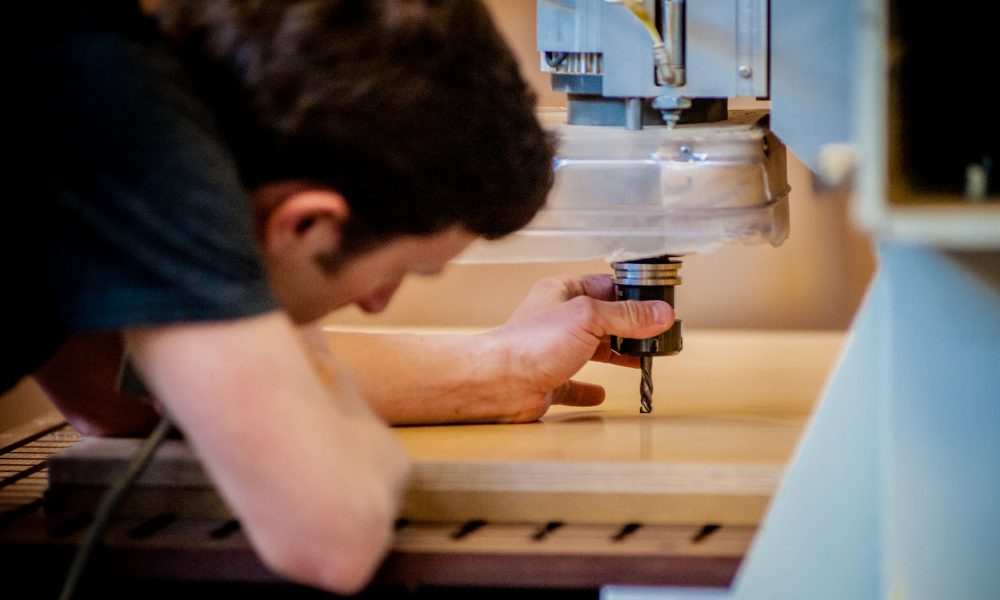
Housefish, at its core, is trying to define a new paradigm for manufacturing not just furniture, but almost any product. I don’t believe the model we’ve used for the last 25 years or so, where we outsource all of it to China and SE Asia is viable for more than another 5-10 years. And nobody has an alternative yet. We are not going to build giant furniture factories in the US again. Automation in the form of computer-controlled machines and robotics is filtering down to levels where very small companies can bring it in and compete with anyone. Housefish’s efficiency is 3-6 times better than similar companies our size. We can produce with a couple people what normally takes 6-12 people.
Our business has been all over the place: residential furniture sold wholesale to traditional and online retailers, direct sales, commercial furniture through designers and architects, pretty much every category has been something I’ve tried. The whole company was an experiment, and that mindset carries through to everything. We’ve been lucky to be asked to help with a number of high profile spaces that are seen by lots of people: Avanti, Birdcall, Uchi, Whole Foods.
I don’t tend to feel much pride- it’s adjacent to hubris, and once you go there, you’re setting yourself up to fail. But I’m pleased that the Denver Art Museum put one of our chairs in its permanent collection, and that we were asked to exhibit at Ventura Lambrate in Milan twice.
I think what sets us apart is our robust design and engineering capability, and our commitment to finding clever solutions to problems. I’m not interested in being a fab shop and just making stuff that other people have designed. Every time I’ve caved in and done that, I’ve been disappointed. Our value comes from the ideas we bring.
Has luck played a meaningful role in your life and business?
“Luck” is just another word for events that are outside of our control, which is to say, most events. All we can really control is our reaction to what goes on around us. So luck, or fate, plays a dominant role in everyone’s life, but it’s not necessarily good or bad, it’s neutral on its own. Our response is what’s important.
I could make a long list of all the good luck events (people, projects, etc.) that got us where we are today, or I could just as easily make a long list of bad luck events that kept me from getting to where I wanted to go. It’s irrelevant either way. We just have to do our best to deal with what’s in front of us today, right now.
Pricing:
- Planar chair, $349
- Key module, medium height, walnut, with doors, $698
- Lock barstool, $379
Contact Info:
- Address: 4800 Washington St
Unit E
Denver CO 80216
(workshop open by appointment only) - Website: housefish.com
- Phone: (720) 295-5068
- Email: info@houefish.com
- Instagram: https://www.instagram.com/housefishdesign/
- Facebook: https://www.facebook.com/housefish


Image Credit:
Kylie Fitts, David Pahl, Ali Vagnini
Suggest a story: VoyageDenver is built on recommendations from the community; it’s how we uncover hidden gems, so if you or someone you know deserves recognition please let us know here.
Popular
-

The Trailblazers: Rewriting the Narrative
-

Celebrating the Spotlight: Kaytee Shashore Turns Milestones Into Momentum
-

Humanity in the Machine: Alexander Raye Pimentel’s Cyborg Recall Questions the Cost of a Data‑Driven World
-

Raemi Anderson on Courage, Caution, and Answering the Call of the Landscape
-

Hidden Gems: Local Businesses & Creatives You Should Know