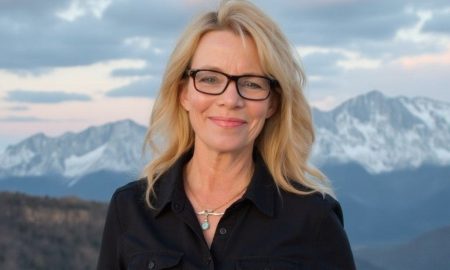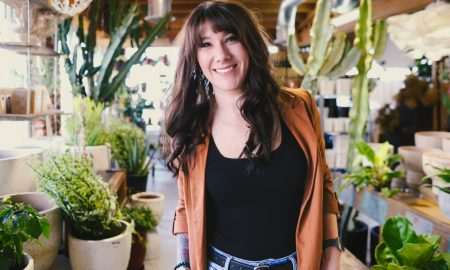


Today we’d like to introduce you to Erica Tardiff.
Erica, let’s start with your story. We’d love to hear how you got started and how the journey has been so far.
As a child, I became fascinated with nature. Growing up in the woods of central New York, I spent my time flipping rocks over to collect salamanders and insects and deeply observed the plants and animals surrounding me. I was so enamored with nature that my mother used a bell to call me home for dinner.
As I grew into a young adult, my wonder with nature remained and I grew into passions for fishing and protecting our natural resources. This led me to pursue my undergraduate degree at SUNY Environmental Science and Forestry in Environmental Biology. During this time, I learned a great deal about natural resource management, deep data analysis, and had the opportunity to do lots and lots of field sampling in beautiful locations throughout central New York and on the small tropical island of Dominica.
I took a few years off after my undergraduate degree and worked in the veterinary world. I toyed with the idea of going to veterinary school and even took some extra classes in my free time to get in. But, I knew if I went to veterinary school, my future would be decided. I always have been a dreamer, and I wanted to feel like I was making an impact on the world as a whole. For the past few years, I’ve thought about the notion that there is this huge gap in our system of thinking and action. Science does have (most) of the answers. We know what practices are harmful for our climate, our bodies, etc. It is the policy and practice side of things that struggle to enact these positive changes. So, I had the idea that if we could create profitable businesses that also uphold our climate and health, why not focus on creating these? This led to a deep search of what program might give me the tools to do such a thing, and I landed at Colorado State University, earning my MBA in Global, Social and Sustainable Enterprise (now called the Impact MBA). This program helped me to form the basis of my start-up, Nobilis Aqua, a fish feed company that uses invasive Asian Carp as the main source of protein instead of wild-caught ocean fish, which traditional feeds use.
Overall, has it been relatively smooth? If not, what were some of the struggles along the way?
Simply put, no. My journey has had bumps in the road, and it still does. Owning a startup has been a difficult and slow process. My business partner, Kelly, and I have put a lot of time and work into our business. We’ve travelled to compete in business competitions and left empty-handed. We’ve had difficulty with communication with co-packers and manufacturers on occasion, which slows our progress. And most recently, we’ve been struggling with an issue regarding the physical capability of our co-packers machinery to process our fishmeal. Most days, I wish all of the parties involved were my neighbors, and that I could just knock on their door. Unfortunately, that isn’t how this all works. And, as a startup, we are lower on the priority list for our manufacturer and co-packer.
My advice on these issues is to remain tenacious. Have questions and issues to talk about lined up for when the opportunity to communicate does come. Also, realize that any opportunity to compete in business competitions, forums or conferences is positive. At the very least, you’ve formed new contacts and you’ve gotten your name out there. On a personal level, I’ve had difficulty finding a job. I think that the job market here is particularly competitive and that many people I’ve interviewed with know I have this startup. I’ve worked as a restaurant manager to stay afloat and am continuing to search for a career job.
Some days, its difficult to remain positive about all of this, but I know it is something I’ve worked very hard for and am very passionate about. My advice for young entrepreneurs is to find a way to make your project relatable. Some businesses are easy to do this with, I believe, particularly social businesses. These are the “fuzzy polar bears” of the business world. But, if you own a “weird creepy crawler” business- you have to find a way to make people care. This was something Nobilis Aqua struggled with in the beginning, but we’ve overcome that by making the story more visual to understand the impact that the Asian Carp has on the ecosystems it has invaded. Find your way to do this- and get advice from others.
As a woman that owns a startup in a male-dominated industry, I would say its important to be confident when you speak and to be a master of the information that you have. Don’t be afraid to speak up. I’ve been in several situations where men I’ve been talking to only look at my business partner, who is also male. It’s frustrating, indeed. I cope with this by showing them I know my stuff. Not in a cocky way, but prove to them that you know what you’re doing.
Alright – so let’s talk business. Tell us about Nobilis Aqua – what should we know?
Nobilis Aqua was formed out of CSU’s Impact MBA program. We create fish feeds from invasive Asian Carp. The business has a dual ecological benefit because it avoids using ocean fish to create feeds while creating a market for the invasive Asian Carp.
During our MBA program, my team travelled to and camped in Illinois, Kentucky, Idaho, and British Columbia. We researched Asian Carp with Kentucky Fish and Wildlife service and met with the Illinois Department of Natural Resources. In Idaho and British Colombia, we visited fish farmers and met with a business who was creating feeds from an invasive shrimp. We brought Asian Carp back from Kentucky and created fishmeal from them in my backyard using a meat grinder and a dehydrator. We got these samples analyzed and were impressed with the results.
Fast forward to two years later, and we are currently in the process of producing our first trial run of feed, which we couldn’t be more excited about. We raised about $15,000 from friends, family, and supporters on GoFundMe to produce our first run. Our feeds will be tested at Frontier Trout Ranch in Southern Colorado. We hope to have the testing started in the next few months. I am particularly proud of my business because its a culmination of everything I’m passionate about- sustainability, fishing, and protecting natural resources.
We’re interested to hear your thoughts on female leadership – in particular, what do you feel are the biggest barriers or obstacles?
I think the biggest barrier to female leadership is the constant notion of feeling like we have to prove ourselves worthy. Women are challenged more than men to prove that they know things and are capable of a job. I think that this whole issue has come a long way, but it still exists nonetheless.
In the aquaculture feed space, it is definitely a male-dominated industry, although I’ve met many amazing females within the industry as well. They are well respected and incredible at what they do. For this industry, I believe it comes down to more degrees being pursued by men than women.
In general, I think there needs to be a huge push for women to pursue STEM degrees, and I think these efforts do exist. In the future, I’d like to see more women working professionally in science fields.
Contact Info:
- Website: nobilisaqua.com
- Phone: 3154126268
- Email: eltardif@gmail.com
- Instagram: @nobilis.aqua


 Image Credit:
Kelly Haugen
Suggest a story: VoyageDenver is built on recommendations from the community; it’s how we uncover hidden gems, so if you or someone you know deserves recognition please let us know here.
Popular
-

The Trailblazers: Rewriting the Narrative
-

Celebrating the Spotlight: Kaytee Shashore Turns Milestones Into Momentum
-

Humanity in the Machine: Alexander Raye Pimentel’s Cyborg Recall Questions the Cost of a Data‑Driven World
-

Raemi Anderson on Courage, Caution, and Answering the Call of the Landscape
-

Hidden Gems: Local Businesses & Creatives You Should Know