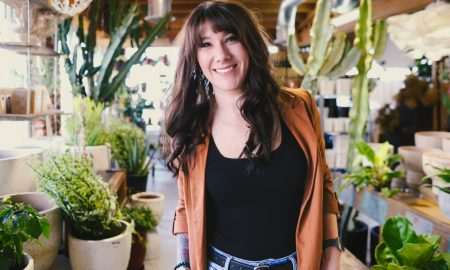


Today we’d like to introduce you to LeeAnne Sanders.
LeeAnne, please share your story with us. How did you get to where you are today?
My current life as a small market farmer is something I never envisioned.
I grew up in the Midwest in a typical suburban neighborhood with, essentially, no exposure to farming. While my father’s side of the family owned commodity crop fields in the southeast of Missouri, the family leased out the land to other farmers and had little involvement in them. My immediate family didn’t even keep a vegetable garden and I grew up not knowing anything, really, about raising food. Like many kids, I enjoyed spending time outside, but I certainly wasn’t known as a particularly outdoorsy type. In fact, I was rather nerdy. Quite nerdy, and most of my focus through college was on academics. I got a degree in Spanish and then a Masters in Education and went into teaching. It wasn’t until I bought my first house in my twenties that I realized how much I enjoyed digging in the dirt. The house came with zero landscaping, and putting in the first few flower beds and planting a couple of trees, I found that hours would pass with my hands in the soil and I would be completely oblivious to the time. I also discovered the I enjoyed mowing the lawn, building walls and beds, essentially anything that fits under the category of “yard work.”
When I moved to Denver from the Midwest and bought a house there, I ventured from just playing with landscaping and basic flowers to attempting my first vegetable garden. That first garden, overall, was a spectacular failure. Coming from the Midwest, where we have decent soil and lots of rain, I thought that one planted a vegetable garden by literally digging up the ground and planting seeds or vegetable starts. I cannot emphasize how little I knew – nothing about sunlight requirements for plants, soil quality, pest or insect control, nothing. That first year, I managed to kill most of the baby tomato plants by under-watering. The ones that survived I planted in too much shade, so they ended up dying, too. I planted carrot seeds in straight clay soil and got carrots stubbier than my thumb. The onions stayed the exact same size (scallion size) and did not grow the entire season. And yet… I was hooked. The few things that came out of that terrible garden tasted so good and I was so proud of growing them, that each consecutive year I expanded my space and begin learning about the basics of keeping vegetables alive. I added compost, moved the beds to sunnier locations, and started bringing in some decent produce from a small Denver backyard. I also became an avid reader on the modern food system, and the more I learned, the more horrified I was at where most of our food came from, and so one year, I made a mental commitment to become self-sufficient, to be able to sustain myself on my own land, however small.
In 2014, I moved up to Berthoud in Northern Colorado with my now-husband, who was also an avid gardener. We purchased a house on a small piece of land – 1.5 acres – with the goal of doing what I had promised myself years before – becoming self-sufficient in food supply. Upon purchasing the house, the first thing I did was start digging a garden. My husband wanted me to wait, he suggested we walk the property, get to know it, discuss the best spot. I pointed to a flat piece on the west side of the property, said “This is the best spot,” got out a shovel and started digging. Finally, he just threw up his hands and started helping me.
Since we were new to Berthoud, I was looking for a way to meet people and saw on social media that the town was beginning a farmers market and looking for volunteers, so I signed up to help for a couple of weeks. I ended up volunteering the entire season, then becoming the co-president of the non-profit that ran the market. Just like with gardening, I was hooked. I loved the local food focus of farmers markets and the community they create. I spent every weekend at the market chatting with folks and getting to know more about our new town. But much like my first garden, that first market season was rough. We began with something like six tents and only one produce vendor who only sold tomatoes and cucumbers. We discovered that produce vendors are extremely hard to find. Most of our agriculture in the United States these days is large-scale farming of monocrops that are then shipped all over the country (or, often, in from other countries.) Finding small farms that grow a variety of produce and can support local markets is difficult.
It was at about this we were having this discussion as a market that, at home, I was pushing off beets and cucumbers to anyone at work who would take them. I was threatening friends with “drive-by zuke-ings” telling them if they weren’t home, I was going to go by their houses just to fill them with zucchini. In the midst of the summer harvest, I looked at my husband and said, “What if we became market vendors?” And that was it. That fall and winter we planned an even bigger garden and began selling. We later formed an LLC for the farm and made it an official business. We’re in our fifth season now, and our farm has evolved but we still love what we do, and we love the contribution it makes to our local community.
Overall, has it been relatively smooth? If not, what were some of the struggles along the way?
Farming is brutally hard, and I say that knowing that we are on the smaller and more manageable end of things. We have a slew of farmer friends working much bigger and more difficult projects than ours and regularly take our hats off to them.
I wouldn’t be a farmer if I didn’t mention the weather. Growing anything in the Front Range climate is quite the task. Last year, I counted six hailstorms on our property during farm season and while we got through all of them without huge losses, each one was a lot of hand-wringing at the windows praying the hail would stay small and end quickly. Every farmer we know in Colorado has had major damage from hail at some point. This year, we got snow on May 21st, which wiped out all the cucumbers we had just planted. Another year, we had a surprise frost in mid-September which is the biggest harvest month for us and spent hours bringing in as much produce as we could harvest so we wouldn’t lose it. I must say, I enjoyed the weather, especially extreme weather, a lot more before I started this venture.
Weather aside, however, our biggest struggle, and that of many, if not most young farmers, is access to land. We try and utilize our small piece of land efficiently and pull an amazing amount of produce off a small space, but a couple of years ago we begin specializing in garlic. Garlic, while a hearty crop, is also prone to a handful of nasty diseases and the best way to prevent these is to keep it on a 3 to 4-year rotation. That means that once we plant garlic in one spot, we can’t plant it in the same spot for at least three years. The end result is that whatever quantity of garlic we want to grow, we need to find about four times that space in land. We quickly outgrew our small property. However, as anyone who lives in the Front Range knows, land prices here are horrifically expensive and it seems that all available land is being snapped up for development. Additionally, the profit margin on vegetables in pretty thin to say the least, so there’s no way we can purchase land at Front Range prices and have any prayer of even breaking even. So far, we have worked around this problem via our wonderful network of friends who have leased us land to use. Each year, we have moved the garlic to a different location, but this, too, is less than the ideal. Land that is farmed needs to be carefully tended to. Ideally, a farmer puts effort into building her soil year after year after year. In the type of sustainable farming we do, there is no “quick fix” to poor soil. It’s years of care. By moving our garlic to a different site each year, we’re dumping too much money into amending the soil, fertilizing, getting weeds under control and then we’re just moving again and have to start from scratch. It’s inefficient and certainly effects the quality of what we grow. We need to find a permanent way to do this, but admittedly, we haven’t yet. In the meantime, we’re just plugging away and hoping things work out.
While both of the challenges above are pretty typical challenges for any farmer, we had one major unanticipated bump in the road. Just a year and a half into our farming venture, my husband was unexpectedly diagnosed with multiple sclerosis, an autoimmune disease that attacks the brain and often results in muscle and mobility issues, providing a whole new set of challenges to a lifestyle that requires a lot of physical labor. We went through a year of him being pretty sick and wondering if we were going to have to shut down the whole farm, but we made it through, adjusted to a new normal, learning what he can and can’t do. When you asked about challenges, the first thing to come to mind was weather and not multiple sclerosis so that is indicative as to just how far we’ve come.
As for young women who may just be beginning a journey into farming (or into anything, for that matter), my two pieces of advice would be simply: 1) Go for it! and 2) Find other women who are doing the same (or similar) things and make them your tribe. Women are definitely a minority in farming, but we’re a minority that is slowly growing. I have been lucky to build a community in our area of female farmer friends who are complete badasses, which only makes me more confident that farming is something I am capable of. And women are excellent at taking care of one another. When a thunderstorm rolls in, texts are flying to check in on one another to see who got hail. When one of us has a loss – an animal dies, a crop gets flattened – these are friends that can offer support that comes from a place of genuine understanding. I feel like it’s the same for any woman in a business where she’s a minority. It’s going to be hard. Find other folks who know just how hard it is and can offer a helping hand through those rough patches.
Please tell us about Lake Hollow Homestead – what should we know?
In tandem with my husband, I run Lake Hollow Homestead, a small garlic farm in Northern Colorado that specializes in gourmet culinary garlic, seed garlic for hobby gardeners, and garlic-related cottage foods such as garlic salts and powder. We also grow small amounts of additional produce such as cabbage, beets, carrots, and turnips.
Everything we grow is grown sustainably or regeneratively. We care deeply for our land and use no synthetic pesticides, herbicides, or fertilizers. We believe in growing healthy soil to grow healthy food, and we invest great time and care in tending to our plants.
Just like we believe in investing in our soil and food, we also believe deeply in investing in our community. Based out of the small town of Berthoud, we have been involved in the Berthoud Farmers Market since it began, and currently that is the only market we sell out of. There is something inherently wonderful about being at a market where we know most of our customers by name, where we trade tips and tidbits, and where people seek us out at the first market of the season and exclaim, “Your back! I’ve missed your garlic soooo much!”
We take great pride in being a small-town farm. We make it a challenge to ourselves to grow the nicest-looking produce at the market. This year, we grew 7,000 heads of garlic, and each one of those will be cleaned, sorted, and inspected by hand which is not a quick process. But we guarantee that every head we put on the table will look beautiful.
We are proud to be small, local, sustainable growers and we believe that what we do is one small way of making the world around us just a little bit better.
We’re interested to hear your thoughts on female leadership – in particular, what do you feel are the biggest barriers or obstacles?
In farming, one of the biggest barriers to female leadership is, quite simply, the lack of it. Leaders grow leaders, and for a female farmer just starting out, it can be difficult to even find another female farmer, much less one willing to serve as a potential mentor. Luckily, I truly believe that is changing, even if slowly.
There is also still a bit of a stereotype that hard physical work is the domain of men. I spend hours upon hours outdoors doing heavy work of varying types, and yet due to my relatively small frame some people have a hard time understanding just how much work I can actually knock out. I remember one afternoon when I was moving loads of compost with a wheelbarrow to our newest beds, a friend of my husband’s came over to hang out with him for the afternoon. He offered to help my husband with the compost so I could take care of other chores, which I happily agreed to. Later that evening, when the friend had left and my husband and I were having a drink on the back patio, my husband said, “Man – don’t ever let John help me again. He’s useless. He took forever to move that stuff. You would have had it done in half the time.” I have to admit, I got a smug pride out of outworking a six-foot-plus man that most would have assumed could have kicked my butt any day.
Contact Info:
- Website: www.lakehollowhomestead.com
- Email: info@lakehollowhomestead.com
- Instagram: https://www.instagram.com/lakehollowhomestead/
- Facebook: https://www.facebook.com/lakehollowhomestead/


 Image Credit:
Emily Sierra Photography
Suggest a story: VoyageDenver is built on recommendations from the community; it’s how we uncover hidden gems, so if you or someone you know deserves recognition please let us know here.
Popular
-

The Trailblazers: Rewriting the Narrative
-

Celebrating the Spotlight: Kaytee Shashore Turns Milestones Into Momentum
-

Humanity in the Machine: Alexander Raye Pimentel’s Cyborg Recall Questions the Cost of a Data‑Driven World
-

Raemi Anderson on Courage, Caution, and Answering the Call of the Landscape
-

Hidden Gems: Local Businesses & Creatives You Should Know