

Today we’d like to introduce you to Ron Isaacson.
Ron, let’s start with your story. We’d love to hear how you got started and how the journey has been so far.
I’m often asked when was it that I knew I wanted to be an artist and what prompted me into incorporating recycled materials in the creation of my sculptures.
As a child growing up on the northwest side of Chicago, I had few friends but found refuge and enjoyment in creating stuff. In the age before digital technology, we relied on our imagination to challenge and change our reality. I was one of those kids that enjoyed taking things apart to see how they worked and, to the wonder of adults; I was one of those kids that reassembled things in strange creative ways.
Creating something from whatever I could find was my escape from solitude and growing up, I had a wealth of wonderful whatever to capture my imagination.
My grandfather on my father’s side was a junk dealer who salvaged parts from discarded plumbing fixtures then he rebuilt and resold them. Ultimately, he opened a large wholesale plumbing supply business on Chicago’s south side that my father became part owner of.
My mother’s father had been a tailor – creating high fashion fur and leather goods in New York and Chicago. He was also an inventor, cobbling together an amazing assortment of strange but useful things.
Though long retired from being a tailor, he retained a big old industrial sewing machine and boxes full of scraps, old fur, and leather in his workshop.
Image how lucky I was as a creative soul. I had weekly access to explore and play in a junkyard full of odd and interesting stuff… and when on vacation to visit my grandfather in Florida, I had access to a trove of exotic leather & fur, a monster sewing machine to use and a wizard to mentor me.
Back then I never thought about it as recycling
As a young artist, it was second nature for me to use everyday found objects, assembling different components to make stuff. A good scissors, my Swiss Army Knife and a bottle of glue were my tools of choice. I carved bits of found wood, nuts & fruit. I actually carved and sold dried apple head sculptures at an art fair when I was 15.
Then, when my mother got called into to see the high school principal because I carved a landscape into my desktop during biology class, I think she understood that creating art was going to be part of my life.
My life took a turn in the mid-’60s when I found myself in Berkley, CA. during the summer of Love. – Does anyone remember the Summer of Love? There, I repurposed a small closet under a winding staircase in an old Victorian home into my sleeping quarters then took to the streets and discovered that I could make a few dollars by manipulating leather to create things like hippy headbands, fringed bags, and other new age stuff.
Coming back to Chicago, home to the stockyards and a lot of leather processing tanneries, I made a deal with two of the largest tanneries to come in and sweep their floors a few nights a week for free.
In exchange, I was allowed to keep the trash on the floor. That trash consisted of blemished leather remnants and discarded scrap leather. With a constant source of free leather, I set up shop at home making an array of leather goods and sold my creations to five of the major head shops in Old Town Chicago for a few years. That, in turn, helped finance my going to art school (I’ve made more Jimmy Hendrix white leather fringed vests than you can imagine).
While my initial area of concentration in art school was clay, at some point I decided I want to try my hand at carving stone so I again turned to recycled materials. I soon found that chunks of large cornerstones from derelict/demolished Chicago buildings were great materials to practice on.
From there, the urge to carve in blocks of marble was too great to ignore. Where do you find large pieces of free Marble?
Again, I turned to recycling. I got to know the caretakers at Chicago cemeteries who let me rummage back behind crematoriums and outbuildings through centuries of discarded broken tome stones and cart away segments of marble to practice my skills.
In the early ’70s, looking to create larger sculptures I learned to weld and forge iron, steel, brass, copper and stainless steel. But those materials were too expensive for an art students budget so I researched the world of industrial waste and became a certified dumpster diver. I actually made up some business cards that said “artist/dumpster diver.”
After getting caught knee-deep pulling discarded metals from industrial dumpsters by security personnel a few times too many, I arranged to meet with various managers at manufacturing plants and fabricators of architectural components to get permission to regularly scrounge behind the locked factory gates for metal cutoffs and waste materials.
By that time I understood the concept of recycling and found object art when describing my own artforms. My compulsion to create was fueled by the public’s interest and acceptance of my work.
My Art degree gave rise to a teaching certificate and then the opening of an art school with a small art gallery and my own art studio in Chicago. It happened to be located at a busy bus stop that brought in lots of lookers and buyers. The seed was planted to grow the gallery into a fulltime business. I found a larger location in Evanston, Illinois, and became the founder and owner of Mindscape Gallery which over the course of 30 years grew to a 10,000 sq. ft. facility gaining a national reputation as one of the top 10 Contemporary American Fine Craft Galleries in the United States, representing many nationally acclaimed artists. Many of artists I chose to represent also incorporated found/recycled/repurposed materials into their art. The challenge was often frustrating and exciting as I blazed the trail to expose the work of those artists to collectors.
Then, at the end of the ’90s came to a significant shift in the retail/gallery marketplace. With hundreds of artists relying on me for sales and dozens of employees, I had achieved fame and fortune as a gallery owner but it was time to rethink my role in the art world. I sold off part of the gallery, closed related retail endeavors, sold the building that housed my companies and went back to being an artist.
Then, in 2010, my personal life took a new turn. In response, I shut down my studio in the four-car lofted garage where I was creating large-scale metal sculptures out of recycled materials. I purchased a vintage 1983 Airstream motorcoach and left the Chicago area to travel the country in search of the meaning of life and to recapture joy by following my creative spirit. Chance brought me through Denver and the mountains where I found love and life near the city on 12 acres of forestland. I determined that the risk associated with working hot metals with an open flame to make sculptures holds too great a risk in a place where an errant spark can ignite a forest fire so I went back to another creative pursuit creating sculptures and artforms using recycled vintage leathers and found objects. (Visit www.amazaravians.world to see my current creations.)
Great, so let’s dig a little deeper into the story – has it been an easy path overall and if not, what were the challenges you’ve had to overcome?
One of the key barriers I face as an artist using found objects and recycled leathers as the main media in the creation of my sculpture is that my work doesn’t fit standard categories in defining what I do. When approaching art galleries, exhibition curators, arts festivals and arts organizations or filling out standardized forms and applications my work doesn’t meet traditional categories and definitions.
I’m not a fiber artist doing weaving, wall hangings or making clothes. Though I have created sculptures in the past in a full range of traditional sculptural media like wood, clay, stone, and steel or bronze, my current work is of a completely different nature. I don’t by any means do traditional leatherwork, makings purses, belts, knife sheaths and such. The closest my work comes to current art categories is checking the box marked “Mixed media.” But even then people viewing digital or print images of my work are not able to fully grasp the textural and dimensional subtleties of my creations.
Someday perhaps those traditional art/sculpture categories will be expanded to include a found object/ recycled art category and arts organizations will regularly host exhibitions that feature art using recycled materials.
But I have been waiting for that day for a long time and yet as an artist, I continue to push the boundaries of the traditional use of materials. To that end, I have set for myself a major challenge. In the spring/summer of 2021, I will be having a major exhibition featuring the world of Amazar Avians and my Amazar Tales. I’ll be having flocks of hundreds of my avian sculptures winging around 3D landscapes of my Forever Gardens and groups of extraordinary Amazar Avians holding consul to offer wisdom and hope for the planet and its inhabitants. As co-curator for a tangent showcase of other artists using recycled materials, I hope to open discussions through workshops on Creative ReUse, Storytelling and the Power of Conscious Creation.
I’m sure there will be countless obstacles and challenges to make the exhibition and installation come together but as a creative spirit I choose to live by following the guiding business principle: “ One can always meet their minimum revised expectations.”
Please tell us about Amazar Avians/Unbound Leathers – what should we know?
I call my studio “Unbound leathers ® because I free my leathers from their former existence to create art forms that offer the materials an extended life. I honor and celebrate the raw organic nature of the repurposed leather. To achieve the imaging, the leather has been cut, skived, manipulated or fabricated to enhance the texture, grains shapes, colors and contrasts inherent in the hide, the original tanning/dyeing process & daily wear experienced during the leathers previous existence.
In all my marketing materials I make a point to let people know that I do not condone the taking of an animals’ life for commercial use. Yet, like many who believe in animal rights, I see no honor in the sacrifice made by discarding the hide when it is no longer desired for use in its current form. In recycling leather, I pay homage to that life.
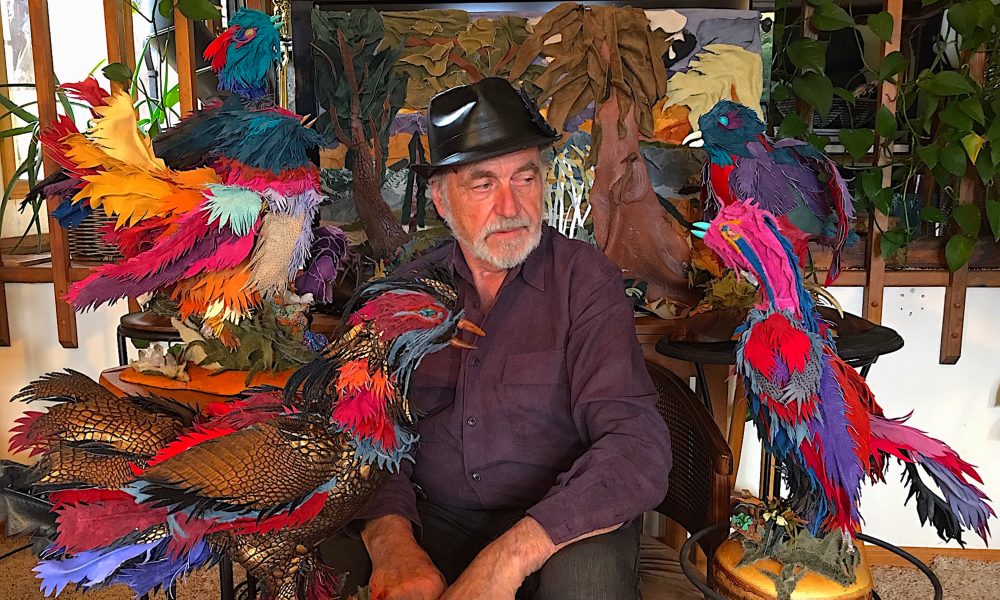
People visiting my studio (by appointment) find I’ve hatched a unique flock of Amazar Avians; Crystal Beaks, Rainbow Beaks, Red Beak Guardians, Hummers, Wing Writers, Horned Owls and other Avians that are ready to take wing to bring Healing, Peace, Love, Joy and Good Fortune where ever they roam. I’ve crafted their flamboyant plumage from upcycled vintage leathers on armatures fabricated from found objects. And people discover Avian environments that incorporate scared crystals, ancient artifacts and “Forever Gardens.”
From the research I’ve done, I’m the only artist/sculptor in the country and perhaps beyond, that uses recycled materials and recycled leathers to make sculptures.
Surely, I’m the only artist/sculptor/wordsmith who has created a realm of Avians who have come to earth to help preserve the environment, raise awareness to issues facing the planet and its inhabitants and open a dialogue for hope,
I was recently asked why I choose birds to carry my message?
So, given the incentive to ponder the question I’m happy to share my answer.
I’ve always been fascinated by creatures that fly. Flying squirrels, bats, birds, butterflies, dragons and such. Though I tend to avoid whenever possible, flying bugs and winged critters that sting and bite.
As a child, I always marveled at bird’s ability to fly, to move at will across the country, to navigate unburdened gravity, to function summer and winter without adding layers of protective coverings, I would run around with my arms spread wide, fly a kite or throw handmade paper airplanes in the air but they could truly capture the wind and soar off to lands unknown.
Fascinating creatures birds. So many varieties exist on earth yet we still know so little about them and their relationship with humans throughout history except through myth and legend. Their beauty never fails to excite me, however, I was never driven to study them in depth or to become an avid birder. I was happy to simply accept them as one of those true wonders of nature, mysterious creatures whose evolution inspired awe.
For the past seven years, I’ve lived in what some have described as a rustic glass enclosed tree house that perches on the side of a mountain looking out over peaks and valleys of lush pine forests, aspen groves and wandering creeks – a place where seasons are marked by the arrival and departure of hummingbirds – a place where Blue Stellar Jays and dozens of other types of birds are my nearest neighbors. I watch them at our bird feeders as they flit in and out of sight and speak in a language I do not understand. I turn my eyes to the sky and glimpse giant winged shapes crossing the valley and I wonder where their journey will take them.
But my art is not truly about birds. Unbound to the realities of bird anatomy, physiology, and intellect, as an artist I am free to let my imagination soar and just draw my inspiration from these marvelous creatures. Doing so has allowed for the evolution of an entirely new species, the Amazar Avians. The basic shape, form and physical attributes of my sculptures do indeed have similarities to the birds of earth and it is that commonality that often attracts my audience. From there we can embark on a magical journey.
As a child, I can remember the excitement I felt when finding a fallen feather, I would treasure that connection with a creature that could soar the sky and conjure stories in my head about the adventures of the bird that left it behind. It was a gift from above. When I ask others if they ever found a feather, I’ll often see a twinkle in their eye, a slight smile and a sense of mystery.
So now, I create my feathered Avians for the world, bearing gifts for all and I offer special Ceremonial Feathers to bring a little magic to peoples lives.
I invite people to visit www.amazaravians.world to discover more about my creations.
Is there a characteristic or quality that you feel is essential to success?
For me success is measured in nuances, small victories moving me forward in a positive direction.
The mission of the Amazar Avians Avians is to visit Earth to help those in need, bring healing energy, love, peace, goodwill, and positive energy wherever they appear. They have come in response to desperate cries for help from the earth itself and a surge in the frequency of meditative energies sent forth by those aspiring to bring about a more harmonious balance to the planet, and help end the pain and suffering threatening to destroy it. They have flown through the Amazar portal to offer assistance and hope.
If I can create an experience that causes people to pause, consider and view something outside their normal world if I can offer an expanded view of reality that enables a smile and stimulates a desire to touch and look closer at my work. That is a success.
If my creations can motivate someone to step outside their day-to-day patterns and look within, to seek and find beauty in life, marvel at the creative process, appreciate the wonders of the universe, to look beyond self and find joy in life, that is a success.
People who know me refer to me as a catalyst, a person able to help others look at things from multiple perspectives in ways that may spark them to action. I freely plant seeds of ideas and take satisfaction in motivating others to see possibilities or consequences.
The mission of the Amazar Avians manifested through my sculptures is capturing the attention of broad audiences, including people interested in sustainability, recycling, animal rights, the green movement, art collectors, the arts community and curators within the American Craft movement. Daily, people are discovering my website www.amazaravians.world and conversations around how, why and what I’m creating are taking wing.
My 2021 exhibition/installation at the Center for Arts Evergreen is scheduled to be the first in a number of major events featuring Amazar Tales and as I adopt out more amazing Amazar Avians my flock of followers will continue to grow.
Each person motivated to read about my Amazar Avians, spend a few precious moments pondering the mission of the Amazar Avians or interested in gaining more insight into what motivates my creations lifts my spirit. Small victories like that encourage me to move forward and take the next step in the creative process.
Where do you see your industry going over the next 5-10 years? Any big shifts, changes, trends, etc?
While the concept of upcycling is only recently becoming part of any serious discussion dealing with recycling trash and unwanted materials, it’s something that some of your readers may have direct connection with.
I’m sure you’ve heard stories about grandmothers fashioning dresses from old curtains or flower sacks? Making rugs from old rags? Anyone quilt bedspreads from segments of old fabric?
And if you’ve turned leftover dinners into tomorrows lunch or compost it into garden fertilizer? …. That’s Recycling
If anyone saw the recent Cuba exhibit at the Denver museum and loves the old cars from the 50th they have been keep running? …That’s Upcycling
The concept of Creative ReUse holds that that by converting refuse into artwork, the discarded trash can acquire a new aesthetic.
The resulting artwork can also take on moral and conceptual dimensions.
Artists have always been incorporating and adapting found objects to create their art. Carving in wood, stone, clay, drawing with carbon based materials, using natural dyes and stains to bring forth their artistic vision are just a few examples. Yet, as those materials and mediums have became more refined, they have also become more expensive. The alternative …for the creative spirit on a budget, the idea of adapting discarded manufactured materials into components to make art was inevitable. Now it’s happening globally out of necessity in countries torn apart by war and famine.
Currently the art world is leaping to the forefront of a movement that intertwines aspects of invention, innovation and imagination with the need for recycling manufactured materials.
This in turn has also opened the door to new opportunities in the area of arts education by encouraging the creation of unique and original artforms by recycling/upcycling/repurposing discarded objects.
The general public is only now learning that the concept of Creative Re-use introduced across environmental and educational sectors through the arts can actually encourage an insightful aspect of sustainable thinking and in offering extended life to materials that might otherwise end up in landfills.
Over the next 5 years, using my Amazar Avians to bring attention to and encourage those efforts I people will consider the role they might be able to play in the following areas to help Denver and surrounding communities explore, develop or promote the concept of Creative Re-Use.
- Upcycling – Existing recycling and sustainability programs should be encouraged to add a category of “Upcycling” in order to redistribute a variety of discarded materials for use as possible art components to artists, crafters, educators and others.
- Reimagining Art – Arts festivals and arts organizations should be encouraged to expand traditional art/sculpture categories to include a found object/ recycled art category and host exhibitions that feature art using recycled materials.
- Environmental Education and the Arts – Schools and communities should develop activities and programs that encourage artistic innovation using upcycled materials and creative reuse.
- Creative Materials Exchange – Develop a way to access used, reclaimed, salvaged and donated art materials as free, low cost or bartered supplies for artists
Pricing:
- Artforms range in price from $18. to $1800.00 based on: Complexity of design, size of sculptures, scarcity of colors available in vintage recyclable leathers.
- • Ceremonial Feathers $18 – 36
- • Forever Flowers and Forever Gardens $36 – 98
- • Avian Flyers $46 – 96
- • Nesting Avians $58 -126
- • Extraordinary Avians $350 -1800.
Contact Info:
- Website: www.amazaravians.world
- Phone: 303-957-7369
- Email: [email protected]


Image Credit:
Cherie Petersen
Getting in touch: VoyageDenver is built on recommendations from the community; it’s how we uncover hidden gems, so if you know someone who deserves recognition please let us know here.