

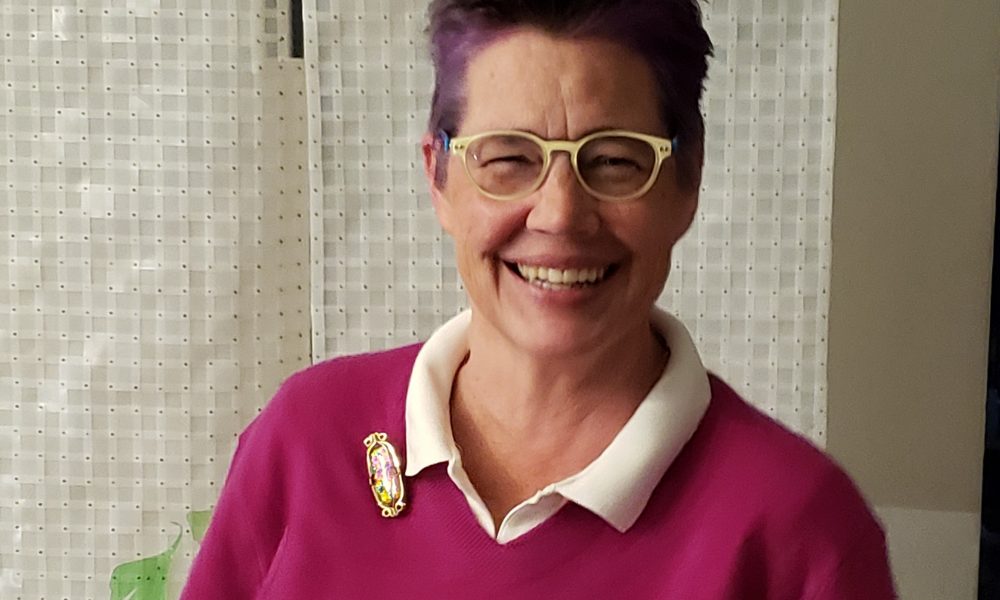
Today we’d like to introduce you to Leigh Cabell.
Leigh, please share your story with us. How did you get to where you are today?
Recycled, environmental or sustainable artist. I have been called all of these because I really do not fit into any standard classification. I like to think of myself as a trash quilter and how I got there follows…..
I started out in the sciences with a degree in Marine Biology and worked in Neuro research for 20 years. Science raised my awareness of the negative impact we have on our environment and made me want to have a positive effect. After retiring from research, I decided to pursue my lifelong ambition of being a full-time artist. I have ALWAYS enjoyed creating, especially hand quilting which I find relaxing. I tried a variety of crafts while I was doing research. Woodworking, stained glass, sculpting, knitting and, of course, quilting throughout this time. Given this background of handcrafting, my first foray into the art business was creating bracelets and necklaces, stringing beads and stones for my creations.
This did not satisfy my need to sew things together or my desire to create something totally unique. One day, I had card stock and beads on my work table and thought it would be fun to sew the little pieces of card stock together. The result was my first bowl! Somewhat funky but Very satisfying and I was off and running. This led to several more bowls constructed using purchased paper. Because I was experimenting, I started to look at materials I found around the house e.g. milk jugs, cereal boxes and playing cards. I noticed that manufacturers, in their attempts to catch our eye, make some fantastic packaging with very vibrant colors and a variety of textures. Packaging that almost everyone simply throws away and which ends up in our landfills or worse, our oceans and waterways.
I did not want to contribute more to it, so I started working with found objects and product packaging that was readily available. However, I did not want my art to look like what is usually thought of as “recycled” art, where all the items are easily identifiable. I wanted it to look like art and then the secondary thought be “that is made out of potato chip bags?” Using my quilting background, I use the concept of taking something larger and cutting it up into small pieces and sewing them together to create a larger piece of art.
I have enjoyed the challenge of creating something beautiful out of normally discarded items. It has also provided me with a way to have a conversation about how to be more environmentally conscious consumers. A completely unexpected result of this has been the desire of so many people that have seen my work wanting to contribute to future pieces. I frequently receive envelopes, or even boxes, full of items from people all over the United States for me to use. The fact that so many people are willing to spend time and money to send me “art supplies” makes me feel like I am making at least a small difference and that I am not alone in this concern for our environment.
Has it been a smooth road?
While it has not necessarily been a rough road, it has been a winding road. It has taken a while to find my voice in my art but it has been a fun challenge. One I would not trade for an easier path.
The biggest obstacle was believing that I could be an artist with my chosen medium. Some days I felt like the crazy cat lady only with trash. I finally had to own it because I could not stop playing with it. I was compelled to continue. The ideas and possibilities were waking me up in the middle of the night. Everyone should do what makes them feel alive.
The most challenging thing is to explain my art to people who have not seen it. Once they see my work in person, people are constantly telling me that it is nothing like they pictured in their mind from a verbal description or even photos. This also tends to be a drawback when applying for opportunities like juried shows that rely on photos and written descriptions to select participants.
We’d love to hear more about your art.
The thing that I specialize in, as well as what sets me apart from other artists, is taking everyday discarded items e.g. potato chip bags, coffee bags and transforming them into something totally different like pictures of the front range or national park posters.
What I am most proud of is the number of people that have expressed the impact of my work on how they look at everyday items and how they affect the environment.
Is our city a good place to do what you do?
Like many things, the answer is not black and white. The Denver Metro area is very accepting of alternative art forms. On the other hand, larger markets like Washington D.C. support a higher-end price range. It is a very open and accepting art community, so it is a good place to start out and try new things.
The city could be more supportive of the art districts, which are fairly unique. Promote and support the art districts but stop trying to develop them to the point the artists and gallery owners can no longer afford to be in that location. The artists have made the area desirable so help keep them there. This would increase diversification in the art community and give the city the opportunity to hear a wider range of voices. Diversity is what makes us interesting as humans.
Contact Info:
- Address: Artists on Santa Fe
747 Santa Fe Drive
Denver, Co 80204 - Website: www.leighcabell.com
- Email: [email protected]
- Instagram: artistleigh


Suggest a story: VoyageDenver is built on recommendations from the community; it’s how we uncover hidden gems, so if you or someone you know deserves recognition please let us know here.